Monosaccharides
Monosaccharides are the simplest form of carbohydrates and serve as fundamental building blocks for more complex sugars and polysaccharides. These single sugar molecules play critical roles in energy metabolism, cellular communication, and structural components of cells. In this section, you will find a wide variety of monosaccharides essential for research in biochemistry, molecular biology, and glycoscience. These compounds are crucial for studying metabolic pathways, glycosylation processes, and developing therapeutic agents. At CymitQuimica, we offer high-quality monosaccharides to support your research needs, ensuring precision and reliability in your scientific investigations.
Subcategories of "Monosaccharides"
- Alloses(11 products)
- Arabinoses(21 products)
- Erythroses(11 products)
- Fructoses(9 products)
- Fucoses(36 products)
- Galactosamine(41 products)
- Galactose(261 products)
- Glucoses(365 products)
- Glucuronic Acids(51 products)
- Glyco-substrates for Enzyme(77 products)
- Guloses(6 products)
- Idoses(4 products)
- Inositols(15 products)
- Lyxoses(4 products)
- Mannoses(65 products)
- O-Glycans(48 products)
- Psicoses(3 products)
- Rhamnoses(10 products)
- Riboses(61 products)
- Sialic Acids(100 products)
- Sorboses(4 products)
- Sugars(173 products)
- Tagatoses(4 products)
- Taloses(8 products)
- Xyloses(20 products)
Show 17 more subcategories
Found 6088 products of "Monosaccharides"
Sort by
Purity (%)
0
100
|
0
|
50
|
90
|
95
|
100
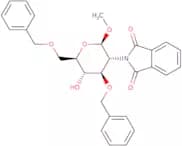
Methyl 3,6-di-O-benzyl-2-deoxy-2-phthalimido-b-D-glucopyranoside
CAS:<p>Methyl 3,6-di-O-benzyl-2-deoxy-2-phthalimido-b-D-glucopyranoside is a custom synthesis product that is used to modify saccharides. This compound is an oligosaccharide and polysaccharide that can be fluorinated to form a complex carbohydrate. Methyl 3,6-di-O-benzyl-2-deoxy-2-phthalimido-b-D--glucopyranoside has been shown to react with monosaccharides and sugars in the presence of base to form a modified sugar.</p>Formula:C29H29NO7Purity:Min. 95%Molecular weight:503.54 g/mol1-Acetyl-3-O-(2,3,4,6-tetra-O-acetyl-b-D-glucopyranosyl)indole
CAS:<p>1-Acetyl-3-O-(2,3,4,6-tetra-O-acetyl-b-D-glucopyranosyl)indole is a synthetic glycoside that is used as a fluorescent probe for the analysis of glycoconjugates. It has been shown to be a highly sensitive reagent for the detection of N-linked glycoproteins. 1A3G can be modified by click chemistry and the modifications are stable under harsh conditions.</p>Formula:C24H27NO11Purity:Min. 95%Molecular weight:505.47 g/mol2,3,4,6-Tetra-O-acetyl-a-D-mannopyranosyl-N-Fmoc-L-serine pentafluorophenyl ester
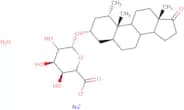
CAS:<p>2,3,4,6-Tetra-O-acetyl-a-D-mannopyranosyl-N-Fmoc-L-serine pentafluorophenyl ester is a saccharide that has been modified using the Click chemistry. It is a polysaccharide and an oligosaccharide with a high degree of purity. The chemical formula for this compound is C22H32FN3O14PS and its molecular weight is 594.06 g/mol. This substance can be used in the synthesis of complex carbohydrates.</p>Formula:C38F5H34NO14Purity:Min. 95%Molecular weight:823.68 g/mol1-a-Methyl-5-a-androstan-3-a-ol-17-one glucuronide
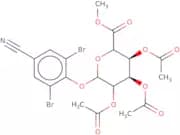
<p>1-a-Methyl-5-a-androstan-3-a-ol-17-one glucuronide is a synthetic, fluorinated, and modified monosaccharide. It has a molecular weight of 244.062 g/mol and its chemical formula is C10H9FO6. The CAS number for this compound is 47597-62-1. This product can be custom synthesized or ordered as a high purity product. 1-a-Methyl 5a -androstan 3a -ol 17one glucuronide has been shown to be useful in glycosylation reactions with oligosaccharides, sugars, and polysaccharides. This product can also be used in Click chemistry modifications to complex carbohydrates.</p>Formula:C26H39O8·Na·H2OPurity:Min. 95%Molecular weight:520.59 g/molBromoxynil 2,3,4-tri-O-acetyl-D-glucuronide methyl ester
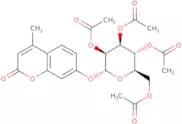
<p>Bromoxynil 2,3,4-tri-O-acetyl-D-glucuronide methyl ester is a custom synthesis of a polysaccharide. It is a modification of the natural saccharides with an acetyl group at the 3’ position on glucose and a methyl group at the 4’ position. Bromoxynil 2,3,4-tri-O-acetyl-D-glucuronide methyl ester is synthesized by glycosylation and then fluorination to form the desired product. The compound has high purity and is stable in water solution.</p>Formula:C20H19Br2NO10Purity:Min. 95%Molecular weight:593.17 g/mol4-Methylumbelliferyl 2,3,4,6-tetra-O-acetyl-a-D-mannopyranoside
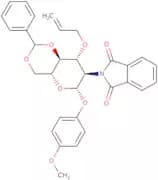
CAS:<p>The expression profile of 4-methylumbelliferyl 2,3,4,6-tetra-O-acetyl-a-D-mannopyranoside was analyzed in human cells. The gene expression levels were analyzed and compared to the profiles from other cell types. Analysis showed that this compound is expressed at high levels in the zingiberaceae family of plants.</p>Formula:C24H26O12Purity:Min. 95%Molecular weight:506.46 g/mol4-Methoxyphenyl 3-O-allyl-4,6-O-benzylidene-2-deoxy-2-phthalimido-b-D-glucopyranoside
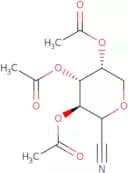
CAS:<p>4-Methoxyphenyl 3-O-allyl-4,6-O-benzylidene-2-deoxy-2-phthalimido-b-D-glucopyranoside (BAP) is a phosphatase inhibitor. It binds to the active site of the enzyme phosphatase and prevents it from hydrolyzing phosphate esters. BAP is used to prevent the release of calcium ions from bone, which can lead to osteitis fibrosa cystica in patients with esophagectomy or those who have undergone abdominal surgery. Thermodynamic studies indicate that BAP binds to phosphatases with a 1:1 stoichiometry and that this binding is irreversible.</p>Formula:C31H29NO8Purity:Min. 95%Molecular weight:543.56 g/mol2,3,4-Tri-O-acetyl-b-D-arabinopyranosyl cyanide
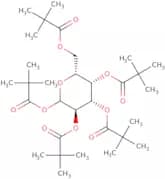
CAS:<p>2,3,4-Tri-O-acetyl-b-D-arabinopyranosyl cyanide is a synthetic sugar used in the synthesis of complex carbohydrates. It is a white to light yellow powder that is soluble in water and alcohol. This compound can be used to modify saccharides, such as monosaccharides and oligosaccharides. It has been shown that 2,3,4-tri-O-acetyl-b-D-arabinopyranosyl cyanide can be used for the fluorination of saccharides with high purity and modification.</p>Formula:C11H15N3O7Purity:Min. 95%Molecular weight:301.3 g/mol1,2,3,4,6-Penta-O-pivaloyl-b-D-galactopyranoside
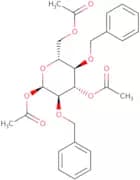
CAS:<p>1,2,3,4,6-Penta-O-pivaloyl-b-D-galactopyranoside is a high purity custom synthesis sugar. It is the product of a click modification, fluorination, glycosylation and carbamylation. This compound is also methylated and modified with an oligosaccharide and monosaccharide. The CAS number for 1,2,3,4,6-Penta-O-pivaloyl-b-D-galactopyranoside is 108342-85-4.</p>Formula:C31H52O11Purity:Min. 95%Molecular weight:600.74 g/mol1,3,6-Tri-O-acetyl-2,4-di-O-benzyl-a-D-glucopyranose
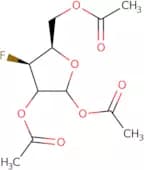
CAS:<p>Glycosylation is a process by which glucose molecules are covalently attached to other molecules, such as proteins or lipids. This process can be accomplished through the addition of a phosphate group to the glucose molecule. The Methylation, Click modification, and Polysaccharide reactions are all methods of modifying glycosides. Glycosylation is an important part of many biological processes such as cell growth and repair, the immune response, and blood clotting. Fluorination is a chemical reaction between fluorine and another element or compound in which one or more atoms of fluorine replace hydrogen atoms on the other element or compound. This process has been used for the synthesis of carbohydrates with specific properties that may not be found in nature. The CAS number for 1,3,6-Tri-O-acetyl-2,4-di-O-benzyl-a-D-glucopyranose is 79414-66-7. This product</p>Formula:C26H30O9Purity:Min. 95%Molecular weight:486.51 g/mol1,2,5-Tri-O-acetyl-3-deoxy-3-fluoro-D-ribofuranose
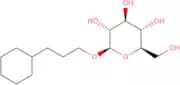
CAS:<p>1,2,5-Tri-O-acetyl-3-deoxy-3-fluoro-D-ribofuranose is a custom synthesis. It is a complex carbohydrate that can be modified with methylation and glycosylation to produce an Oligosaccharide or Polysaccharide. This molecule has been used in click chemistry to modify the sugar moiety and fluorinate the ribose group. 1,2,5-Tri-O-acetyl-3-deoxy--D--ribofuranose has CAS number 1556020-32-6 and has a purity of 99%.</p>Formula:C11H15FO7Purity:Min. 95%Molecular weight:278.23 g/mol3-Cyclohexylpropyl-b-D-glucopyranoside
CAS:<p>3-Cyclohexylpropyl-b-D-glucopyranoside is a synthetic glycoside that is used as an intermediate in the production of complex carbohydrates. This product is custom synthesized and available at a purity of 99%. It can be modified with methylation, glycosylation, or click chemistry. The saccharide can also be fluorinated for use in the synthesis of other products. 3-Cyclohexylpropyl-b-D-glucopyranoside has been shown to be stable during storage at room temperature for up to three months.</p>Formula:C15H28O6Purity:Min. 95%Molecular weight:304.38 g/mol4-Thio-1-acetyl-2,3,5-tri-O-benzoyl-b-L-ribofuranose
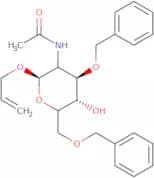
<p>4-Thio-1-acetyl-2,3,5-tri-O-benzoyl-b-L-ribofuranose is a modified carbohydrate that is used in the synthesis of oligosaccharides. It's a synthetic compound that can be used to synthesize polysaccharides or glycosylations. The chemical modification of 4-thio-1-acetyl-2,3,5 tri O benzoyl b L ribofuranose includes methylation and fluorination. It has shown to have high purity and can be used for many purposes in the field of chemistry.</p>Purity:Min. 95%Allyl 2-acetamido-3,6-di-O-benzyl-2-deoxy-b-D-glucopyranoside
CAS:<p>Allyl 2-acetamido-3,6-di-O-benzyl-2-deoxy-b-D-glucopyranoside is a synthetic sugar that is used in the modification of complex carbohydrates. It is an Oligosaccharide that has a Glycosylation and fluorination. Allyl 2-acetamido-3,6-di-O-benzyl-2-deoxy-b--D--glucopyranoside contains a methyl group on the C1 position, which can be modified at the C1 position to produce various derivatives. Click chemistry reactions are also possible with this compound. The chemical name for this compound is 65730–02–1 and it has CAS number 65730–02–1.</p>Formula:C25H31NO6Purity:Min. 95%Molecular weight:441.53 g/molmyo-Inositol 1,2,3,4,6-pentakisphosphate
CAS:<p>Myo-inositol 1,2,3,4,6-pentakisphosphate is a compound that belongs to the group of myo-inositols. It can be isolated from rice bran or synthesized by reacting inositol with phosphoric acid. Myo-Inositol 1,2,3,4,6-pentakisphosphate has been shown to be an analog of myo-inositol and has a similar chromatographic profile. This compound also has the ability to dephosphorylate diacylglycerol (DAG) and reduce its levels in cells.<br>Myo-inositol 1,2,3,4,6-pentakisphosphate can be quantified by reversed phase high performance liquid chromatography (RP-HPLC). The result can then be used to calculate the concentration of DAG in cells based on the standard curve obtained from the quantification of DAG in</p>Formula:C6H17O21P5Purity:Min. 95%Molecular weight:580.06 g/mol1,2,3,4-Tetra-O-benzoyl-6-O-tert-butyldimethylsilyl-b-D-galactopyranose
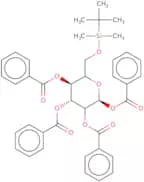
<p>Tetra-O-benzoyl-6-O-tert-butyldimethylsilyl-b-D-galactopyranose is a tetrasaccharide that has been modified with the fluoride ion. This compound is synthesized from 1,2,3,4-tetraacetyl bromoacetone and 2,3,4,6-tetraacetyl bromoethanol by an acetalization reaction followed by a silylation reaction. Tetra-O-benzoyl-6-O-tert butyldimethylsilyl b D galactopyranose may be used in glycosylation reactions. The product is soluble in water or ethanol and can be stored for up to 2 weeks at 4°C.</p>Formula:C40H42O10SiPurity:Min. 95%Molecular weight:710.86 g/mol1,3-O-Benzylidene-L-erythritol
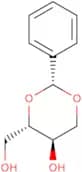
CAS:<p>1,3-O-Benzylidene-L-erythritol is a potent inhibitor of the intestinal maltase. It has two diastereomers, one of which is more potent than the other. The more potent diastereomer inhibits both the maltase and L-arabinose isomerase enzymes in the intestine. This inhibition prevents digestion of complex carbohydrates such as starch and sucrose into simple sugars that can be absorbed by the body. 1,3-O-Benzylidene-L-erythritol also inhibits salacinol synthase and thiosugar synthetases from bacteria and plants, preventing synthesis of these important compounds.</p>Purity:Min. 95%(2R,4R)-2-[D-Xylo-tetrahydroxybut-1-yl]-1,3-thiazolidine-4-carboxylic acid
CAS:<p>(2R,4R)-2-[D-Xylo-tetrahydroxybut-1-yl]-1,3-thiazolidine-4-carboxylic acid is a methylated saccharide that has been modified by the click chemistry method. It is a synthetic product with high purity and good quality. This compound can be used for glycosylation and oligosaccharide synthesis. (2R,4R)-2-[D-Xylo-tetrahydroxybut-1-yl]-1,3-thiazolidine-4-carboxylic acid has CAS No. 110270-19-4 and can be found in complex carbohydrates in nature.</p>Formula:C8H15NO6SPurity:Min. 95%Molecular weight:253.27 g/molN-Cyclohexylpropyl deoxynorjirimycin
CAS:<p>N-Cyclohexylpropyl deoxynorjirimycin is a sugar that belongs to the group of carbohydrates. It is an analog of deoxynojirimycin and has been synthesized by glycosylation, methylation, and fluorination of the natural product. N-Cyclohexylpropyl deoxynorjirimycin can be used as an intermediate for the synthesis of other carbohydrate compounds.</p>Formula:C15H29NO4Purity:Min. 95%Molecular weight:287.4 g/mol6-Amino-6-deoxy-D-galactopyranose HCl
CAS:<p>6-Amino-6-deoxy-D-galactopyranose HCl is a sugar that is synthesized by the modification of 6-amino-6-deoxygalactose with hydrochloric acid. It is used as an intermediate in the synthesis of complex carbohydrates, polysaccharides and oligosaccharides. 6-Amino-6-deoxygalactose HCL has been modified to introduce fluorine atoms at different positions. This chemical compound has been shown to have antimicrobial activity against methicillin resistant Staphylococcus aureus (MRSA) in vitro, but not against other bacterial strains tested.</p>Formula:C6H13NO5·HClPurity:Min. 95%Molecular weight:215.63 g/mol



![(2R,4R)-2-[D-Xylo-tetrahydroxybut-1-yl]-1,3-thiazolidine-4-carboxylic acid](/_next/image/?url=https%3A%2Fstatic.cymitquimica.com%2Fproducts%2F3D%2Fthumb-webp%2FMX01042.webp&w=3840&q=75)