Monosaccharides
Monosaccharides are the simplest form of carbohydrates and serve as fundamental building blocks for more complex sugars and polysaccharides. These single sugar molecules play critical roles in energy metabolism, cellular communication, and structural components of cells. In this section, you will find a wide variety of monosaccharides essential for research in biochemistry, molecular biology, and glycoscience. These compounds are crucial for studying metabolic pathways, glycosylation processes, and developing therapeutic agents. At CymitQuimica, we offer high-quality monosaccharides to support your research needs, ensuring precision and reliability in your scientific investigations.
Subcategories of "Monosaccharides"
- Alloses(11 products)
- Arabinoses(21 products)
- Erythroses(11 products)
- Fructoses(9 products)
- Fucoses(36 products)
- Galactosamine(41 products)
- Galactose(260 products)
- Glucoses(365 products)
- Glucuronic Acids(51 products)
- Glyco-substrates for Enzyme(77 products)
- Guloses(6 products)
- Idoses(4 products)
- Inositols(15 products)
- Lyxoses(4 products)
- Mannoses(65 products)
- O-Glycans(48 products)
- Psicoses(3 products)
- Rhamnoses(10 products)
- Riboses(61 products)
- Sialic Acids(100 products)
- Sorboses(4 products)
- Sugars(173 products)
- Tagatoses(4 products)
- Taloses(8 products)
- Xyloses(20 products)
Show 17 more subcategories
Found 6088 products of "Monosaccharides"
Sort by
Purity (%)
0
100
|
0
|
50
|
90
|
95
|
100
(4-Methylphenyl)methylbeta-D-glucopyranoside
CAS:<p>4-Methylphenyl)methylbeta-D-glucopyranoside is a modified monosaccharide that is synthesized by the methylation of D-glucose. It is a white powder with a molecular weight of 328.4 g/mol and chemical formula C14H22O9. The product's purity level is 99%.</p>Formula:C14H20O6Purity:Min. 95%Molecular weight:284.31 g/molMethyl-O-(2-azido-3,4-di-O-benzyl-2-deoxy-a-D-glucopyranosyl)-(1-4)-O-(2,3-di-O-benzyl-b-D-glucopyranosyluronicacid)- (1-4)-O-(2-azi do-2-deoxy-a-D-glucopyranosyl)-(1-4)-O-(3-O-benzyl-a-L-idopyranosyluronic acid)-(1-4)-3-O-benzyl- 2-benzyloxycarbonyla
CAS:<p>Maltodextrin is a polysaccharide that is made up of glucose units linked together by alpha-glycosidic bonds. Maltodextrin is commonly used as a food additive, but it also has several industrial applications. It can be used to produce escherichia coli, which is a bacterium that produces maltose and amylopectin. Maltodextrin can also be used as an animal feed supplement or as an ingredient in baby food. The glycosidic bond between the glucose units are metabolized by mouse enzymes to produce maltose and glycogen, which are both plant metabolites. Maltodextrin consists of unbranched subunits with linear chains of alpha-1,4-linked glucose residues that have alpha-1,6-linked branches at every second residue. This means that maltodextrin has a glycosidic linkage between the two glucose molecules in the chain and one of these links will always be an alpha-</p>Formula:C81H91N7O27Purity:Min. 95%Molecular weight:1,594.62 g/molMethyl 1-(5-fluoro-1H-2-oxopyrimidin-4-yl)-b-D-glucopyranuronate
CAS:<p>Methyl 1-(5-fluoro-1H-2-oxopyrimidin-4-yl)-b-D-glucopyranuronate is an anticancer drug that inhibits β-glucuronidase. Methyl 1-(5-fluoro-1H-2-oxopyrimidin-4-yl)-b-D-glucopyranuronate is a colorless solid that has been recrystallized, purified, and analyzed for its chloride content. The function of this compound has been tested in vitro using tissue cultures and animal models. The reaction vessel used for the test was an acetonitrile solution with a pH between 7 and 8. The methylester form of methyl 1-(5-fluoro-1H--2--oxopyrimidin 4--yl)-b--D--glucopyranuronate reacts with sulphite to produce a green product with a colorimetric method</p>Formula:C11H13FN2O8Purity:Min. 95%Molecular weight:320.23 g/molO-(2-Acetamido-3,4,6-tri-O-acetyl-2-deoxy-D-glucopyranosylidene)amino N-(4-nitrophenyl)carbamate
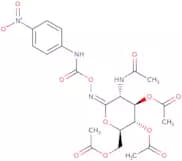
CAS:<p>O-(2-Acetamido-3,4,6-tri-O-acetyl-2-deoxy-D-glucopyranosylidene)amino N-(4-nitrophenyl)carbamate is a modification of an oligosaccharide that is synthesized by the reaction of an alpha, beta unsaturated nitrophenyl carbamate with a 2,6-anhydro glucose. The product is a white solid that can be used as a source for polysaccharides and monosaccharides. It has been shown to be modified by methylation, glycosylation and fluorination.</p>Formula:C21H23N3O12Purity:Min. 95%Molecular weight:509.42 g/mol2,3,5-Tri-O-benzoyl-b-D-ribofuranosyl azide
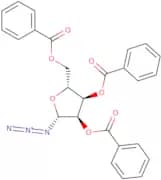
CAS:<p>2,3,5-Tri-O-benzoyl-b-D-ribofuranosyl azide (2,3,5-TRBA) is an antiviral agent that inhibits the synthesis of viral nucleic acid by targeting a glycosylation step in the synthesis of herpes simplex virus type 1 (HSV1). 2,3,5-TRBA has significant antiviral activity against HSV1 and other herpes viruses. This compound is also active against influenza A virus and vaccinia virus. 2,3,5-TRBA inhibits the enzyme triosephosphate isomerase (TPI), which catalyzes the conversion of dihydroxyacetone phosphate to glyceraldehyde 3-phosphate. Inhibition of TPI leads to decreased glucose production in cells infected with herpes viruses. The acetonitrile used as a solvent in this reaction can be replaced by pyridine or DMF. The sulfonate group</p>Formula:C26H21N3O7Purity:Min. 98 Area-%Color and Shape:PowderMolecular weight:487.46 g/mol3,4,6-Tri-O-acetyl-2-deoxy-2-phthalimido-a-D-galactopyranosyl fluoride
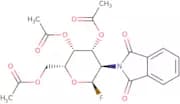
CAS:<p>3,4,6-Tri-O-acetyl-2-deoxy-2-phthalimido-a-D-galactopyranosyl fluoride is a synthetic glycoside of anhydrogalactose. It is a white crystalline powder and is soluble in water. 3,4,6-Tri-O-acetyl-2-deoxygalactofuranose has been used to study the reaction of glycosides with fluorinating agents. This product can be custom synthesized.</p>Formula:C20H20FNO9Purity:Min. 95%Molecular weight:437.37 g/mola-D-1,5-Difluoroglucose
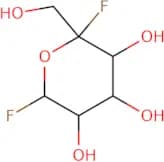
CAS:<p>a-D-1,5-Difluoroglucose is a synthetic sugar that is used in the modification of complex carbohydrates. It is fluorinated to give a stable compound that can be methylated and glucosylated. The compound has been shown to have high purity and a long shelf life.</p>Formula:C6H10F2O5Purity:Min. 95%Molecular weight:200.14 g/mola-D-Glucosyl hesperidin
CAS:<p>a-D-Glucosyl hesperidin is a water-soluble drug that has been shown to have antioxidant properties. It inhibits the activity of certain enzymes, such as phospholipase A2 and lipoxygenase, which are involved in inflammation. The compound has also been shown to inhibit cancer cells in vitro by inducing apoptosis and inhibiting cell proliferation. Glibenclamide, the active form of a-D-glucosyl hesperidin, is an orally active hypoglycemic agent used to treat diabetes mellitus type 2 and gestational diabetes. It works by stimulating insulin release from beta cells in the pancreas and promoting insulin sensitivity in peripheral tissues. This compound also inhibits annexin V binding to phosphatidylserine, which leads to apoptosis.</p>Formula:C34H44O20Purity:75%Color and Shape:Off-White To Yellow SolidMolecular weight:772.7 g/molButyl 2-acetamido-3,4,6-tri-O-acetyl-2-deoxy-b-D-glucopyranoside
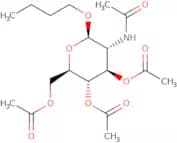
CAS:<p>Butyl 2-acetamido-3,4,6-tri-O-acetyl-2-deoxy-b-D-glucopyranoside is a custom synthesis that can be used for glycosylation. It has CAS No. 155197-37-8 and it is a fluorination of a monosaccharide with an acetamide group. This product is an oligosaccharide that contains a complex carbohydrate consisting of many sugar residues linked together by glycosidic bonds. The modification of this product includes methylation and sugar substitution.</p>Formula:C18H29NO9Purity:Min. 95%Molecular weight:403.42 g/mol2-Keto-D-galactonic acid
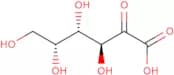
CAS:<p>2-Keto-D-galactonic acid is a chemical compound that is used as an intermediate in the synthesis of antibiotics. It has been found to inhibit the growth of bacteria, such as Erwinia carotovora and Escherichia coli. The 2-keto-d-galactonic acid can be crystallized in two forms: an amorphous form or a crystalline form.</p>Purity:Min. 95%2,4:3,5-Di-O-benzylidene-L-iditol
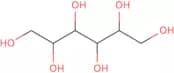
CAS:<p>2,4:3,5-Di-O-benzylidene-L-iditol is a custom synthesis that has been modified with methylation and glycosylation. It is a complex carbohydrate consisting of an oligosaccharide and polysaccharide. This product is a modification of saccharides by Methylation and Glycosylation. 2,4:3,5-Di-O-benzylidene-L-iditol is fluorinated at the C2 position. It has high purity with less than 1% impurities. The product is synthetic and consists of one monosaccharide</p>Formula:C20H22O6Purity:Min. 95%Molecular weight:358.39 g/molCotinine b-D-glucuronide
CAS:<p>Cotinine is a major metabolite of nicotine. It is excreted in the urine and has been extensively studied for its role in nicotine addiction and the development of cancer. Cotinine is also used as a biomarker to identify exposure to tobacco smoke, secondhand smoke, and nicotine replacement therapy. The levels of cotinine are proportional to the number of cigarettes smoked per day, with an average half-life of 15 hours. The concentration can be determined by LC-MS/MS with chemical ionization or LC-MS/MS with electron impact ionization. Cotinine can be hydrolyzed by esterases or glucuronidases, oxidized by cytochrome P450 enzymes, reduced by glutathione reductase, or conjugated with glucuronic acid.</p>Formula:C16H20N2O7Purity:Min. 95%Molecular weight:352.34 g/molGlufosfamide
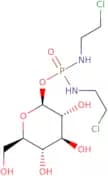
CAS:<p>Glufosfamide is a cytotoxic drug that is used in the treatment of some types of cancer. It is a prodrug that requires conversion to its active form, glufosfamid, by esterase enzymes before it can exert its genotoxic effects. Glufosfamide has shown to be active against platinum-resistant ovarian cancer and solid tumours. This drug also has been shown to inhibit the growth of prostate cancer cells and miapaca-2 cells, which are derived from pancreatic cancer. Glufosfamide has been found to have low toxicity in mice, but there may be adverse reactions when combined with other drugs such as erythromycin or ketoconazole.</p>Formula:C10H21Cl2N2O7PPurity:Min. 95%Molecular weight:383.16 g/moltrans-3'-Hydroxycotinine-O-b-D-glucuronide D3 sodium salt
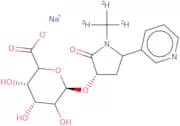
Controlled Product<p>Trans-3'-Hydroxycotinine-O-b-D-glucuronide D3 sodium salt is a modification of the natural product trans-3'-hydroxycotinine. It is an oligosaccharide with a complex carbohydrate structure, which may be synthesized by custom synthesis or by glycosylation. This modification has a high purity and may be monosaccharide or polysaccharide. Trans-3'-hydroxycotinine-O-b-D-glucuronide D3 sodium salt may have CAS number and fluorination. It has been shown to have antihistamine activities, which are due to its ability to inhibit the release of histamine from mast cells in the lungs.</p>Formula:C16H16N2O8D3·NaPurity:Min. 95%Molecular weight:393.34 g/molMethyl 2-deoxy-3,5-di-O-pivaloyl-a-D-ribofuranoside
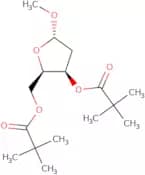
<p>Methyl 2-deoxy-3,5-di-O-pivaloyl-alpha-D-ribofuranoside is a custom synthesis of a complex carbohydrate that can be used in glycosylation and polysaccharide synthesis. This product is a sugar with a CAS No. that has been modified with methylation, fluorination, and click chemistry. <br>This product is synthesized by reacting the corresponding reactant monosaccharides with an acylating agent in the presence of a base to form 2,3,5-trihydroxybenzaldehyde esters. The 2,3,5-trihydroxybenzaldehyde esters are then reacted with an alcohol or phenol to form 2,4,6-trihydroxybenzalacetone derivatives which are converted into the desired product by hydrolysis.</p>Formula:C16H28O6Purity:Min. 95%Color and Shape:Oil.Molecular weight:316.39 g/mol1,2,3,6-Tetra-O-benzoyl-a-D-talose
<p>1,2,3,6-Tetra-O-benzoyl-a-D-talose is a modified sugar that can be used as a saccharide or oligosaccharide. It can be synthesized by the Click reaction with 1,2,3,6-tetra-O-benzoyl-D-talose and methyl iodide. The product can also be obtained from the reaction of methyl acetate with glycerol in the presence of hydrochloric acid. This compound has been shown to have good solubility and is available in high purity.</p>Formula:C34H28O10Purity:Min. 95%Molecular weight:596.58 g/mol3-Azido-2,3-dideoxy-D-ribose
CAS:<p>3-Azido-2,3-dideoxy-D-ribose is a boron trifluoride etherate that has significant activity against the anomers of d-mannitol. It can be used as a stereoselective synthesis of the triflate on the corresponding anomer. Triflate is prepared by reaction with trifluoromethanesulfonic acid chloride and then reacted with sodium azide in ethanol to yield 3-azido-2,3-dideoxy-D-ribose. The product can be purified by recrystallization from acetic acid and water or by extraction with chloroform. This compound is also extracted from boric acid and dioxane using aqueous sodium hydroxide solution.</p>Purity:Min. 95%1-O-(5-Carboxy-N-phenyl-2-(1H)-pyridone)-D-glucuronide
<p>1-O-(5-Carboxy-N-phenyl-2-(1H)-pyridone)-D-glucuronide is a modification of Oligosaccharide, Carbohydrate. It's CAS No. is 61877-69-8 and it has a molecular weight of 398.7 g/mol. The purity of this product is >99%. This product can be custom synthesized and has a glycosylation and methylation level of 100%. 1-O-(5-Carboxy-N-phenyl-2-(1H)-pyridone)-D-glucuronide is soluble in water and insoluble in oils, fats, ethers, chloroform and benzene. It is also resistant to acid hydrolysis.</p>Formula:C18H17NO9Purity:Min. 95%Molecular weight:391.33 g/mol1,6-Anhydro-2,3-dideoxy-b-D-threo-hex-2-enopyranose
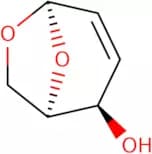
CAS:<p>1,6-Anhydro-2,3-dideoxy-b-D-threo-hex-2-enopyranose is a carbohydrate that is synthesized from the sugar D-ribose. It can be used as a fluoroquinolone antibiotic. 1,6-Anhydro-2,3-dideoxy-b-D-threohexenopyranose has been modified with fluorine in order to increase its antibacterial activity. This modification makes the compound resistant to bacterial enzymes and allows it to bind to bacterial DNA. 1,6-Anhydro 2,3dideoxy bDthreo hexenopyranose also reacts with sugars and proteins to form glycosides and oligosaccharides that have high purity.</p>Formula:C6H8O3Purity:Min. 95%Molecular weight:128.13 g/mol2-Methoxycarbonylphenyl 2,3,4,6-tetra-O-acetyl-b-D-glucopyranoside
CAS:<p>2-Methoxycarbonylphenyl 2,3,4,6-tetra-O-acetyl-β-D-glucopyranoside is a high purity and custom synthesis sugar that can be fluorinated and glycosylated. This molecule has been modified with methyl groups and is an oligosaccharide. It is a complex carbohydrate with saccharide units, which are monosaccharides or polysaccharides. CAS No. 7791-66-4</p>Formula:C22H26O12Purity:Min. 95%Molecular weight:482.43 g/mol