Monosaccharides
Monosaccharides are the simplest form of carbohydrates and serve as fundamental building blocks for more complex sugars and polysaccharides. These single sugar molecules play critical roles in energy metabolism, cellular communication, and structural components of cells. In this section, you will find a wide variety of monosaccharides essential for research in biochemistry, molecular biology, and glycoscience. These compounds are crucial for studying metabolic pathways, glycosylation processes, and developing therapeutic agents. At CymitQuimica, we offer high-quality monosaccharides to support your research needs, ensuring precision and reliability in your scientific investigations.
Subcategories of "Monosaccharides"
- Alloses(11 products)
- Arabinoses(21 products)
- Erythroses(11 products)
- Fructoses(9 products)
- Fucoses(36 products)
- Galactosamine(41 products)
- Galactose(260 products)
- Glucoses(365 products)
- Glucuronic Acids(51 products)
- Glyco-substrates for Enzyme(77 products)
- Guloses(6 products)
- Idoses(4 products)
- Inositols(15 products)
- Lyxoses(4 products)
- Mannoses(65 products)
- O-Glycans(48 products)
- Psicoses(3 products)
- Rhamnoses(10 products)
- Riboses(61 products)
- Sialic Acids(100 products)
- Sorboses(4 products)
- Sugars(173 products)
- Tagatoses(4 products)
- Taloses(8 products)
- Xyloses(20 products)
Show 17 more subcategories
Found 6088 products of "Monosaccharides"
Sort by
Purity (%)
0
100
|
0
|
50
|
90
|
95
|
100
2-Decyltetradecyl-D-xylopyranoside
CAS:<p>2-Decyltetradecyl-D-xylopyranoside is a synthetic, fluorinated carbohydrate that has been modified to contain a reactive methylene group. This compound can be used as a reactant in Click chemistry, which is an easy and convenient method for modifying the structure of polysaccharides. 2-Decyltetradecyl-D-xylopyranoside may be used for the synthesis of oligosaccharides or carbohydrates. This compound is soluble in water and organic solvents such as methanol and ethanol. It has a CAS number of 446264-02-4.</p>Formula:C29H58O5Purity:Min. 95%Color and Shape:Colourless solid.Molecular weight:486.77 g/molb-D-Thioglucose sodium salt hydrate
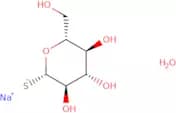
CAS:<p>b-D-Thioglucose sodium salt hydrate is a complex carbohydrate that is used as an intermediate for the synthesis of oligosaccharides and polysaccharides. It is also used in the modification of saccharide chains, such as glycosylation, and for the preparation of fluorinated carbohydrates. b-D-Thioglucose sodium salt hydrate is high purity, with no detectable impurities or degradation products. It has been modified with fluorine to form a new chemical entity that has not been previously described in the literature.</p>Formula:C6H11NaO5S·H2OPurity:Min. 95%Molecular weight:236.22 g/molPhenyl 2,3-di-O-benzyl-4,6-O-benzylidene-a-D-thiomannopyranoside
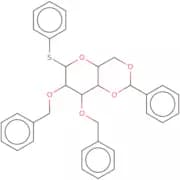
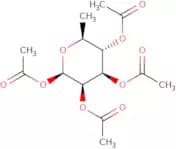
CAS:<p>Phenyl 2,3-di-O-benzyl-4,6-O-benzylidene-a-D-thiomannopyranoside is a complex carbohydrate that is synthesized by methylation and glycosylation of thiomannose. This product has been modified to contain a fluorinated substituent on the phenyl ring. Phenyl 2,3-di-O-benzyl-4,6-O-benzylidenea D thiomannopyranoside is soluble in water and has an HPLC purity of >99%.</p>Formula:C33H32O5SPurity:Min. 95%Molecular weight:540.67 g/mol1,2,3,4-Tetra-O-acetyl-a-L-rhamnopyranose
CAS:<p>1,2,3,4-Tetra-O-acetyl-a-L-rhamnopyranose is a modified carbohydrate with the general structure of an oligosaccharide. It is a synthetic compound that has been modified with methylation and glycosylation. The purity of this product is high and it can be synthesized to order. This product has a CAS number of 27821-11-0 and can be found in the Carbohydrate section.</p>Formula:C14H20O9Purity:Min. 95%Molecular weight:332.3 g/mol2-Acetamido-2-deoxy-b-D-galactopyranosylamine
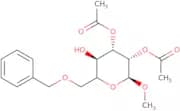
CAS:<p>2-Acetamido-2-deoxy-b-D-galactopyranosylamine is a methylated polysaccharide that has been modified with a click chemistry reaction. It can be used as a glycosylation site for the synthesis of oligosaccharides. This compound is an excellent carbohydrate building block for the synthesis of complex carbohydrates. 2-Acetamido-2-deoxy-b-D-galactopyranosylamine is available in high purity and CAS number 102039-79-2.</p>Formula:C8H16N2O5Purity:Min. 95%Molecular weight:220.22 g/mol6-O-Benzyl-2,3-di-O-acetyl-methyl-a-D-glucopyranoside
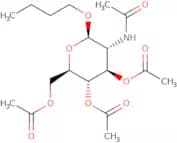
CAS:<p>6-O-Benzyl-2,3-di-O-acetyl-methyl-a-D-glucopyranoside is a high purity synthetic compound with a CAS number of 162284. It is a carbonyl sugar that has been modified with fluorination and methylation. The 6 position of the glucose monosaccharide has been acetylated to give an O6 benzyl group. This compound is used for glycosylation and click chemistry modifications.</p>Formula:C18H24O8Purity:Min. 95%Molecular weight:368.38 g/molButyl 2-acetamido-3,4,6-tri-O-acetyl-2-deoxy-b-D-glucopyranoside
CAS:<p>Butyl 2-acetamido-3,4,6-tri-O-acetyl-2-deoxy-b-D-glucopyranoside is a custom synthesis that can be used for glycosylation. It has CAS No. 155197-37-8 and it is a fluorination of a monosaccharide with an acetamide group. This product is an oligosaccharide that contains a complex carbohydrate consisting of many sugar residues linked together by glycosidic bonds. The modification of this product includes methylation and sugar substitution.</p>Formula:C18H29NO9Purity:Min. 95%Molecular weight:403.42 g/mol4-O-Acetyl-2,5-anhydro-1,3-O-isopropylidene-6-[bis(2-cyanoethyl)phosphoryl]-D-glucitol
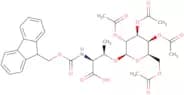
CAS:<p>4-O-Acetyl-2,5-anhydro-1,3-O-isopropylidene-6-[bis(2-cyanoethyl)phosphoryl]-D-glucitol is a synthetic carbohydrate that can be used as a pharmaceutical intermediate. 4-O-Acetyl-2,5-anhydro-1,3,-O isopropylidene 6-[bis(2 cyanoethyl)phosphoryl]-D glucitol is a sugar that has been fluorinated and methylated. It is an oligosaccharide sugar with glycosylation and click modification.</p>Formula:C17H25N2O9PPurity:Min. 95%Molecular weight:432.36 g/mol2,3,4,6-Tetra-O-acetyl-b-D-galactopyranosyl-(N2-Fmoc)-L-threonine
CAS:<p>Mecamylamine is a drug that binds to the active site of the acetylcholine esterase enzyme and prevents the breakdown of acetylcholine, which causes muscle contractions. Mecamylamine is used for the treatment of bowel disorders, such as diarrhoea. Randomised placebo-controlled trials have shown that mecamylamine is an effective treatment for chronic idiopathic constipation. The optimal dose and duration of treatment remain unclear, but it has been suggested that a cycle of 4 weeks on and 4 weeks off may be appropriate. Mecamylamine can cause adverse reactions, such as dizziness and blurred vision. It should not be used by people with asthma or other respiratory problems or by pregnant women.</p>Formula:C33H37NO14Purity:Min. 95%Molecular weight:671.65 g/molD-Ribose-2-D
CAS:<p>D-Ribose-2-D is a modified D-ribose sugar. It is an oligosaccharide that is a component of polysaccharides and glycosaminoglycans. The modification of this sugar includes methylation, glycosylation, and fluorination. This product has CAS No. 202480-69-1 and is synthesized in high purity with 98% purity.</p>Formula:C5H10O5Purity:Min. 95%Molecular weight:151.14 g/mol(2-Pirydyl) 2,3,4,6-tetra-O-acetyl-1-deoxy-a-D-manno-1-C-pyranoside
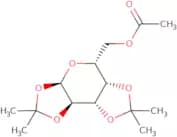
<p>2-Pyridyl-2,3,4,6-tetra-O-acetyl-1-deoxy-a-D-manno-1Cpyranoside is a glycosylated pyranoside that can be used as a building block to synthesize complex carbohydrate. It has been modified with fluorination and acetylation. The purity of this compound is greater than 98% and it is available for custom synthesis.</p>Purity:Min. 95%Molecular weight:409.39 g/mol6-O-Acetyl-1,2:3,4-di-O-isopropylidene-α-D-galactopyranose
CAS:<p>Glycosylation is the chemical process of adding sugars to other molecules. It often occurs in the cell, but can also be done in a lab. The process of glycosylation is called O-glycosylation when it attaches a carbohydrate molecule to an amino acid or protein, and it's called N-glycosylation when it attaches a carbohydrate molecule to nitrogen-containing compounds such as proteins or nucleic acids. 6-O-Acetyl-1,2:3,4-di-O-isopropylidene-a-D-galactopyranose is a synthetic compound that is used as an intermediate in the synthesis of glycoproteins and other complex carbohydrates. This product has been modified by fluorination and acetylation. It has been shown to inhibit cancer cell proliferation, induce apoptosis (cell death), and increase chemosensitivity in cancer cells.</p>Formula:C14H22O7Purity:Min. 95%Molecular weight:302.32 g/mol2,3,5-Tri-O-p-chlorobenzoyl-D-ribofuranoside
CAS:<p>2,3,5-Tri-O-p-chlorobenzoyl-D-ribofuranoside is a fluorinated and modified sugar that is synthesized in the laboratory. The chemical name is 2,3,5-Tri-O-p-chlorobenzoyl-D-(+)-ribofuranoside. It is a white to off white crystalline solid with a melting point of 154°C. The molecular weight of this compound is 366.2 g/mol and its empirical formula is C12H14ClO7. The CAS number for this compound is 29755-02-0.</p>Formula:C26H19Cl3O8Purity:Min. 95%Molecular weight:565.78 g/molPhenyl 2,3,4,6-tetra-O-benzyl-b-D-thiogalactopyranoside
CAS:<p>The chemical name for Phenyl 2,3,4,6-tetra-O-benzyl-b-D-thiogalactopyranoside is Phenyl 2,3,4,6-tetra-O-benzyl-b-D-thiogalactopyranoside. This chemical is a Carbohydrate that is Modification and saccharide. It has the molecular formula of C12H14O8S2. Phenyl 2,3,4,6-tetra-O-benzyl-b-D-thiogalactopyranoside is an Oligosaccharide with a sugar type of Monosaccharide. The Chemical Abstracts Service (CAS) registry number for this chemical is 577861 - 19 - 1. Phenyl 2,3,4,6 tetra O benzyl b D thiogalactop</p>Formula:C40H40O5SPurity:Min. 95%Color and Shape:PowderMolecular weight:632.81 g/molN-Boc-1,5-imino-D-glucitol
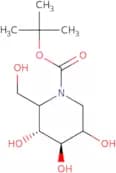
CAS:<p>N-Boc-1,5-imino-D-glucitol is a complex carbohydrate that is synthesized by the N-Boc protection group. It is an oligosaccharide with a molecular weight of about 190 daltons and it can be modified at the C1 position to produce various saccharides. N-Boc-1,5-imino-D-glucitol has been shown to be effective as a glycosylation agent for protein modification and for its ability to form stable complexes with other complex carbohydrates. This compound has also been used in the synthesis of polysaccharides and as a fluorination reagent.</p>Formula:C11H21NO6Purity:Min. 95%Molecular weight:263.29 g/molPBS 57
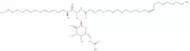
CAS:<p>PBS 57 is a pluripotent cell-derived protein that has been shown to be a potent vaccine adjuvant. PBS 57 is derived from the plasma of pregnant women and contains the following antigenic determinants: glucose, human albumin, and human immunoglobulin G. PBS 57 can stimulate both humoral and cellular immunity in mice with deficiencies in antibody production or T cells. PBS 57 has also been shown to have strong pro-inflammatory cytokine activity, which may be due to its ability to induce galacturonic acid release from macrophages.</p>Formula:C50H96N2O9Purity:Min. 95%Molecular weight:869.31 g/mol1-O-Propargyl 2, 3, 4, 6- tetra-O-acetyl- D- fructofuranose
<p>1-O-Propargyl 2, 3, 4, 6- tetra-O-acetyl-D-fructofuranose is a monosaccharide that is modified with an acetyl, propargyl and fluorine. It can be used as a glycosylation agent, as well as a methylating and click modification agent. 1-O-Propargyl 2, 3, 4, 6- tetra-O-acetyl -D -fructofuranose has been shown to have antiinflammatory properties in addition to its ability to inhibit the growth of bacteria and fungi. This compound can also be used for the synthesis of polysaccharides and oligosaccharides.</p>Purity:Min. 95%D-Gluconic acid sodium salt
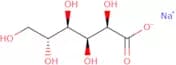
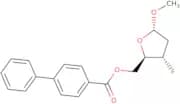
CAS:<p>D-Gluconic acid sodium salt - USP grade is a biochemical reagent that is used in the synthesis of nucleotides and various other biomolecules. It is also used as an antimicrobial agent, with broad-spectrum activity against bacteria, fungi, and viruses. In addition to its antimicrobial activity, D-gluconic acid has been shown to inhibit carcinoma cell lines in vitro. This inhibition may be due to the inhibition of enzymes involved in phosphorylation reactions such as adenylate kinase, glyceraldehyde 3-phosphate dehydrogenase (GAPDH) and hexokinase. X-ray diffraction data on wild-type strains of E. coli have shown that D-gluconic acid binds to the enzyme phosphogluconate dehydrogenase (PGD), which catalyzes a reaction between D-gluconic acid and NAD+ or NADP+. The matrix effect for this reaction was</p>Formula:C6H11NaO7Purity:Min. 95%Molecular weight:218.14 g/molMethyl-2,3-dideoxy-3-fluoro-5-O-(4-phenylbenzoyl)-a-D-erythro-pentofuranoside
CAS:<p>A mutant is a modified form of a gene that can be either natural or artificial. This gene has been modified by the introduction of an additional chemical group, such as methyl, at a specific position in the DNA sequence. The new compound is not found in nature and may have beneficial effects on the organism. The control system for this experiment is programmable and allows for the introduction of multiple mutations to be introduced simultaneously into a single gene. This technique has been shown to create mutants with neurological disorders, including protein overload, which occurs when there are too many proteins made by one particular gene.</p>Purity:Min. 95%2,3,4,6-Tetra-O-acetyl-b-D-glucopyranosyl-(N2-Fmoc)-L-asparagine tert-butyl ester
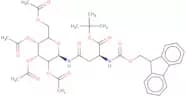
CAS:<p>2,3,4,6-Tetra-O-acetyl-b-D-glucopyranosyl-(N2-Fmoc)-L-asparagine tert-butyl ester is a glycosylation reagent that contains a reactive primary amine. It is used in the synthesis of complex carbohydrates and oligosaccharides. This compound is also used as a fluorinating agent for saccharides and sugars. 2,3,4,6-Tetra-O-acetyl-b-D-glucopyranosyl-(N2-Fmoc)-L-asparagine tert butyl ester can be custom synthesized to meet your needs. This product has CAS number 16041617 1 and it is available in high purity.</p>Formula:C37H44N2O14Purity:Min. 95%Molecular weight:740.75 g/mol



![4-O-Acetyl-2,5-anhydro-1,3-O-isopropylidene-6-[bis(2-cyanoethyl)phosphoryl]-D-glucitol](/_next/image/?url=https%3A%2Fstatic.cymitquimica.com%2Fproducts%2F3D%2Fthumb-webp%2FMA05705.webp&w=3840&q=75)