Monosaccharides
Monosaccharides are the simplest form of carbohydrates and serve as fundamental building blocks for more complex sugars and polysaccharides. These single sugar molecules play critical roles in energy metabolism, cellular communication, and structural components of cells. In this section, you will find a wide variety of monosaccharides essential for research in biochemistry, molecular biology, and glycoscience. These compounds are crucial for studying metabolic pathways, glycosylation processes, and developing therapeutic agents. At CymitQuimica, we offer high-quality monosaccharides to support your research needs, ensuring precision and reliability in your scientific investigations.
Subcategories of "Monosaccharides"
- Alloses(11 products)
- Arabinoses(21 products)
- Erythroses(11 products)
- Fructoses(9 products)
- Fucoses(36 products)
- Galactosamine(41 products)
- Galactose(260 products)
- Glucoses(365 products)
- Glucuronic Acids(51 products)
- Glyco-substrates for Enzyme(77 products)
- Guloses(6 products)
- Idoses(4 products)
- Inositols(15 products)
- Lyxoses(4 products)
- Mannoses(65 products)
- O-Glycans(48 products)
- Psicoses(3 products)
- Rhamnoses(10 products)
- Riboses(61 products)
- Sialic Acids(100 products)
- Sorboses(4 products)
- Sugars(173 products)
- Tagatoses(4 products)
- Taloses(8 products)
- Xyloses(20 products)
Show 17 more subcategories
Found 6088 products of "Monosaccharides"
Sort by
Purity (%)
0
100
|
0
|
50
|
90
|
95
|
100
1,2,3,4-Tetra-O-acetyl-a-D-glucuronide methyl ester
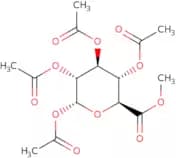
CAS:<p>1,2,3,4-Tetra-O-acetyl-a-D-glucuronide methyl ester is a synthetic molecule that has been modified with the click chemistry technique. This product is a white solid that can be used to modify saccharides and polysaccharides. It can also be used in the synthesis of oligosaccharides or glycosylation reactions. This product is useful for modifying sugars with custom modifications and fluorination. 1,2,3,4-Tetra-O-acetyl-a-D-glucuronide methyl ester has CAS number 5432-32-6 and can be synthesized from glyceraldehyde and acetone.</p>Formula:C15H20O11Purity:Min. 95%Molecular weight:376.31 g/mol(8-Ethoxycarbonyloctyl)-2,3,4,6-tetra-O-acetyl-b-D-galactopyranoside
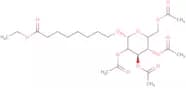
<p>(8-Ethoxycarbonyloctyl)-2,3,4,6-tetra-O-acetyl-b-D-galactopyranoside is a custom synthesis of a complex carbohydrate. It is an Oligosaccharide with CAS No. and has been modified with saccharide, methylation and glycosylation. The molecular weight of this compound is (1,000) g/mol and the purity level is >99%. This product also has fluorination and click modification as modifications.</p>Formula:C24H38O12Purity:Min. 95%Molecular weight:518.55 g/mol6-O-tert-Butyldiphenylsilyl-3,4-O-carbonyl-D-galactal
CAS:<p>6-O-tert-Butyldiphenylsilyl-3,4-O-carbonyl-D-galactal is a custom synthesis that has been modified with fluorine and methyl groups. It is a monosaccharide that can be found in complex carbohydrates such as saccharides and polysaccharides. The chemical name for 6-O-tert-Butyldiphenylsilyl-3,4-O-carbonyl-D-galactal is 6-[(tertiary butyl)diphenylsilyl]-3,4-[(carboxymethyl)oxymethyl]oxymethyl]oxymethyl]-D--glucopyranoside. This compound is an example of a sugar that can be found in carbohydrates.</p>Purity:Min. 95%Benzyl 2-acetamido-6-O-benzoyl-2-deoxy-a-D-muramic acid methyl ester
<p>Benzyl 2-acetamido-6-O-benzoyl-2-deoxy-a-D-muramic acid methyl ester is a high purity, custom synthesis, monosaccharide that can be used to modify saccharides and oligosaccharides. It has been shown to be effective in glycosylation reactions and click chemistry. The CAS number for this compound is 84778-00-3.</p>Formula:C26H31NO9Purity:Min. 95%Molecular weight:501.53 g/mol2-Acetamido-2-deoxy-b-D-galactopyranosyl serine
<p>2-Acetamido-2-deoxy-b-D-galactopyranosyl serine is a glycosylation agent that can be used as a sugar donor in glycoprotein synthesis. This product is available as custom synthesis and has been modified with fluorination, saccharide, and modification. It also has CAS number: 3897-78-5. 2 Acetamido-2 deoxy b D galactopyranosyl serine is a monosaccharide that is synthesized from D galactose and L serine. It can be used to produce complex carbohydrates for Methylations, Click modifications, Polysaccharides, or Fluorinations.</p>Purity:Min. 95%Dimethylthexylsilyl 2,3,6-tri-O-benzyl-b-D-galactopyranoside
<p>Dimethylthexylsilyl 2,3,6-tri-O-benzyl-b-D-galactopyranoside is a synthetic oligosaccharide with a fluorinated benzene ring. It is an important intermediate for glycosylation and can be modified with methyl groups or click chemistry. This product is of high purity and has been custom synthesized. Dimethylthexylsilyl 2,3,6-tri-O-benzyl-b-D-galactopyranoside has CAS number 69422-24-2.</p>Purity:Min. 95%Minoxidil D-glucuronide
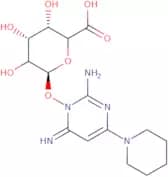
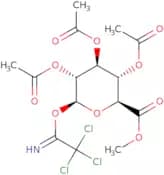
CAS:<p>Minoxidil D-glucuronide is a modification of minoxidil, which is an antihypertensive drug. It has been shown to have stronger activity than minoxidil in the treatment of hypertension. Minoxidil D-glucuronide is a complex carbohydrate that has been synthesized from minoxidil and glucuronic acid. It is a white powder with high purity, and it can be used for glycosylation reactions.</p>Formula:C15H23N5O7Purity:Min. 95%Molecular weight:385.37 g/mol2,3,4-Tri-O-acetyl-b-D-glucuronide methyl ester trichloroacetimidate
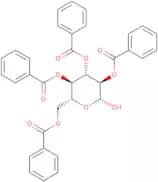
CAS:<p>2,3,4-Tri-O-acetyl-b-D-glucuronide methyl ester trichloroacetimidate is a custom synthesis that contains a fluorinated sugar. It is synthesized by the modification of an oligosaccharide with a polysaccharide. The modification includes the addition of methyl groups to the sugar and the introduction of chlorine atoms in place of hydroxyl groups. This compound has been shown to be effective at inhibiting bacterial growth and at reducing inflammation.</p>Formula:C15H18Cl3NO10Purity:Min. 95%Molecular weight:478.66 g/mol2,3,4,6-Tetra-O-benzoyl-D-glucopyranose
CAS:<p>2,3,4,6-Tetra-O-benzoyl-D-glucopyranose is an aldehyde that has been synthesized by the oxidation of D-glucofuranose with nitric acid. It has been shown to act as a competitive inhibitor of lipase and c-glycosidases. The acetal group in 2,3,4,6-tetra-O-benzoyl-D-glucopyranose is activated with acetyl chloride to form an acetal derivative. This compound can be used as a chemoenzymatic glycosidic bond formation method for the synthesis of various glycosides.</p>Formula:C34H28O10Purity:Min. 95%Molecular weight:596.6 g/mol3-Deoxy-1,2:5,6-di-O-isopropylidene-a-L-gulofuranose
<p>3-Deoxy-1,2:5,6-di-O-isopropylidene-a-L-gulofuranose is a synthetic monosaccharide that is used in the synthesis of oligosaccharides and polysaccharides. The chemical has been modified with fluorination, methylation, and click chemistry to produce a range of products. This product can be custom synthesized to meet the needs of customers. It has a CAS No. and purity of >99%.</p>Formula:C12H20O5Purity:Min. 95%Molecular weight:244.28 g/molβ-D-Galactose pentaacetate
CAS:<p>1,2,3,4,6-Penta-O-acetyl-b-D-galactopyranose, also known as beta-D-galactose pentaacetate, has high chemical stability and long shelf life. This protected form of galactose is a key building block of any chemical synthesis of galactose-containing oligosaccharides or glycoconjugates. In the presence of Lewis acids it can be used as a glycosyl donor to make simple glycosides. In order to perform more complex galactosylations it can be converted into more reactive donors, such as glycosyl halides or thioglycosides.</p>Formula:C16H22O11Purity:Min. 95.0 Area-%Molecular weight:390.35 g/molRef: 3D-G-1781
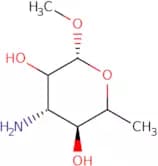
1kgTo inquire5kgTo inquire10kgTo inquire500gTo inquire2500gTo inquire-Unit-kgkgTo inquireMethyl 3-amino-3,6-dideoxy-a-L-taloside
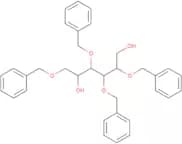
<p>Methyl 3-amino-3,6-dideoxy-a-L-taloside is a custom synthesis of a monosaccharide. It is modified with fluorine and methyl groups and may be used in click chemistry. The CAS number for this compound is 103614-34-8. Methyl 3-amino-3,6-dideoxy-a-L-taloside is an oligosaccharide that can be glycosylated or complexed with sugar. This compound has properties of a carbohydrate and can be classified as a saccharide or polysaccharide.</p>Formula:C7H15NO4Purity:Min. 95%Molecular weight:177.2 g/mol2,3,4,6 -Tetra-O-benzyl-D-glucitol
CAS:<p>2,3,4,6 -Tetra-O-benzyl-D-glucitol is an atypical compound with a spectrum of activities. It has been shown to inhibit the synthesis of alditols and aldosides in vitro, and it also inhibits miglustat which is the first drug for Gaucher's disease approved by the FDA. 2,3,4,6 -Tetra-O-benzyl-D-glucitol is synthetically produced from D-glucose and benzyl chloride. The compound crystallizes as a chiral form that can exist as either (S) or (R) conformation. The (S) form has been observed to be more active than the (R) form against showdomycin and cyclic peptidase A.</p>Formula:C34H38O6Purity:Min. 95%Color and Shape:liquid.Molecular weight:542.66 g/mol3,4,6-Tri-O-acetyl-2-deoxy-2-phthalimido-b-D-glucopyranosyl chloride
CAS:<p>3,4,6-tri-O-acetyl-2-deoxy-2-phthalimido-b-D-glucopyranosyl chloride is a modification of the carbohydrate. It is a complex carbohydrate that has been custom synthesized for research purposes. It can be used as a monosaccharide or polysaccharide in glycosylation reactions. This compound has not been fluorinated and the CAS number is 7772-87-4.</p>Formula:C20H20ClNO9Purity:Min. 95%Molecular weight:453.83 g/molO-(2-Azido-4,6-O-benzylidene-2-deoxy-a-D-galactopyranosyl)-N-[(9H-fluoren-9-ylmethoxy)carbonyl]-L-serine tert-Butyl Ester
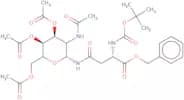
CAS:<p>O-(2-Azido-4,6-O-benzylidene-2-deoxy-a-D-galactopyranosyl)-N-[(9H-fluoren-9-ylmethoxy)carbonyl]-L-serine tert butyl ester (Fluoride) is a modified carbohydrate that has been synthesized from a sugar. The fluorination step of the synthesis has replaced the hydroxyl group at C1 with fluorine. <br>The glycosylation and methylation steps have added a new saccharide to the existing carbohydrate chain. The modification step has introduced an oligosaccharide which has been linked to the monosaccharides by an amide bond. This synthetic carbohydrate was designed to be used as a fluorescent probe for glycoproteins and glycolipids in biomedical research.</p>Formula:C35H38N4O9Purity:Min. 95%Molecular weight:658.7 g/mol2N-Boc-4N-(2-acetamido-2-deoxy-3,4,6-tri-O-acetyl-b-D-glucopyranosyl)-L-asparagine-O-benzyl ester
<p>Glycosylation is the process of adding glycosyl groups to a molecule. This process is essential for the synthesis of complex carbohydrates, which are essential in cell membranes and other biological structures. Methylation is the addition of one or more CH3 groups to a compound. Click chemistry is a type of chemical reaction that is used when an orthogonal protection strategy is required. Polysaccharides are long chains of sugar molecules linked together by glycosidic bonds. Fluorination is the introduction of fluorine into organic molecules to modify their properties. Saccharide refers to any sugar, especially monosaccharides and oligosaccharides. Modification refers to the altering of a molecule by adding or removing functional groups, such as methyl groups or glycosyl groups. Sugar refers to any carbohydrate that contains two hydroxyl (OH) groups on adjacent carbons and includes monosaccharides and oligosaccharides. Synthetic means artificially made by humans</p>Formula:C30H41N3O13Purity:Min. 95%Molecular weight:651.67 g/mol1,2:5,6-Di-O-cyclohexylidene-myo-inositol
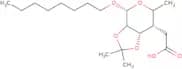
CAS:<p>1,2:5,6-Di-O-cyclohexylidene-myo-inositol is an experimental solvent that has been shown to form hydrogen bonds with solutes. It crystallizes in the monoclinic system and shows a single crystal x-ray diffraction pattern. The molecule consists of two vicinal cyclohexane rings linked by a six carbon chain. The molecule has two conformations: one where the hydroxyl group is on the top of the ring and one where it is on the bottom. The former conformation is more favorable because it stabilizes the molecule by covering its hydroxyl group and uncovers its other functional groups. This conformation also makes the dihedral angle between C1 and C2 larger than that between C1 and C3, which causes conformational strain. In addition, this conformation creates polarities in different areas of the molecule, which may be due to intramolecular bonding or vic</p>Purity:Min. 95%Octyl 4-O-acetyl-2,3-O-isopropylidene-a-L-rhamnopyranoside
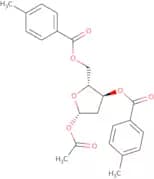
CAS:<p>Octyl 4-O-acetyl-2,3-O-isopropylidene-a-L-rhamnopyranoside is a monosaccharide that is synthesized from the glycosylation of octyl β-D-glucopyranoside and L-rhamnose by means of an acetal exchange reaction. The product is a complex carbohydrate with a molecular weight of 578. This compound can be fluorinated at the hydroxyl group to produce octyl 4-[4-(trifluoromethoxy)phenyl]butanoate, which has been shown to have significant antiinflammatory activities in animal models.</p>Formula:C19H34O6Purity:Min. 95%Molecular weight:358.47 g/mol1-O-Acetyl-2-deoxy-3,5-di-O-toluoyl-b-D-erythropentofuranose
CAS:<p>1-O-Acetyl-2-deoxy-3,5-di-O-toluoyl-b-D-erythropentofuranose is a monosaccharide that belongs to the group of complex carbohydrates. It is synthetically derived and has been modified with fluorination and acetylation. 1OATBDE is used as a selective labeling agent for glycosyls in glycoconjugates.</p>Purity:Min. 95%Methyl 3,4-O-isopropylidene-a-D-galactopyranoside
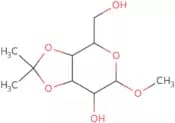
CAS:<p>Methyl 3,4-O-isopropylidene-a-D-galactopyranoside is a white crystalline powder that is soluble in water. This product is used in the synthesis of complex carbohydrate and glycosylation. It has CAS No. 40269-01-0 and can be custom synthesized to meet your requirements. The purity of this product is over 99%.</p>Formula:C10H18O6Purity:Min. 95%Molecular weight:234.25 g/mol






![O-(2-Azido-4,6-O-benzylidene-2-deoxy-a-D-galactopyranosyl)-N-[(9H-fluoren-9-ylmethoxy)carbonyl]-L-…](/_next/image/?url=https%3A%2Fstatic.cymitquimica.com%2Fproducts%2F3D%2Fthumb-webp%2FMA60610.webp&w=3840&q=75)