Enzyme Substrates
Enzyme substrates are molecules upon which enzymes act to catalyze chemical reactions. The substrate binds to the active site of the enzyme, where it undergoes a specific transformation to form the product of the reaction. Enzyme substrates are essential tools in research for studying enzyme kinetics, specificity, and mechanism of action. They are also used in diagnostic assays and biochemical studies. At CymitQuimica, we provide a diverse selection of high-quality enzyme substrates to support your research in enzymology and biochemistry.
Subcategories of "Enzyme Substrates"
Found 1527 products of "Enzyme Substrates"
Sort by
Purity (%)
0
100
|
0
|
50
|
90
|
95
|
100
Coelenterazine cp
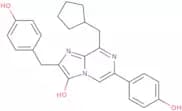
CAS:<p>Coelenterazine cp is a coelenterazine analog for Renilla luciferase. In certain studies, it has been shown to be highly sensitive for the detection of human papilloma virus (HPV) and can be used in the diagnosis of cervical cancer.</p>Formula:C25H25N3O3Purity:Min. 95%Molecular weight:415.48 g/molResorufin b-D-cellobioside
CAS:<p>Resorufin b-D-cellobioside is a fluorogenic substrate for measurement of cellulase activity. The product of enzyme reaction, resorufin, exhibits fluorescence emission at 585 nm with excitation at 571 nm at or near physiological pH values.</p>Formula:C24H27NO13Purity:Min. 95 Area-%Color and Shape:Brown Orange PowderMolecular weight:537.47 g/mol4-Nitrophenyl-β-D-glucopyranoside
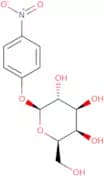
CAS:<p>Chromogenic β-glucosidase substrate yielding a yellow solution upon cleavage.</p>Formula:C12H15NO8Purity:Min. 99.0 Area-%Molecular weight:301.25 g/molNaphthol AS-BI b-D-glucuronide
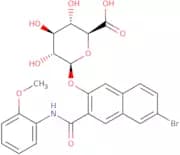
CAS:<p>Chromogenic substrate to visualize beta-glucuronidase activity; produces a red color</p>Formula:C24H22BrNO9Purity:Min. 98 Area-%Color and Shape:White PowderMolecular weight:548.34 g/mol4-Methylumbelliferyl cholin phosphate
CAS:<p>4-Methylumbelliferyl phosphocholine, commonly known as 4-MUPC, is a synthetic phosphodiester used as an enzyme substrate for phospholipase enzymes. 4-MUPC is used as a fluorogenic substrate to measure the activity of phopholipases, which are important mediators of cell signalling.</p>Formula:C15H20NO6PPurity:Min. 99.0 Area-%Molecular weight:341.30 g/mol3-Nitrophenyl β-D-glucopyranoside
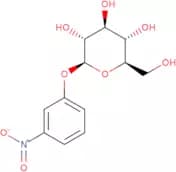
CAS:<p>3-Nitrophenyl beta-D-glucopyranoside is a chromogenic enzyme substrate commonly used to assay for beta-glucosidase activity. Upon hydrolysis by the enzyme, it produces a yellow product that can be easily detected by spectrophotometry. This substrate is often used in the field of carbohydrate chemistry and biochemistry to study enzyme kinetics and inhibition in both in vitro and in vivo systems.</p>Formula:C12H15NO8Purity:Min. 95%Color and Shape:White Yellow PowderMolecular weight:301.25 g/molL-Alanine-7-amido-4-methylcoumarin hydrochloride
CAS:<p>L-Alanine-7-amido-4-methylcoumarin hydrochloride is a synthetic peptide substrate used as a fluorogenic substrate for alanine aminopeptidase.</p>Formula:C13H14N2O3·HClPurity:Min. 90%Color and Shape:PowderMolecular weight:282.72 g/molAldol® 484 β-D-galactopyranoside, Biosynth Patent: EP 2427431 and US 8940909
CAS:<p>Aldol® 484 beta-D-galactopyranoside is a chromogenic enzyme substrate for beta-galactosidase activity. The colorless product is cleaved by lactose-utilizing bacteria in liquid or solid media, yielding intense red color. Aldol® 484 beta-D-galacto-pyranoside can also be used in beta-gal reporter gene assays or for identification of beta-gal positive transformants on agar. Aldol® 484 beta-D-galactopyranoside can be used under aerobic and anaerobic conditions.</p>Formula:C26H24ClFN2O7Purity:Min. 95%Color and Shape:PowderMolecular weight:530.93 g/mol2-Chloro-4-nitrophenyl β-D-glucopyranoside
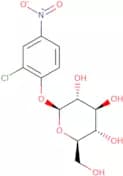
CAS:<p>2-Chloro-4-nitrophenyl β-D-glucopyranoside is a chromogenic substrate for beta-glucosidases. In biochemical enzyme assays and in vitro diagnostics analysis, the substrate is used to monitor the glycosyltransferase activity. When 2-chloro-4-nitrophenyl β-D-glucopyranoside is cleaved by beta-glucosidase, 2-chloro-4-nitrophenol is released and quantified.</p>Formula:C12H14ClNO8Purity:Min. 95%Color and Shape:White PowderMolecular weight:335.69 g/mol4-Methylumbelliferyl-β-D-xylopyranoside
CAS:<p>Fluorogenic substrate for β-D-xylosidase. Identification within the family of Enterobacteriaceae.</p>Formula:C15H16O7Purity:Min. 99.0 Area-%Molecular weight:308.29 g/mol3-Indoxyl sulfate, potassium salt
CAS:<p>3-Indoxyl sulfate, potassium salt (3ISK) is a chemical compound that is soluble in water. It has been used as a marker for bowel disease, and it has been shown to react with analytical methods such as titration calorimetry and lc-ms/ms. 3ISK can be used to determine the optimum concentration for pharmacological treatment of bowel disease. The metabolic fate of 3ISK has been studied extensively and it is found that 3ISK is metabolized by microbial enzymes in the gut, which may lead to an increased incidence of bowel disease in patients with low levels of microbial metabolism. 3ISK also plays an important physiological function by maintaining mitochondrial membrane potential, which could have implications for pharmacological treatment of bowel disease.</p>Formula:C8H6KNO4SPurity:Min. 98.0 Area-%Molecular weight:251.31 g/molL-Proline 7-amido-4-methylcoumarin hydrobromide
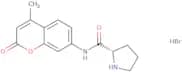
CAS:<p>L-Proline 7-amido-4-methylcoumarin hydrobromide is a fluorogenic substrate that is used to measure esterase and peptidase activity in a variety of animal and microbial sources. This compound has been shown to have a lipase activity. L-Proline 7-amido-4-methylcoumarin hydrobromide is also used as an enzyme preparation and as an enzyme source.</p>Formula:C15H17BrN2O3Molecular weight:353.22 g/molRef: 3D-P-7280
1gTo inquire5gTo inquire10gTo inquire500mgTo inquire2500mgTo inquire-Unit-ggTo inquire4-Methylumbelliferyl b-D-glucosaminide - Moscerdam™ biochemical purity
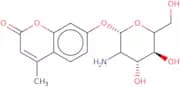
CAS:<p>A substrate used for the diagnosis of Sanfilippo disease C (MPS III C).</p>Formula:C16H19NO7Purity:Min. 98 Area-%Color and Shape:White PowderMolecular weight:337.32 g/mol4-Nitrophenyl-β-D-glucuronic acid
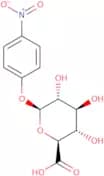
CAS:<p>Chromogenic β-glucuronidase substrate yielding a yellow solution upon cleavage. Used to detect E. coli contamination in food and drinking water due to their β-glucuronidase activity.</p>Formula:C12H13NO9Purity:Min. 98.0 Area-%Molecular weight:315.24 g/molAc-DEVD-6-Amino-D-Luciferin
<p>Caspases are a family of protease enzymes playing essential roles in programmed cell death and inflammation. The acronym caspase stands for Cysteine Aspartic Acid Specific Protease due to their specific cleavage of an aspartic acid residue, by mean of a cysteine in the catalytic site of the enzyme._x000D_About 11 or 12 different caspases are known in humans and 10 in mice, participating in numerous different cellular functions. Caspase deficiency, for example, has been identified as a cause of tumor development, while over-activation of some caspases such as caspase-3 can lead to excessive apoptosis that can be observed in several neurodegenerative diseases. Caspases cleave proteins at specific peptide recognition sequences. Ac-DEVD-6-Amino-D-Luciferin (Ac-Asp-Glu-Val-Asp-6-Amino-D-Luciferin, Cat.No_x000D_L-8282) is a synthetic chemiluminescent peptide for the determination of caspase-3 and caspase-7activity.</p>Formula:C31H37N7O13S2Molecular weight:779.79 g/molRef: 3D-L-8282
10mgTo inquire25mgTo inquire50mgTo inquire100mgTo inquire250mgTo inquire-Unit-ggTo inquire4-Nitrophenyl-β-D-galactopyranoside
CAS:<p>Chromogenic β-galactosidase substrate yielding a yellow solution upon cleavage. Can be used for the detection of coliforms due to their β-galactosidase activity.</p>Formula:C12H15NO8Purity:Min. 98.0 Area-%Molecular weight:301.26 g/mol4-Methylumbelliferyl-N-acetyl-β-D-glucosaminide-6-sulfate, sodium salt
CAS:<p>4-Methylumbelliferyl 2-acetamido-2-deoxy-beta-D-glucopyranoside-6-sulfate sodium salt is a high-quality fluorogenic substrate specifically designed for the detection and quantification of various enzymes, including beta-glucosidases and sulfatases. Upon hydrolysis by the target enzyme, this substrate releases the highly fluorescent 4-methylumbelliferone, allowing for real-time monitoring and accurate measurement of enzyme activities in biochemical assays, diagnostic tests, and research applications. 4-Methylumbelliferyl 2-acetamido-2-deoxy-beta-D-glucopyranoside-6-sulfate sodium salt has excellent solubility in water, ensuring a consistent and reliable performance in different experimental conditions. This versatile substrate is an essential tool for researchers and industry professionals who require a sensitive and reproducible detection method for enzymes of interest.</p>Formula:C18H20NNaO11SPurity:Min. 98.0 Area-%Molecular weight:481.41 g/molRef: 3D-M-5505
5mgTo inquire25mgTo inquire50mgTo inquire100mgTo inquire250mgTo inquire-Unit-ggTo inquireIsopropyl-β-D-thiogalactopyranoside, <5ppm dioxane, plant origin (ex peach gum)
CAS:<p>A non-metabolizable allolactose analogue, widely used in molecular biology for overexpression of recombinant proteins from inducible systems under the control of lac promoter. IPTG binds to the LacI repressor and causes its release from the lac operator, allowing gene expression to take place. Present in vectors of pGEX, pGEM-T, pET, pRSET, pMAL class and others.</p>Formula:C9H18O5SPurity:Min. 99.0 Area-%Molecular weight:238.30 g/molRef: 3D-I-8070
1kgTo inquire50gTo inquire100gTo inquire250gTo inquire500gTo inquire-Unit-ggTo inquire4-Methylumbelliferyl-β-D-glucuronic acid dihydrate
CAS:<p>4-Methylumbelliferyl beta-D-glucuronide (MUG) is commonly used as a substrate for detecting beta-glucuronidase. MUG is used for identifying E. coli contamination in food, drinking water, clinical samples and for rapid bacterial identification in blood cultures. It is recommended in international normatives (ISO, DIN) as a fluorogenic substrate for detection of E. coli. MUG is also a tool assaying the glucuronidase gene in plants.</p>Formula:C16H20O11Purity:Min. 99 Area-%Molecular weight:388.33 g/molD-Luciferin Firefly, sodium salt monohydrate
CAS:<p>Water soluble substrate for firefly luciferase.</p>Formula:C11H9N2NaO4S2Purity:Min. 99.0 Area-%Molecular weight:320.32 g/mol