Fluorogenic Substrates
Found 217 products for "Fluorogenic Substrates".
- Lower prices
- Higher prices
- Lower purities
- Higher purities
- Faster estimated delivery
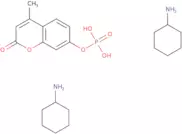
4-Methylumbelliferyl phosphate bis(cyclohexylammonium) salt
CAS:Sensitive fluorogenic substrate for fluorometric and UV-spectrophotometric assays of phosphatases. This may also be used for in-gel assaysFormula:C22H35N2O6PPurity:Min 99%Color and Shape:White to off-white solid.Molecular weight:454.50 g/molRef: 3D-EM32193
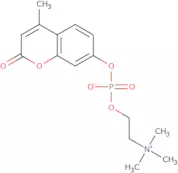
Discontinued product4-Methylumbelliferyl cholin phosphate
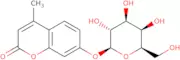
CAS:4-Methylumbelliferyl phosphocholine, commonly known as 4-MUPC, is a synthetic phosphodiester used as an enzyme substrate for phospholipase enzymes. 4-MUPC is used as a fluorogenic substrate to measure the activity of phopholipases, which are important mediators of cell signalling.Formula:C15H20NO6PPurity:Min. 99.0 Area-%Molecular weight:341.30 g/mol4-Methylumbelliferyl-beta-D-galactopyranoside
CAS:Fluorogenic substrate for β-D-galactosidase yielding a blue fluorescent solution upon cleavage.Formula:C16H18O8Purity:Min. 98.0 Area-%Molecular weight:338.32 g/mol4-Methylumbelliferyl lignocerate
CAS:4-Methylumbelliferyl lignocerate is a fluorogenic substrate for lipase. After enzymatic cleaveage, free 4-methylumbelliferone (also known as hymecromone) is released, exhibiting blue fluorescence upon excitation with UV light. The strongest fluorescence of 4-methylumbelliferone requires deprotonation of the hydroxyl group (thus requires alkaline pH), with a maximal fluorescence intensity obtained with excitation at 350 to 370 nm and emission at 440 to 470 nm. The use of 4-methylumbelliferyl lignocerateas a substrate for measuring the lipase activity is used for X-linked adrenoleukodystrophy diagnosis and peroxisomal disorder screening.
Formula:C34H54O4Purity:Min. 95%Color and Shape:PowderMolecular weight:526.79 g/molRef: 3D-EM65953
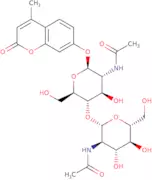
Discontinued product4-Methylumbelliferyl-N,N-diacetyl-beta-D-chitobioside
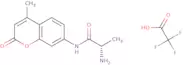
CAS:4-Methylumbelliferyl-N,N-diacetyl-beta-D-chitobioside is a molecule that has been expressed in the yeast Pichia pastoris. It can be used as a fluorescent probe for chitinase activity and has been shown to be sensitive to tryptophan residues and aromatic residues in proteins. 4-Methylumbelliferyl-N,N-diacetyl-beta-D-chitobioside has also been used as a fluorescent probe for isozymes of glucose phosphate isomerase. The nature of the trisaccharide is unknown, but it appears to be hydrophobic.Formula:C26H34N2O13Purity:Min. 99.0 Area-%Molecular weight:582.57 g/molL-Alanine 7-amido-4-methylcoumarin, trifluoroacetate salt
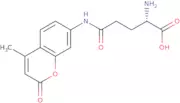
CAS:Fluorogenic substrate for aminopeptidase yielding a blue fluorescent solution.Formula:C15H15F3N2O5Purity:Min. 98.0 Area-%Molecular weight:360.29 g/molγ-L-Glutamic acid 7-amido-4-methylcoumarin trifluoroacetic acid
CAS:Substrate for aminopeptidase A
Formula:C15H16N2O5•C2F3O2HPurity:Min. 98 Area-%Color and Shape:White PowderMolecular weight:418.4 g/molRef: 3D-EG31007
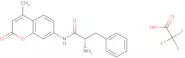
Discontinued productL-Phenylalanine 7-amido-4-methylcoumarin trifluoroacetate salt
CAS:L-Phenylalanine 7-amido-4-methylcoumarin trifluoroacetate salt is a fluorogenic peptide substrate for aminopeptidase. This AMC peptide substrate is normally used to rapidly profile the N-terminal specificity of proteases.Formula:C19H18N2O3•C2HF3O2Purity:Min. 98 Area-%Color and Shape:White PowderMolecular weight:436.38 g/molRef: 3D-EP15999
Discontinued productBoc-Val-Pro-Arg-PAB-Resorufin
Boc-Val-Pro-Arg-PAB-Resorufin is fluorogenic substrate for thrombin and the thrombin-staphylocoagulase complex.
Formula:C40H50N8O8Purity:Min. 97 Area-%Molecular weight:770.87 g/molRef: 3D-B-0233
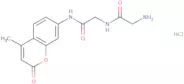
Discontinued productGlycyl-glycine 7-amido-4-methylcoumarin hydrochloride
CAS:Glycyl-glycine 7-amido-4-methylcoumarin hydrochloride is a synthetic peptide substrate used as a fluorogenic substrate for aminopeptidase.Formula:C14H16ClN3O4Purity:Min. 95%Color and Shape:PowderMolecular weight:325.75 g/molRef: 3D-EG172126
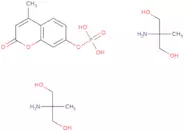
Discontinued product4-Methylumbelliferyl phosphate, bis(2-amino-2-methyl-1,3-propanediol) salt
CAS:Sensitive fluorogenic substrate for fluorometric and UV-spectrophotometric assays of phosphatases.Formula:C18H31N2O10PPurity:Min. 98.0 Area-%Molecular weight:466.43 g/molRef: 3D-M-5850
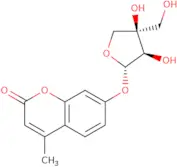
Discontinued product4-Methylumbelliferyl beta-D-apiofuranoside
4-Methylumbelliferyl beta-D-apiofuranoside is a fluorescent substrate that is used in the detection of enzyme activity. It is a yellow crystalline powder with a melting point of 132°C and an optical rotation of +27°. 4-Methylumbelliferyl beta-D-apiofuranoside can be used as a conjugate for fluorescence, chemiluminescence, or bioluminescence detection of enzymes such as β-galactosidase, phosphatases, esterases, and peroxidases. It is also used to stain cells and tissues for microscopic analysis. This product has been tested for its effects on the environment and found to have little potential for harm to the environment. 4-Methylumbelliferyl beta-D-apiofuranoside has been shown to be high purity with no significant impurities detected in testing. The chemical has shown high quality characteristics inFormula:C15H16O7Purity:Min. 95 Area-%Molecular weight:308.29 g/molResorufin β-D-xylobioside
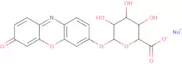
Resorufin b-D-xylobioside is a fluorogenic substrate for xylanases useful for xylanase activity assays.Purity:Min. 95%Color and Shape:PowderMolecular weight:477.42 g/molResorufin b-D-glucuronide sodium salt
CAS:Resorufin b-D-glucuronide sodium salt is used as a fluorogenic substrate for beta-glucuronidase (GUS) to study drug metabolism.Purity:Min. 95%Color and Shape:Brown Orange Red PowderMolecular weight:411.29 g/molRef: 3D-ER03328
Discontinued product4-Methylumbelliferyl palmitate
CAS:4-Methylumbelliferyl palmitate, commonly names as 4-MUP, is a fluorescent probe that binds to lipases, enzymes responsible to assist on the hydrolysis of fats. In diagnosis, 4-MUP is used for screening of lysosomal storage diseases (LSD) caused by a deficiency of a single enzyme involved in the metabolism of glycoproteins, lipids or mucopolysaccharides.
Formula:C26H38O4Purity:Min. 95%Color and Shape:White PowderMolecular weight:414.58 g/molRef: 3D-EM35421
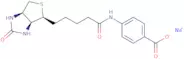
Discontinued product(+)-Biotin 4-amidobenzoic acid sodium salt
CAS:(+)-Biotin 4-amidobenzoic acid sodium salt, often referred as (+)-biotin PABA, is a fluorogenic substrate used to measure biotinidase activity, especially in newborn screening programs.
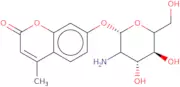
Formula:C17H20N3NaO4SPurity:Min. 95%Color and Shape:White Slightly Yellow PowderMolecular weight:385.41 g/mol4-Methylumbelliferyl b-D-glucosaminide - Moscerdam™ biochemical purity
CAS:A substrate used for the diagnosis of Sanfilippo disease C (MPS III C).
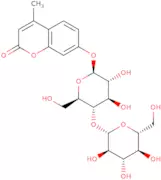
Formula:C16H19NO7Purity:Min. 98 Area-%Color and Shape:White PowderMolecular weight:337.32 g/mol4-Methylumbelliferyl-beta-D-cellobioside
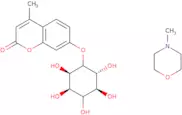
CAS:Fluorogenic substrate for β-D-Cellobiosidase yielding a blue fluorescent solution upon cleavage.Formula:C22H28O13Purity:Min. 98.0 Area-%Molecular weight:500.46 g/mol4-Methylumbelliferyl myo-inositol-1-phosphate, N-methyl-morpholine salt
CAS:Fluorogenic substrate for phosphatidylinositol-specific phospholipase C. Isolation and identification of Listeria monocytogenes, bacteria of the Bacillus cereus group, yeasts and molds. See also B-7404.Formula:C21H30NO12PPurity:Min. 98.0 Area-%Molecular weight:519.45 g/molRef: 3D-M-5717
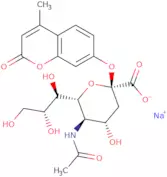
Discontinued product2'-(4-Methylumbelliferyl)-alpha-D-N-acetylneuraminic acid, sodium salt
CAS:4-Methylumbelliferyl N-acetyl-a-D-neuraminic acid sodium salt (4-MUNANA) is a fluorogenic substrate of neuraminidase. 4-Methylumbelliferone is released from 4-MUNANA by neuraminidase in the assay and can be detected fluorometrically with excitation at 365-380 nm and emission at 445-454 nm. It can also be used for fluorescent staining of sialidases in PAGE.Formula:C21H24NNaO11Purity:Min. 98 Area-%Molecular weight:489.42 g/mol