Dyes, Stains and Tinctures
Subcategories of "Dyes, Stains and Tinctures"
- Acid Dyes(49 products)
- Azobenzenes(270 products)
- Azoic Dyes(7 products)
- Basic Dyes(27 products)
- Coumarin Dyes(72 products)
- Cyanine Dyes, Squarylium Dyes(53 products)
- DCM Dyes(4 products)
- Diarylethenes(12 products)
- Dipyrromethene Dyes(26 products)
- Direct Dyes(17 products)
- Disperse Dyes(2 products)
- Dye Sensitizers(12 products)
- Dyes(417 products)
- Dyes & Stains(911 products)
- Generating Insoluble Dyes(14 products)
- Generating Soluble Dyes(11 products)
- Hexaarylbiimidazole(4 products)
- Indicators(575 products)
- Mordant Dyes(10 products)
- Near-Infrared (NIR) Dyes(28 products)
- Oil Dyes(15 products)
- Other Stains and Dyes(2 products)
- Perylene Dyes(17 products)
- Photochromic Dyes(40 products)
- Phthalocyanine Dyes, Porphyrin Dyes(101 products)
- Quinacridone Dyes(8 products)
- Spiropyrans(16 products)
- Stains and Dyes(243 products)
- Stains and Dyes for Microscopy(5 products)
- Vat Dyes(5 products)
- Xanthene Dyes(67 products)
Found 758 products of "Dyes, Stains and Tinctures"
Disperse Red 60
CAS:Disperse Red 60 is a dye that is used in wastewater treatment. It binds to the substrate film, which is the layer of organic matter on the surface of water, and causes it to fluoresce. The optimum concentration for Disperse Red 60 is 0.1% (w/v). Disperse Red 60 has been shown to be reactive with hydroxyl groups in particle activated carbon and uptake by light emission. This product is used in wastewater treatment as it can be adsorbed onto particles in the water and cause them to fluoresce.Formula:C20H13NO4Purity:Min. 95%Color and Shape:PowderMolecular weight:331.32 g/molC.I.Vat Orange 15
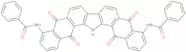
CAS:C.I. Vat Orange 15 is a polymerization inhibitor that prevents polymerization by reacting with the hydrogen peroxide, which is generated during the chemical reaction. The addition of C.I. Vat Orange 15 to a polymerization system will slow down the reaction and increase the yield of the desired product. This chemical can also be used in organic solvents and a variety of other reactions, such as light resistance and surfactant production. It is not soluble in water and requires an organic solvent for use in coatings or resins, but it does not react with esters or ethers. C.I. Vat Orange 15 has been shown to have high concentrations, but it is not toxic to animals or humans.>>END>>Purity:Min. 95%16a-Hydroxyprednisolone
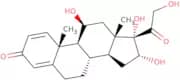
Controlled Product16a-Hydroxyprednisolone is a synthetic corticosteroid that has been used in the treatment of inflammatory diseases. It has a potency of 1/10th that of prednisolone and is used as an industrial preparation, such as for the production of plastics. 16a-Hydroxyprednisolone is prepared by reacting phthalic anhydride with hydrocortisone or hydrocortisone acetate. Impurities are removed by preparative thin-layer chromatography using silica gel plates. The product can be purified further by recrystallization from water or from chloroform/methanol mixtures. The presence of virulent microorganisms can be detected by adding a small amount to tissue samples and then examining them for signs of lysis or death. Acid catalysis is required in the sample preparation, which involves the use of an inorganic acid (e.g., hydrochloric acid) to remove any tracesFormula:C21H28O6Purity:Min. 98 Area-%Color and Shape:White PowderMolecular weight:376.44 g/molC.I.Disperse Orange 89
CAS:Please enquire for more information about C.I.Disperse Orange 89 including the price, delivery time and more detailed product information at the technical inquiry form on this pagePurity:Min. 95%Propyl red
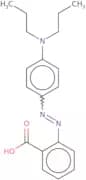
CAS:Propyl red is a diacetate that is used in the diagnosis of infectious diseases. The color of propyl red is due to the presence of an acetate group and its affinity for nucleic acids, which allows it to be used as a stain in blood culture. Propyl red has been shown to have a catalytic effect on the oxidation of hydrogen peroxide and can be used as a chromophore in the detection of radiation. The optical properties of propyl red are dependent on pH, with the maximum absorbance at pH 3.5-4.5 and minimum absorbance at pH 7-8. The molecular weight and protonation state are also important factors for determining optical properties. It has been shown that propyl red can be used to highlight mastitis by visualizing milk fat globules within cells.END>>Formula:C19H23N3O2Purity:Min. 95%Color and Shape:PowderMolecular weight:325.4 g/molC.I.Disperse Blue 87:1
CAS:Please enquire for more information about C.I.Disperse Blue 87:1 including the price, delivery time and more detailed product information at the technical inquiry form on this pagePurity:Min. 95%C.I.Mordant Orange 3
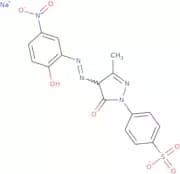
CAS:Please enquire for more information about C.I.Mordant Orange 3 including the price, delivery time and more detailed product information at the technical inquiry form on this pageFormula:C16H13N5O7S·NaPurity:Min. 95%Molecular weight:442.36 g/molAlizarin red S
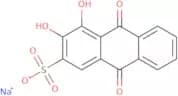
CAS:Alizarin red is used in histology and medicine to stain calcium-containing specimens, e.g. bones and calcifications. Chromogenic substrates for enzymes based on alizarin have been developed and, as an example, alizarin-beta-D-galactoside (Aliz-gal) has been reported for the detection of bacterial beta-galactosidase by researchers at the University of Northumbria and the Freeman Hospital, Newcastle upon Tyne in the UK (James, 2000).Formula:C14H7O7SNaColor and Shape:PowderMolecular weight:342.26 g/molMalachite green oxalate
CAS:Malachite green oxalate is an adsorbent that can be used for wastewater treatment. It has a high affinity for organic molecules, which allows it to remove the substances from water. Malachite green oxalate reacts with the dissolved organic molecules and forms a strong bond with them, which prevents them from being redeposited in the water. The reaction mechanism of malachite green oxalate is based on its ability to adsorb onto the surface of organic molecules and react with them. The Langmuir adsorption isotherm shows that malachite green oxalate has a significant cytotoxicity and toxicological effect on human cells. Malachite green oxalate also binds to p-nitrophenyl phosphate (PNPP) in human serum, which is an enzyme substrate that is involved in many metabolic processes such as glycolysis and gluconeogenesis. The optical sensor was used to measure the redox potential of malachite green
Formula:C23H25N2•(C2H2O4)0•C2HO4Purity:Min. 95%Color and Shape:PowderMolecular weight:927 g/molICG-alkyne
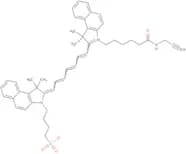
CAS:The non-invasive near-infrared fluorescence imaging dye ICG is used in ophthalmologic angiography to determine cardiac output and liver blood flow and function. The ICG alkyne can be used to label azido functionalised biomolecules eg glycans, lipids and peptides via click chemistry protocols.Formula:C48H53N3O4SPurity:Min. 95%Color and Shape:PowderMolecular weight:768 g/molAcid blue 1
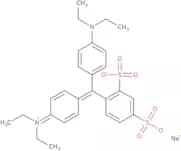
CAS:Acid blue 1 is a reactive dye that reacts with metal hydroxides to form a precipitate. It is used in analytical chemistry as a reagent for the detection of hydroxyl groups, lymphatic vessels, and sodium salts. Acid blue 1 has been shown to have toxic effects on the heart and lungs, but not in all cases. Acid blue 1 has also been shown to be an effective synchronous fluorescence indicator for radiation and light exposure. It is also used as a cationic surfactant in detergent compositions.Formula:C27H31N2NaO6S2Color and Shape:PowderMolecular weight:566.67 g/molC.I.Acid Red 410
CAS:Please enquire for more information about C.I.Acid Red 410 including the price, delivery time and more detailed product information at the technical inquiry form on this pagePurity:Min. 95%C.I.Direct Blue 72
CAS:C.I. Direct Blue 72 is a versatile compound with various applications. It is used in the field of molybdenum crystallization and photocatalytic reactions. Additionally, it has cholinergic properties, which means it can interact with choline receptors in the body. This compound also contains secoisolariciresinol and sphingosine, which are both phytoestrogens known for their potential health benefits.Formula:C36H22N7Na3O10S3Purity:Min. 95%Molecular weight:877.8 g/molPrussian blue insoluble - Technical grade
CAS:Controlled ProductPrussian blue insoluble is a natural compound that is used as an industrial dye in the textile industry and as an analytical reagent in the chemical industry. It consists of ferric iron, potassium ferrocyanide, and varying amounts of copper. Prussian blue insoluble has been shown to have genotoxic properties, with x-ray diffraction data indicating it can cause DNA damage. The rate constant for the thermal expansion of Prussian blue insoluble has been determined by measuring the change in volume over time. This reaction solution also has michaelis–menten kinetics and glycol esters. Prussian blue insoluble can be used for wastewater treatment due to its ability to bind heavy metals and radioactive isotopes. It has also been observed that this compound can be used for biological sample testing.
Formula:C18Fe7N18Purity:Min. 95%Color and Shape:PowderMolecular weight:859.23 g/mol2-Naphthol violet
CAS:2-Naphthol violet is a versatile building block that can be used as a reagent, intermediate and scaffold in various chemical reactions. It is a high-quality product and is available at competitive prices. 2-Naphthol violet has been shown to be useful in the synthesis of many different compounds, including pharmaceuticals, fine chemicals, dyes and other specialty chemicals. It is also an important building block for organic synthesis due to its ability to form complex structures. 2-Naphthol violet has CAS number 7143-21-7.Formula:C16H9N3Na2O9S2Purity:Min. 95%Color and Shape:PowderMolecular weight:497.36 g/molReactive Red 195
CAS:Reactive Red 195 is a synthetic dye that reacts with mineralization. It is used in wastewater treatment to remove organic compounds by oxidation and complexation. Reactive Red 195 undergoes a number of reactions, including hydroxylation, hydrolysis, and photo-degradation. Reactive Red 195 has been shown to have photocatalytic activity, which can be increased by the addition of iron oxides or triazine. The rate of these reactions can be determined using surface methodology such as X-ray photoelectron spectroscopy (XPS).Formula:C31H19ClN7Na5O19S6Purity:Min. 95%Color and Shape:PowderMolecular weight:1,136.32 g/molDihydrofolate reductase
CAS:Dihydrofolate reductase (DHFR, 1.5.1.3) is a NADP+/NADPH-dependent oxidoreductase, that reduces dihydrofolate to tetrahydrofolate in the following reaction: dihydrofolate + NADPH + H+ ⇌ tetrahydrofolate + NADP+One unit of dihydrofolate reductase will convert 1.0 μmole of dihydrofolic acid into tetrahydrofolic acid in 1 minute at pH 7.5, 22°C and presence of NADPH.
Purity:Min. 95%C.I.Direct Yellow 107
CAS:C.I.Direct Yellow 107 is a versatile dye that can be used for various applications. It is commonly used in the textile industry to dye cellulose-based fabrics, providing vibrant and long-lasting colors. This dye is also used as a stain in laboratory settings, particularly in histology and microscopy, where it helps visualize specific structures or cells.Purity:Min. 95%C.I.Basic Yellow 24
CAS:Please enquire for more information about C.I.Basic Yellow 24 including the price, delivery time and more detailed product information at the technical inquiry form on this pagePurity:Min. 95%Indocyanine green
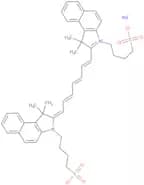
CAS:Indocyanine green is a fluorescent dye with a variety of applications in medical imaging. It has been used to diagnose and evaluate the activity of cancer cells and brain functions. Indocyanine green has also been used as an angiographic agent for diagnosis of solid tumours. In addition, it can be used to evaluate liver function and the blood flow in the brain. The biological properties of indocyanine green have not yet been fully elucidated, but it is known that it binds to hepatocyte-like cells in culture and is found at high levels in human serum. This dye shows fluorescence when bound to DNA or RNA, which indicates its possible use as a molecular probe for detecting carcinoma cells.
Indocyanine green is a STT3B inhibitor and has been shown to prevent α-amanitin toxicity in mice (Wang et al, 2023). This means it could be a possible antidote to poisoning by Amanita, such as death cap mushroom Amanita phalloides, which is the cause of over 90% of fatal mushroom poisoning.Formula:C43H47N2O6S2·NaPurity:(%) Min. 95%Color and Shape:Green PowderMolecular weight:774.96 g/mol