Dyes, Stains and Tinctures
Subcategories of "Dyes, Stains and Tinctures"
- Acid Dyes(49 products)
- Azobenzenes(270 products)
- Azoic Dyes(7 products)
- Basic Dyes(27 products)
- Coumarin Dyes(72 products)
- Cyanine Dyes, Squarylium Dyes(53 products)
- DCM Dyes(4 products)
- Diarylethenes(12 products)
- Dipyrromethene Dyes(26 products)
- Direct Dyes(17 products)
- Disperse Dyes(2 products)
- Dye Sensitizers(12 products)
- Dyes(418 products)
- Dyes & Stains(911 products)
- Generating Insoluble Dyes(14 products)
- Generating Soluble Dyes(11 products)
- Hexaarylbiimidazole(4 products)
- Indicators(575 products)
- Mordant Dyes(10 products)
- Near-Infrared (NIR) Dyes(28 products)
- Oil Dyes(15 products)
- Other Stains and Dyes(2 products)
- Perylene Dyes(17 products)
- Photochromic Dyes(40 products)
- Phthalocyanine Dyes, Porphyrin Dyes(101 products)
- Quinacridone Dyes(8 products)
- Spiropyrans(16 products)
- Stains and Dyes(243 products)
- Stains and Dyes for Microscopy(5 products)
- Vat Dyes(5 products)
- Xanthene Dyes(67 products)
Found 758 products of "Dyes, Stains and Tinctures"
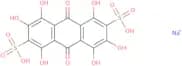
Acid alizarin blue 2b
CAS:For the identification of acidophilic cells, blue color
Formula:C14H8NaO14S2Purity:Min. 95%Molecular weight:487.3 g/molRef: 3D-KAA11440
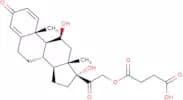
Discontinued productPrednisolone 21-Hemisuccinate
CAS:Controlled ProductPrednisolone 21-hemisuccinate is a synthetic glucocorticoid that has antiinflammatory activity. Prednisolone 21-Hemisuccinate is used in the treatment of inflammatory bowel disease, as well as various other types of inflammatory conditions, such as autoimmune diseases and infectious diseases. It is also used to treat myocardial infarcts and various types of cancer (e.g., leukemia). Prednisolone 21-hemisuccinate acts by binding to the glucocorticoid receptor, which alters gene expression and protein synthesis in cells. Prednisolone 21-Hemisuccinate binds to the Toll-like receptor 4 (TLR4), thereby inhibiting inflammation in mouse models of colitis. Prednisolone 21-Hemisuccinate also decreases glucose levels by decreasing insulin secretion from pancreatic beta cells.
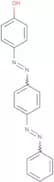
Purity:Min. 95%Metanil yellow, 95%
CAS:Please enquire for more information about Metanil yellow, 95% including the price, delivery time and more detailed product information at the technical inquiry form on this page
Formula:C18H15N3O3S•NaPurity:Min. 95%Molecular weight:376.39 g/molRef: 3D-FM183608
Discontinued productDisperse Yellow 23, technical grade dye content
CAS:Disperse Yellow 23 is a synthetic, industrial dye that is used in the manufacturing of plastics, textiles, and paper. It has a molecular formula of C10H16ClN2O and an x-ray crystal structure with one molecule in the asymmetric unit. Disperse Yellow 23 reacts with hydroxyl groups to form a diazonium salt. It is soluble in water and has a neutral pH. Disperse Yellow 23 is highly reactive and should be handled with care as it may cause burns on contact. The chemical structures of Disperse Yellow 23 are shown below:
Formula:C18H14N4OPurity:Min. 95%Molecular weight:302.33 g/molRef: 3D-FD41304
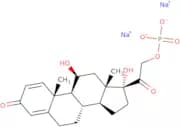
Discontinued productPrednisolone disodium phosphate
CAS:Prednisolone is a corticosteroid that is used to treat inflammation and reduce the body's immune response. Prednisolone disodium phosphate (PDSP) is an enteric-coated tablet that releases prednisolone in the small intestine, where it can be absorbed into the bloodstream. It has been shown to be effective at reducing bowel disease activity in patients with inflammatory bowel disease. Prednisolone disodium phosphate may also have a role in controlling infectious diseases, such as tuberculosis, due to its ability to inhibit toll-like receptor 4 signaling. The drug has been studied as a model system for predicting drug interactions by monitoring the rate constant for benzalkonium chloride binding to human serum albumin.
Formula:C21H29O8P•Na2Purity:Min. 95%Color and Shape:PowderMolecular weight:486.4 g/molMethylene violet
CAS:Please enquire for more information about Methylene violet including the price, delivery time and more detailed product information at the technical inquiry form on this page
Formula:C14H12N2OSPurity:65%Molecular weight:256.32 g/molRef: 3D-FM183308
Discontinued productVictoria blue B
CAS:Victoria Blue B is a compound that contains potassium dichromate and sodium citrate. It has been shown to have high resistance against many types of bacteria, including human serum and cell nuclei. Victoria Blue B has been shown to adsorb nitrite ions from wastewater, which can be useful for the treatment of sewage or as an antimicrobial agent in biological samples. The mechanism by which Victoria Blue B does this is not yet fully understood.
Formula:C33H32N3ClPurity:Min. 70 Area-%Color and Shape:PowderMolecular weight:506.08 g/molRef: 3D-FV52673
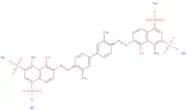
Discontinued productEvans blue
CAS:Evans blue is a basic protein that binds to the active site of metalloproteinases, such as MMP-9. It is used in the study of enzyme activities and in biological samples for determining levels of MMP-9 activity. Caproic acid is capable of chelating metal ions and is often used as a substrate for measuring water permeability. Evans blue has been shown to have a hypoglycemic effect and can be used as a pharmacological agent for treating conditions such as ischemia-reperfusion injury, congestive heart failure, and toll-like receptor 4 (TLR4) mediated inflammation.
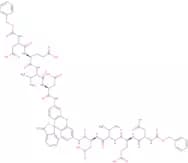
Formula:C34H24N6O14S4Na4Purity:Min. 95%Molecular weight:960.81 g/mol(Z-Asp-Glu-Val-Asp)2-Rhodamine 110
CAS:Fluorogenic dye targeting caspase 3
Formula:C72H78N10O27Purity:Min. 95%Molecular weight:1,515.44 g/molRef: 3D-FA110985
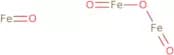
Discontinued productIron oxide black
CAS:Controlled ProductIron oxide black is a reactive dye that is used in wastewater treatment. It is an oxide of iron that can be synthesized from sodium carbonate and langmuir adsorption isotherm. Iron oxide black has been shown to have a colloidal gold-like color, chemical stability, and constant pressure. The particle size of this compound ranges from 10-1000 nm and it reacts with a solution containing anhydrous sodium carbonate to form magnetite nanoparticles. Iron oxide black also has an asymmetric synthesis reaction with ferric chloride and nitric acid, which produces magnetic nanoparticles.
Formula:Fe3O4Purity:Min. 95%Color and Shape:PowderMolecular weight:231.53 g/molRef: 3D-FI41084
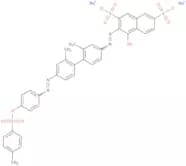
Discontinued productAcid Red 111
CAS:Acid Red 111 is a basic dye that is soluble in water. It has an acid pH, which can be activated by acid catalysts. Acid Red 111 has been shown to be reactive with functional groups and to polymerize with hydroxyl groups. This dye has been shown to have protease activity and potential use as a colorant for polymers. Acid Red 111 has also been found to inhibit the growth of ganoderma lucidum and fatty acids.
Purity:Min. 95%Ref: 3D-FA41265
Discontinued productBP Fluor 488 hydrazide
CAS:Green fluorescent dye used for labelling aldehydes or ketones in polysaccharides or glycoproteins with an excitation peak at 499 nm and an emission peak at 520 nm. Frequently employed in microscopy and flow cytometry.
Formula:C21H16N4O10S2Molecular weight:548.51 g/molRef: 3D-FB184557
Discontinued productDisperse red 277
CAS:Please enquire for more information about Disperse red 277 including the price, delivery time and more detailed product information at the technical inquiry form on this page
Purity:Strength 100%±3%Color and Shape:PowderRef: 3D-FD183458
Discontinued productPigment blue 60 - technical grade
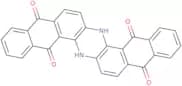
CAS:Pigment blue 60 is a water-soluble dye that is used as a pigment in paints, inks, and textiles. Pigment blue 60 is also used as an indicator of the presence of alkanoic acids in wastewater. The reaction mechanism for the formation of pigment blue 60 has not been fully elucidated; however, it is thought to involve the oxidation of benzalkonium chloride by hydroxyl radicals from hydrogen peroxide. This reaction solution can be analysed using phosphorus pentoxide or nitrogen atoms to determine the quantity of pigment blue 60 present. Pigment blue 60 has been shown to have antibacterial activity against several bacterial strains including Escherichia coli and Staphylococcus aureus. Pigment blue 60 is also used as an analytical method for measuring the amount of oxygen in air or other gasses by reacting with nitrogen oxides at elevated temperatures.
Formula:C28H14N2O4Purity:(With Total Nitrogen) Min. 97.0%Color and Shape:PowderMolecular weight:442.42 g/molSilicon nitride - predominantly β-phase, -325 mesh
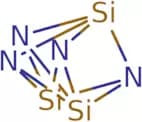
CAS:Silicon nitride is a compound of silicon and nitrogen. It is used in the preparation of high purity silicon, as well as in the production of semiconductors, electronic devices, and other products. Silicon nitride is also used to make parts for aircraft engines and turbines. The thermal expansion coefficient of silicon nitride is typically 5x10⁻⁶/°C, which makes it ideal for use in high-temperature environments. Silicon nitride has antimicrobial properties that may be due to its ability to release hydrogen fluoride and water vapor when heated. These compounds are toxic to bacteria and fungi, making silicon nitride a potential candidate for use in biomedical implants or medical devices such as catheters or prosthetic joints. Silicon nitride is chemically stable at temperatures up to 1000°C, making it an excellent material for high-temperature applications such as aerospace engine components. Silicon nitride can also be used as a sample preparation tool because it can remove impurities from samples without
Formula:N4Si3Purity:Min. 95%Color and Shape:PowderMolecular weight:140.28 g/molRef: 3D-FS168689
Discontinued productTetrabromophenol blue sodium salt
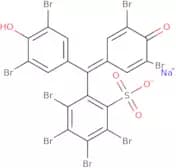
CAS:Tetrabromophenol blue sodium salt is a dye that is used as an additive in the production of vinyl alcohol polymer films. Tetrabromophenol blue sodium salt can be used to measure albumin concentration and postexposure by adding phenyl groups to the molecule. The color of tetrabromophenol blue sodium salt changes upon exposure to radiation, which makes it useful for diagnostic purposes. It also has a hydrocarbon group that transforms into an insoluble form when exposed to evaporation, making it useful for titration methods. Tetrabromophenol blue sodium salt is relatively stable and labile in nature, making it susceptible to techniques such as pyrolysis, oxidation, or reduction.
Formula:C19H5Br8NaO5SPurity:Min. 95%Molecular weight:1,007.53 g/molRef: 3D-FT147404
Discontinued productFluorol yellow 088
CAS:Please enquire for more information about Fluorol yellow 088 including the price, delivery time and more detailed product information at the technical inquiry form on this page
Formula:C22H16OPurity:Min. 95%Molecular weight:296.36 g/molRef: 3D-FF183935
Discontinued productPigment red 48 (C.I. 15865)
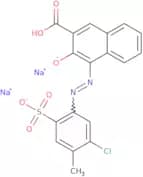
CAS:Pigment Red 48 (C.I. 15865) is a red organic pigment that is soluble in water and most organic solvents. It has a melting point of 200°C and is used in paints, plastics, textiles, paper, and other products. Pigment Red 48 (C.I. 15865) can be synthesized by the diazonium salt coupling reaction between an aromatic amine and an acid chloride. The pigment also has a hydroxyl group that enables it to form covalent bonds with other molecules such as polymers or proteins. Pigment Red 48 (C.I. 15865) is used in many products because of its high stability, excellent heat resistance, low toxicity, non-irritating properties, high transparency, and good color fastness to light and washing.BR> Pigment Red 48 (C.I. 15865) is not considered hazardous according to the Globally Harmonized System of Classification and Lab
Formula:C18H11ClN2Na2O6SPurity:Min. 95%Molecular weight:464.79 g/mol