Dyes, Stains and Tinctures
Subcategories of "Dyes, Stains and Tinctures"
- Acid Dyes(49 products)
- Azobenzenes(270 products)
- Azoic Dyes(7 products)
- Basic Dyes(27 products)
- Coumarin Dyes(72 products)
- Cyanine Dyes, Squarylium Dyes(53 products)
- DCM Dyes(4 products)
- Diarylethenes(12 products)
- Dipyrromethene Dyes(26 products)
- Direct Dyes(17 products)
- Disperse Dyes(2 products)
- Dye Sensitizers(12 products)
- Dyes(418 products)
- Dyes & Stains(911 products)
- Generating Insoluble Dyes(14 products)
- Generating Soluble Dyes(11 products)
- Hexaarylbiimidazole(4 products)
- Indicators(575 products)
- Mordant Dyes(10 products)
- Near-Infrared (NIR) Dyes(28 products)
- Oil Dyes(15 products)
- Other Stains and Dyes(2 products)
- Perylene Dyes(17 products)
- Photochromic Dyes(40 products)
- Phthalocyanine Dyes, Porphyrin Dyes(101 products)
- Quinacridone Dyes(8 products)
- Spiropyrans(16 products)
- Stains and Dyes(243 products)
- Stains and Dyes for Microscopy(5 products)
- Vat Dyes(5 products)
- Xanthene Dyes(67 products)
Found 758 products of "Dyes, Stains and Tinctures"
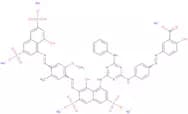
C.I.Direct green 26
CAS:C.I.Direct green 26 is a cationic surfactant that can be used as a dye for diagnostic purposes, as well as an inhibitor for chain reactions. It has been shown to inhibit the process of chondroitin sulfate biosynthesis in cartilage degradation, and has been suggested as a possible treatment for osteoarthritis and other joint diseases. C.I.Direct green 26 has also been shown to have a cytotoxic effect on human leukemia cells in vitro, but not on normal cell lines, suggesting that it may be useful in cancer therapy. C.I.Direct green 26 is soluble in sodium carbonate or sodium hydroxide solution and is activated by radiation energy or heat from sodium hydroxide solution, which can kill bacteria and viruses on surfaces such as glass or stainless steel.
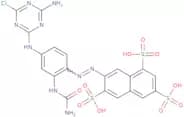
Formula:C50H38N12O18S4•Na5Purity:Min. 95%Color and Shape:PowderMolecular weight:1,338.12 g/molC.I.Reactive Orange 12
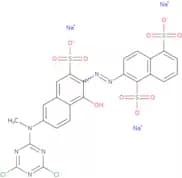
CAS:C.I.Reactive Orange 12 is a reactive dye that belongs to the class of alcohols. It is used in wastewater treatment because it can bind to organic matter, such as polysaccharides and proteins, and has a high affinity for multi-walled carbon. C.I.Reactive Orange 12 is also an active substance that can be used in the production of activated carbon filters for water purification or as a fungicide on fungal biomass. The adsorption mechanism of C.I.Reactive Orange 12 is not yet fully understood, but it has been shown that this compound reacts with methyl glycine under acidic conditions to form an ion pair and then react with activated benzalkonium chloride to form a monolayer on the surface of activated carbon particles, which prevents the adsorption of other substances
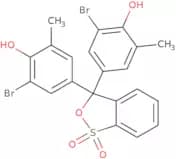
Purity:Min. 95%Bromocresol purple
CAS:Bromocresol purple is a hydrophilic dye that has applications in indicating pH and measuring serum albumin concentrations.
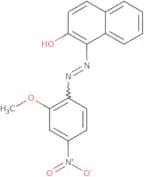
Formula:C21H16Br2O5SPurity:Min. 95%Color and Shape:PowderMolecular weight:540.22 g/molC.I.Solvent Red 13
CAS:Please enquire for more information about C.I.Solvent Red 13 including the price, delivery time and more detailed product information at the technical inquiry form on this page
Purity:Min. 95%C.I.Reactive Orange 4
CAS:C.I.Reactive Orange 4 is a synthetic dye that is used in the textile industry to give colors to fabrics. It is also used as an additive in foods, drugs, and cosmetics. C.I.Reactive Orange 4 is activated by UV irradiation and can be decomposed by wastewater treatment processes such as activated sludge and dyebath with hydrogen peroxide. HPLC analyses suggest that this dye is adsorbed on activated sludge surfaces and can be removed by adsorption kinetic techniques such as the use of a dyebath with hydrogen peroxide.
Purity:Min. 95%Transparent Red Violet R
CAS:Please enquire for more information about Transparent Red Violet R including the price, delivery time and more detailed product information at the technical inquiry form on this page
Purity:Min. 95%Food black 1
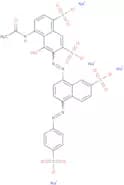
CAS:Food Black 1 is a food additive that is used to dye foods and beverages. It is a dark-colored dye, which can be used to color products such as cakes, soft drinks, ice cream, and cheese. Food Black 1 has been shown to have genotoxic effects and carcinogenic potential in rats; however there are no studies that show it has any carcinogenic properties in humans. There are some concerns about the safety of Food Black 1 in terms of its long-term toxicity, but these have not been confirmed by independent research studies. There are no known cases of adverse reactions to this additive.
Formula:C28H21N5O14S4•Na4Purity:Min. 95%Color and Shape:Brown PowderMolecular weight:871.72 g/molRef: 3D-FF41183
Discontinued productPigment Red 202
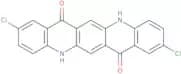
CAS:Pigment Red 202 is a red pigment with a molecular weight of 536. It has a hydroxyl group and two nitrogen atoms, which are responsible for the molecule's stability. Pigment Red 202 has been used as a cross-linking agent in the production of polyester resins or polyurethane coatings because it can form hydrogen bonds. It is also used as an additive to paper and paint to control the rate of drying. Pigment Red 202 is available in crystalline polymorphs, including alpha, beta, gamma, delta, and epsilon forms.
Formula:C20H10Cl2N2O2Purity:Min. 95%Color and Shape:PowderMolecular weight:381.21 g/molRef: 3D-FP41754
Discontinued productDBCO-Cy3 ditriethylamine
CAS:Please enquire for more information about DBCO-Cy3 ditriethylamine including the price, delivery time and more detailed product information at the technical inquiry form on this page
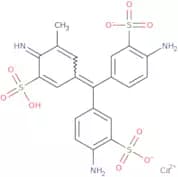
Formula:C50H54N4O11S3•(C6H15N)2Purity:Min. 95%Molecular weight:1,185.56 g/molAcid fuchsin calcium
CAS:Acid fuchsin is a water-soluble, non-toxic, acidic dye that is used in histology to stain connective tissue and mucous membranes. It is used as an indicator for calcium in the presence of acid phosphatase. Acid fuchsin can be detected by light microscopy when it is stained on a section of tissue or cells. This dye can be used with immunocytochemistry or cytogenetics to assess the morphology of cells and tissues. The staining intensity varies according to the concentration of the acid fuchsin solution, which can be quantified by measuring the absorbance at 510 nm. A reference range for this measurement would be 0.1 - 1 μg/ml (10 - 100 μM).
Formula:C20H19N3O9S3·xCaColor and Shape:PowderMolecular weight:541.58 g/molRef: 3D-FA47020
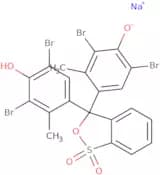
Discontinued productBromocresol green, sodium salt
CAS:Bromocresol green is a dye that is used in biological assays to measure the kinetics of fluorescence. It is a type of tryptophan-releasing compound that releases a yellowish-green light when it absorbs light at wavelengths between 350 and 450 nm. Bromocresol green has been quantified by measuring the intensity of the fluorescence emission as a function of time. This can be done visually or using an instrument called a fluorometer, which detects changes in light intensity over time. Bromocresol green can be used to detect the presence of amino acid residues in proteins through protonation reactions with their tryptophan residues and subsequent quenching with acetonitrile. The bromocresol green dye is also used in lithographic printing, where it serves as an acceptor for electrons from an arene (aromatic hydrocarbon). This process generates energy for lithography and also provides contrast between regions with different electron densities.
Formula:C21H14Br4O5SNaColor and Shape:PowderMolecular weight:721 g/molRef: 3D-FB01465
Discontinued productC.I.Vat green 7
CAS:Please enquire for more information about C.I.Vat green 7 including the price, delivery time and more detailed product information at the technical inquiry form on this page
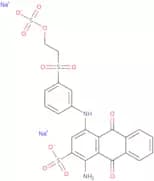
Purity:Min. 95%Reactive Blue 19, Technical grade
CAS:Reactive Blue 19 is a chemical compound that has been used extensively in biological, biochemical, and clinical research. It is a reactive dye with the chemical formula C20H14N2Na4O8S4. The molecule's structure consists of two benzene rings linked by two amine groups, which are connected to an aromatic ring with four sulfonic acid side chains. Reactive Blue 19 has been shown to inhibit the activity of enzymes such as hydroxylase and nitrite reductase. This compound also reacts with protocatechuic acid to form an intense blue-colored complex that can be detected using electrochemical detection.
Formula:C22H16N2Na2O11S3Purity:Min. 95%Color and Shape:PowderMolecular weight:626.55 g/molAcid Black ATT
CAS:Acid Black ATT is a chemical compound that is used to adjust the pH and remove organic matter in wastewater. It is a mixture of trimethyl, collagen, sodium carbonate, calcium carbonate, and sodium chloride. Acid Black ATT can be used as an additive for the treatment of wastewater because it has been shown to inhibit enzymes. This product should be added slowly to water in order to avoid inhaling the vaporized acid. The use of this chemical must be carefully monitored because it can cause corrosion and damage to pipes.
Purity:Min. 95%Acid Orange 95
CAS:Acid Orange 95 is a dye that is used in the textile industry. It is an orange-red liquid and has a pH of 2.0. The dye is soluble in organic solvents and can be analyzed by measuring the diameter of a droplet on a glass slide, which will react with acid to give a pink color. Acid Orange 95 can be used as an initiator for polymerization reactions and has been shown to have reactive properties. The average particle diameter of Acid Orange 95 ranges from 0.5-1 micrometers, with the particle size distribution being bimodal with peaks at 1 micrometer and 3 micrometers.
Purity:Min. 95%Pigment Yellow 108
CAS:Pigment Yellow 108 is a polycarboxylic acid that is used in the production of printing ink, paint, and plastic. It has a molecular weight of 284.40 g/mol and a viscosity of 2.00 cps at 20°C. Pigment Yellow 108 contains a hydroxyl group (-OH), carbonyl group (-CO), aromatic hydrocarbon (benzene ring), and hydrogen chloride (HCl). The reaction products are glycol ester, magnesium oxide, primary amino (-NH2), radiation, thermal expansion, and functional groups (-OH).
Formula:C30H15N3O4Purity:Min. 95%Molecular weight:481.46 g/molAcid blue 62
CAS:Acid blue 62 is a reactive dye that is used in the treatment of wastewater. It is used as a chemical intermediate to produce other dyes and as an ingredient in detergent compositions. Acid blue 62 has been shown to have genotoxic effects and may cause cancer. The potential for acid blue 62 to cause cancer is based on its chemical structure and its ability to form reactive metabolites with DNA, which can lead to the formation of DNA adducts. Acid blue 62 also has the ability to bind strongly to surfaces, which can lead to the formation of particulates or aggregates. The surface methodology suggests that the adsorption process follows a Langmuir adsorption isotherm. This means that there are two equilibrium constants, K1 and K2, where K1 > K2. The higher value of K1 indicates that adsorption will occur at low concentrations while high concentrations will cause desorption. This means that the particle size will increase with increasing concentration until it reaches
Formula:C20H20N2O5S•NaColor and Shape:PowderMolecular weight:423.44 g/molRef: 3D-FA165997
Discontinued productC.I. Solvent blue 68
CAS:C.I. Solvent blue 68 is a reactive dye that is used in the textile industry, as well as for the preparation of medical and biological samples. It has been used in the identification of human serum proteins and for determining their molecular weights. C.I. Solvent blue 68 reacts with a biphenyl derivative to form a quinoline derivative, which is then converted to an electrochemical product by reaction with hydrochloric acid. The CIE color coordinates are: x=0.27, y=0.93 and z=0.01; λmax (ε)=550 nm; εmax (λ)=1×10⁻⁴ cm-1 M-1cm-1; λmin (ε)=490 nm; εmin (λ)=3×10⁻⁵ cm-1 M-1cm-1
Formula:C20H14N2O2Color and Shape:Blue PowderMolecular weight:314.34 g/molC.I.Acid orange 24
CAS:C.I. Acid Orange 24 is an analytical reagent that when added to a sample, it changes and alters the color of the sample. This color change can be used in analytical methods to determine the concentration of certain substances in the sample. C.I. Acid Orange 24 is a colour additive that has been approved for use in food, drugs, cosmetics, and other consumer products by regulatory agencies such as the European Union or United States Food and Drug Administration (FDA).
Formula:C20H17N4NaO5SColor and Shape:PowderMolecular weight:448.43 g/molRef: 3D-FA41253
Discontinued productC.I.Basic Yellow 49
CAS:Please enquire for more information about C.I.Basic Yellow 49 including the price, delivery time and more detailed product information at the technical inquiry form on this page
Purity:Min. 95%