Nucleotides
Nucleotides are organic compounds that serve as the building blocks of nucleic acids, essential for the formation of DNA and RNA. Each nucleotide is composed of a nitrogenous base, a sugar molecule, and one or more phosphate groups. These nucleotides join together to form long chains, creating the genetic material that carries and transmits genetic information in all living organisms. In this section, you will find a wide variety of nucleotides crucial for research in genetics, molecular biology, and biochemistry. They are fundamental for studying genetic processes, synthesizing nucleic acids, and developing diagnostic and therapeutic tools. At CymitQuimica, we offer high-quality nucleotides to support your scientific research and applications, ensuring precision and reliability in your experiments
Subcategories of "Nucleotides"
Found 2638 products of "Nucleotides"
Sort by
Purity (%)
0
100
|
0
|
50
|
90
|
95
|
100
3'-O-Acetyl-2'-deoxycytidine
CAS:3'-O-acetyl-2'-deoxycytidine is an activator that can be used in the synthesis of deoxyribonucleosides and nucleosides. It is a novel, modified, and high purity chemical entity that has shown anticancer and antiviral properties. 3'-O-acetyl-2'-deoxycytidine is a monophosphate nucleotide, which can be used in the synthesis of various pharmaceuticals. This product has been synthesized using high quality reagents in order to provide the best possible product for research purposes.Formula:C11H15N3O5Purity:Min. 95%Color and Shape:White PowderMolecular weight:269.25 g/mol2'-Amino-2'-deoxyuridine
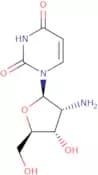
CAS:2'-Amino-2'-deoxyuridine is a modified nucleoside based on uridine. The 2'-hydroxyl group on the sugar is replaced by an amino group. This compound can be used for research purposes
Formula:C9H13N3O5Purity:Min. 98 Area-%Color and Shape:PowderMolecular weight:243.22 g/mol5'-Deoxyadenosine
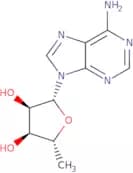
CAS:5'-Deoxyadenosine is a nucleoside that is produced by the enzymatic reaction of glycolaldehyde and ATP. It is found in both DNA and RNA, where it plays an important role in the catalytic subunit of ribonucleotide reductase. 5'-Deoxyadenosine has been shown to be involved in hydrogen bonding with other molecules, such as ethanolamine. It also has a kinetic effect on the enzyme activity of ribonucleotide reductase by forming intramolecular hydrogen bonds with other adenine nucleotides. The analogs of 5'-deoxyadenosine have been shown to inhibit viral replication in cell culture studies using typhimurium virus.Formula:C10H13N5O3Purity:Min. 95%Color and Shape:PowderMolecular weight:251.25 g/mol2'-Deoxyguanosine-5'-monophosphate disodium salt
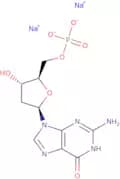
CAS:2'-Deoxyguanosine-5'-monophosphate disodium salt is an inorganic compound that has a furanose ring. It is used as a monofunctional building block for the synthesis of nucleotide derivatives. The conformations of 2'-deoxyguanosine-5'-monophosphate disodium salt are experimentally determined by x-ray data, which shows that the molecule adopts a twisted conformation with two possible orientations: one where the 2'OH group is oriented toward the phosphate group, and another where it is oriented away from it. The nature of these conformers can be confirmed by analyzing their x-ray diffraction patterns.Formula:C10H12N5Na2O7PPurity:Min. 98 Area-%Color and Shape:White PowderMolecular weight:391.19 g/molUridine 5'-triphosphate disodium
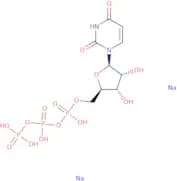
CAS:Uridine 5'-triphosphate disodium salt is a supramolecular complex that binds to gold nanoparticles. The binding of uridine 5'-triphosphate disodium salt to gold nanoparticles can be used for the detection of metal ions through the photometric method. Uridine 5'-triphosphate disodium salt has been shown to inhibit the glutathione-dependent reduction of vitamin B12, which is a key step in methionine synthesis and folate metabolism. This inhibition may lead to a decrease in protein synthesis, ATP production, and cell division.Formula:C9H15N2O15P3•Na2Purity:Min. 95%Color and Shape:PowderMolecular weight:530.12 g/mol2'-Deoxycytidine-5'-monophosphate disodium
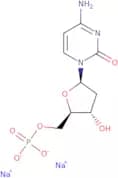
CAS:2'-Deoxycytidine-5'-monophosphate disodium (2DdCMP) is a competitive inhibitor of receptor protein tyrosine kinases. It has been shown to inhibit the growth of various human cancer cell lines in vitro and to reduce tumor size in mice bearing transplanted human tumor xenografts. 2DdCMP inhibits the proliferation of cancer cells by interfering with the expression of growth factors that are involved in mitogenesis. This drug also inhibits the growth of new blood vessels, which is essential for tumor formation and progression. 2DdCMP binds to an allosteric site on receptor molecules, thereby blocking the binding site of other proteins such as growth factors and kinases that may be involved in tumorigenesis.Formula:C9H12N3O7PNa2Purity:Min. 95%Color and Shape:White PowderMolecular weight:351.16 g/molDecitabine
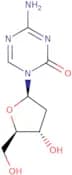
CAS:A synthetic cytosine analogue that incorporates into DNA and prevents DNA methylation via DNA (cytosine-5)-methyltransferase 1 (DNMT1) inhibition. Demonstrated potent anti-leukaemic effects attributed to cell cycle arrest and induction of apoptosis. Has anti-growth effects on solid tumor cell lines.
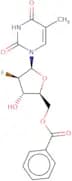
Formula:C8H12N4O4Purity:Min. 98 Area-%Color and Shape:White PowderMolecular weight:228.21 g/mol1-(5'-O-Benzoyl-2'-deoxy-2'-fluoro-beta-L-arabinofuranosyl)thymine
CAS:1-(5'-O-Benzoyl-2'-deoxy-2'-fluoro-β-L-arabinofuranosyl)thymine is a modified nucleoside analog with structural modifications that enhance its biological properties, stability, and pharmaceutical potential. The compound features thymine (5-methyluracil) as the nucleobase, a pyrimidine derivative. The sugar component is 2'-deoxy-2'-fluoro-β-L-arabinofuranose, which includes the L-arabinose configuration, a departure from the natural D-ribose or D-deoxyribose configuration typically found in DNA and RNA, influencing how the molecule is recognized by biological systems. The 2'-fluoro substitution at the sugar position improves the compound's stability and resistance to enzymatic degradation, while also potentially enhancing its antiviral activity. A 5'-O-benzoyl group serves as a protecting group, safeguarding the 5'-hydroxyl group during synthesis.Formula:C17H17FN2O6Purity:Min. 95%Molecular weight:364.33 g/mol2',3'-Dideoxyuridine-5'-triphosphate lithium - 100mM aqueous solution
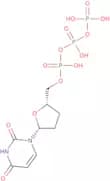
CAS:2',3'-Dideoxyuridine-5'-triphosphate can be used with uracil DNA glycosylase to minimize PCR carryover contamination and enables the kinetics of deoxyuridine 5′-triphosphate nucleotidohydrolases to be investiagated.Formula:C9H15N2O13P3•LixPurity:Min. 95%Color and Shape:Clear LiquidMolecular weight:452.14 g/mol6-Thio-9-(β-D-arabinofuranosyl)purine
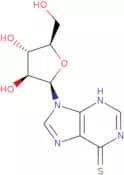
CAS:6-Thio-9-(b-D-arabinofuranosyl)purine is a purine analog that inhibits the enzyme uridine phosphorylase, which is involved in the metabolism of uridine. It has been shown to inhibit the growth of L1210 cells and also to be effective against subcutaneous tumors in mice. 6-Thio-9-(b-D-arabinofuranosyl)purine is active against schistosomiasis in mice, with an LD50 of 1 mg/kg. This drug has also been shown to have potential antitumor activity and was able to inhibit the growth of human lymphocytes and leukocytes.Formula:C10H12N4O4SPurity:Min. 95%Color and Shape:PowderMolecular weight:284.29 g/mol9-(b-D-Arabinofuranosyl)guanine - Bio-X ™
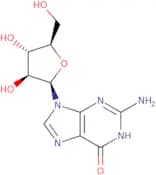
CAS:9-(b-D-Arabinofuranosyl) guanine is a purine nucleoside in which guanine is attached to arabinofuranose via a beta-N(9)-glycosidic bond. 9-(b-D-Arabinofuranosyl) guanine binds to the phosphate groups in DNA and inhibits the synthesis of DNA causing cell death. It also has antineoplastic properties.Formula:C10H13N5O5Purity:Min. 95%Color and Shape:PowderMolecular weight:283.24 g/molInosine 5'-diphosphate trisodium
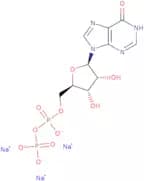
CAS:Inosine 5'-diphosphate trisodium salt is an antiviral compound that is used to inhibit the replication of many viruses, including herpes, influenza, and HIV. It has been shown to be effective against cancer cells in vitro. Inosine 5'-diphosphate trisodium salt is a modified nucleotide that is used as a phosphoramidite for DNA synthesis. This compound can also be used as an activator for deoxyribonucleoside triphosphates. It has been shown to have anticancer activity in vivo and in vitro and also inhibits viral DNA synthesis by preventing the formation of ribonucleotide triphosphates from ribonucleotides. The molecular weight of this compound is 390.4 g/mol and its CAS number is 81012-88-6.Formula:C10H11N4O11P2•Na3Purity:Min. 95%Color and Shape:PowderMolecular weight:494.13 g/mol2'-Azido-2'-deoxyuridine
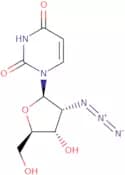
CAS:2'-Azido-2'-deoxyuridine is a synthetic nucleoside analog of uridine in which the 2'-hydroxyl group on the ribose sugar is replaced with an azido group (–N₃), and the base is unmodified uracil. This modification alters the sugar's conformation and chemical reactivity, enabling the use of this analog in bioorthogonal labeling strategies, particularly through azide-alkyne "click" chemistry. Its incorporation into nucleic acids can influence polymerase recognition and chain elongation, making it a useful probe in studies of RNA synthesis, structure, and function.Formula:C9H11N5O5Purity:Min. 98 Area-%Color and Shape:White Off-White PowderMolecular weight:269.21 g/molAcetyl hypoxanthine
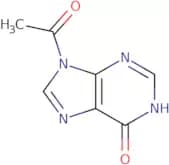
CAS:Acetyl hypoxanthine is an inorganic compound that has a cyclophosphate group. It can be synthesized from the reaction of acetic acid and 6-chloropurine, which is activated with trifluoroacetic acid and irradiated with ultraviolet light. Acetyl hypoxanthine can then be synthesized by ammonolysis of chloroacetone using ammonia or by chlorinating acetylene with chlorine. The advantages of this compound are its high yield and low cost.Formula:C7H6N4O2Purity:Min. 95 Area-%Color and Shape:PowderMolecular weight:178.15 g/molCladribine
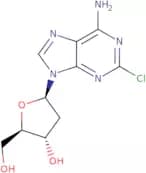
CAS:Deoxyadenosine analog resistant to adenosine deaminase
Formula:C10H12ClN5O3Purity:Min. 97 Area-%Color and Shape:PowderMolecular weight:285.69 g/molGemcitabine base
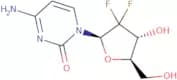
CAS:Gemcitabine is a prodrug that is converted to 5-fluorouracil (5FU) in the body. It has been shown to inhibit the growth of bladder and pancreatic cancer cells by interfering with the synthesis of DNA. Gemcitabine inhibits DNA replication by binding to the epidermal growth factor receptor, which leads to cell death. Gemcitabine also acts as a competitive inhibitor of deoxycytidine kinase, which prevents the formation of deoxycytidine monophosphate from deoxyuridine monophosphate, preventing DNA replication. In addition, gemcitabine can activate apoptosis in some tumor cells by increasing levels of intracellular free calcium, which leads to activation of enzymes such as phospholipases and proteases that degrade proteins, lipids, and nucleic acids.Formula:C9H11F2N3O4Purity:Min. 98 Area-%Color and Shape:White PowderMolecular weight:263.2 g/mol2’-Deoxy-2’-fluorouridine 5’-monophosphate triethyl ammonium
2’-Deoxy-2’-fluorouridine 5’-monophosphate triethyl ammonium is a fluorinated nucleotide analog used in biochemical and medicinal researchFormula:C9H12FN2O8P•C6H15NPurity:Min. 95%Color and Shape:PowderMolecular weight:427.36 g/molDihydrozeatin riboside
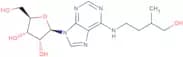
CAS:Dihydrozeatin riboside is a cytokinin, a group of plant hormones that regulate various aspects of plant growth and development. It is found in the form of an ester, dihydrozeatin riboside, which is produced by the action of trifluoroacetic acid on zeatin. The natural function of this hormone is to stimulate cell division in plants, but it has also been shown to have antibacterial effects against bacterial strains such as Bacillus subtilis and Escherichia coli. Dihydrozeatin riboside inhibits bacterial growth by binding to DNA-dependent RNA polymerase, thereby preventing transcription and replication. The high frequency of human activity has been shown using a patch-clamp technique on human erythrocytes. This active form is metabolized through a number of metabolic transformations, including hydrolysis by esterases or glucuronidases, oxidation by cytochrome P450 enzymes, reductionFormula:C15H23N5O5Purity:Min. 95%Color and Shape:PowderMolecular weight:353.37 g/molN4-Benzoylcytidine
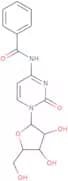
CAS:N4-Benzoylcytidine is a nucleoside that is used as part of the synthesis of the antiviral drug acyclovir. It is synthesized by reacting uridine with benzoyl chloride in a solid-phase synthesis. N4-Benzoylcytidine has shown to inhibit the growth of virus type-1 and other viruses, including those that cause herpes simplex and varicella zoster. This nucleoside also inhibits epidermal growth factor (EGF) and is a hybridization probe for human immunodeficiency virus (HIV). The benzoate group on this compound reacts with hydroxyl groups on proteins, which may be why it has been shown to stimulate epidermal growth in mammalian cells.Formula:C16H17N3O6Purity:Min. 98 Area-%Color and Shape:White PowderMolecular weight:347.32 g/mol5'-Ethylcarboxamidoadenosine
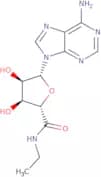
CAS:5'-Ethylcarboxamidoadenosine (5-ECA) is an adenosine receptor antagonist that is used as a radioligand to study the binding of adenosine and other nucleotides to their receptors. 5-ECA binds to the A3 receptor, which is a member of the G protein-coupled receptor family. This compound also inhibits platelet aggregation and has been shown to have anti-inflammatory effects in mice with colon cancer. 5-ECA was found to inhibit tumor growth in a mouse model system by suppressing IL-2 production and reducing levels of PGE2, an effect that may be due to inhibition of cyclase activity. 5-ECA can be used in vitro for studies on pluripotent cells because it does not affect their ability to differentiate.Formula:C12H16N6O4Purity:Min. 95%Color and Shape:White PowderMolecular weight:308.29 g/mol