Monosaccharides
Monosaccharides are the simplest form of carbohydrates and serve as fundamental building blocks for more complex sugars and polysaccharides. These single sugar molecules play critical roles in energy metabolism, cellular communication, and structural components of cells. In this section, you will find a wide variety of monosaccharides essential for research in biochemistry, molecular biology, and glycoscience. These compounds are crucial for studying metabolic pathways, glycosylation processes, and developing therapeutic agents. At CymitQuimica, we offer high-quality monosaccharides to support your research needs, ensuring precision and reliability in your scientific investigations.
Subcategories of "Monosaccharides"
- Alloses(11 products)
- Arabinoses(21 products)
- Erythroses(11 products)
- Fructoses(9 products)
- Fucoses(36 products)
- Galactosamine(41 products)
- Galactose(261 products)
- Glucoses(365 products)
- Glucuronic Acids(51 products)
- Glyco-substrates for Enzyme(77 products)
- Guloses(6 products)
- Idoses(4 products)
- Inositols(15 products)
- Lyxoses(4 products)
- Mannoses(65 products)
- O-Glycans(48 products)
- Psicoses(3 products)
- Rhamnoses(10 products)
- Riboses(61 products)
- Sialic Acids(100 products)
- Sorboses(4 products)
- Sugars(173 products)
- Tagatoses(4 products)
- Taloses(8 products)
- Xyloses(20 products)
Show 17 more subcategories
Found 6088 products of "Monosaccharides"
Sort by
Purity (%)
0
100
|
0
|
50
|
90
|
95
|
100
2-Azido-2-deoxy-2,4-di-C-methyl-L-lyxono-1.4-lactone
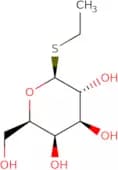
<p>2-Azido-2-deoxy-2,4-di-C-methyl-L-lyxono-1.4-lactone is a synthetic sugar that belongs to the group of carbohydrates. It is a monosaccharide that has been modified with fluorination and glycosylation. This carbohydrate has also been methylated, which makes it useful for click chemistry reactions. 2-Azido-2-deoxy-2,4-diCmethyl L -lyxono 1,4 -lactone is used in the synthesis of complex carbohydrates and oligosaccharides.<br>!--END--></p>Purity:Min. 95%Ethyl b-D-thiogalactopyranoside
CAS:<p>Synthetic building block</p>Formula:C8H16O5SPurity:Min. 95%Color and Shape:White PowderMolecular weight:224.28 g/mol6-Deoxy-a-D-talose
CAS:<p>6-Deoxy-a-D-talose is a non-reducing sugar. It is used in the synthesis of glycosides and polysaccharides. 6-Deoxy-a-D-talose is hydrolyzed by esterases or glucuronidases, oxidized by cytochrome P450 enzymes, reduced by glutathione reductase, or conjugated with glucuronic acid.</p>Formula:C6H12O5Purity:Min. 95%Color and Shape:PowderMolecular weight:164.16 g/molD-Glucose-6-phosphate - 1M, in H2O
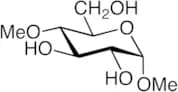
CAS:<p>Glucose 6-phosphatase substrate</p>Formula:C6H13O9PPurity:Min. 95%Color and Shape:Colorless Clear LiquidMolecular weight:260.14 g/molMethyl 4-O-methyl-α-D-glucopyranoside
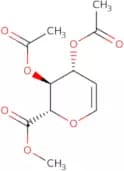
CAS:<p>Methyl 4-O-methyl-α-D-glucopyranoside is a methyl glucoside analogue</p>Formula:C8H16O6Purity:Min. 95%Color and Shape:PowderMolecular weight:208.21 g/molMethyl 3,4-di-O-acetyl-D-glucuronal
CAS:<p>Methyl 3,4-di-O-acetyl-D-glucuronal is a sugar that has been synthesized in the laboratory. It is a functional sugar that can be used as a building block for other sugars. The conformation of this molecule was determined by conformational studies. This molecule has two benzyl groups that are oriented in different ways, which simplifies the parameters for this compound. Methyl 3,4-di-O-acetyl-D-glucuronal is an anomeric sugar and can be found in the pyranose ring. Methyl 3,4-di-O-acetyl-D-glucuronal also has a conformational theory that was developed to optimize its orientations and predict its geometries.</p>Formula:C11H14O7Purity:Min. 95%Color and Shape:White PowderMolecular weight:258.22 g/mol1,2,3,4-Tetra-O-acetyl-6,7-dideoxy-L-galacto-hept-6-enopyranose
CAS:<p>1,2,3,4-Tetra-O-acetyl-6,7-dideoxy-L-galacto-hept-6-enopyranose is a custom synthesis for the modification of saccharides. This compound has high purity and is synthesized by methylation of 1,2,3,4 tetra O acetyl 6,7 dideoxy L galacto hept 6 enopyranose with acetic anhydride and pyridine. The CAS number for this compound is 1193251-65-8.</p>Purity:Min. 95%Methyl 3,5-di-O-acetyl-2,4-anhydro-D-arabinonate
<p>Methyl 3,5-di-O-acetyl-2,4-anhydro-D-arabinonate is a custom synthesis of a complex carbohydrate. It is modified with methylation, glycosylation and click modification. This product has been fluorinated to provide high purity and is used in the preparation of other saccharides. Methyl 3,5-di-O-acetyl-2,4-anhydro-D-arabinonate belongs to the category of carbohydrates and sugars. This product is made up of a saccharide that contains three carbon atoms (C3H7O6) and one oxygen atom (O). The chemical formula for this compound is C3H5(COOC2H5)3.</p>Purity:Min. 95%D-myo-Inositol 1,4,6-triphosphate sodium salt
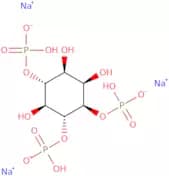
CAS:<p>D-myo-Inositol 1,4,6-triphosphate sodium salt (DMIPS) is an alkaline polymer. It is a high capacity, rechargeable electrode material that can be used in electrochemical cells. DMIPS has been shown to have the highest energy density and power density of any known polymer and can operate at low temperatures. This material has been shown to be effective in polymer electrolyte membrane fuel cells, as well as being used as a separator in lithium ion batteries.</p>Formula:C6H12O15P3·xNaPurity:Min. 95%Molecular weight:417.07 g/mol5-O-tert-Butyldimethylsilyl-N-cyanomethyl-1,4-dideoxy-1,4-imino-2,3-O-isopropylidene-D-ribitol
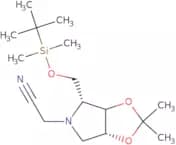
CAS:<p>5-O-tert-Butyldimethylsilyl-N-cyanomethyl-1,4-dideoxy-1,4-imino-2,3-O-isopropylidene--D ribitol is a fluorinated glycosylation product of 5-(O-(tertbutyldimethylsilyl)cyanomethyl)-1,4 dihydroxy imino 2,3 O isopropylidene D ribitol. It is a high purity complex carbohydrate that can be synthesized by click modification of 5-(O-(tertbutyldimethylsilyl)cyanomethyl)-1,4 dihydroxy imino 2,3 O isopropylidene D ribitol with ethynyltrifluoroborate and osmium tetroxide. This compound has CAS No. 577978-59-7.</p>Formula:C16H30N2O3SiPurity:Min. 95%Molecular weight:326.51 g/molTrehalose octaacetate
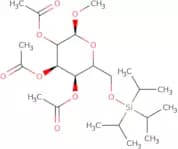
CAS:<p>Trehalose octaacetate is a carbohydrate that can be synthesized from trehalose and acetyl coenzyme A. It has been shown to act as an enzymatic substrate and a carbon source in the production of microparticles. Trehalose octaacetate is an antigenic molecule that can be used as a vaccine adjuvant to enhance the immune response to antigens. It also exhibits anti-inflammatory properties, which may be due to its ability to inhibit prostaglandin synthesis. Trehalose octaacetate is highly viscous, which makes it useful for the formulation of medications such as eye drops.</p>Formula:C28H38O19Purity:Min. 95%Molecular weight:678.59 g/molMethyl 2,3,4-tri-O-acetyl-6-O-triisopropylsilyl-a-D-glucopyranoside
CAS:<p>Methyl 2,3,4-tri-O-acetyl-6-O-triisopropylsilyl-a-D-glucopyranoside is a glycosylation product of D-glucose and methyl 2,3,4,6 triacetate. This product is a fluorinated sugar with the following chemical structure:</p>Formula:C22H40O9SiPurity:Min. 95%Molecular weight:476.64 g/mol(2R, 3R, 4R, 5S) -3, 4, 5- Trihydroxy- N- methyl- 2- piperidinecarboxamid e
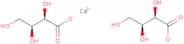
CAS:<p>(2R, 3R, 4R, 5S) -3, 4, 5- Trihydroxy- N- methyl- 2- piperidinecarboxamide is a synthetic compound that can be used in the synthesis of complex carbohydrates. This compound is fluorinated at the C4 position and glycosylated at the C5 position to make it more stable. It is also methylated at the C6 position and modified by Click chemistry to make it easier to synthesize. The sugar chain has a polysaccharide structure with oligosaccharides linked through alpha 1,6 linkages. This sugar chain is then modified by oxidation of its terminal hydroxyl group to produce a reactive aldehyde that reacts with an amine on an adjacent saccharide unit. This process results in the formation of an alpha 1,2 linkage between two saccharides units.</p>Formula:C7H14N2O4Purity:Min. 95%Molecular weight:190.2 g/molCalcium L-threonate
CAS:<p>Calcium L-threonate is a four carbon monosaccharide</p>Formula:C8H14CaO10Purity:Min. 98 Area-%Color and Shape:PowderMolecular weight:310.27 g/mol5-Keto-D-gluconic acid hemicalcium salt
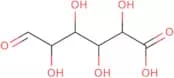
CAS:<p>5-Keto-D-gluconic acid hemicalcium salt (5KDG) is an intermediate in the pentose phosphate pathway. It is a molecule that contains five carbon atoms, one double bond, and two hydroxyl groups. 5KDG has been found to be an effective inhibitor of gluconobacter, a type of bacteria which produces D-gluconic acid. The enzyme 5KDG dehydrogenase catalyzes the conversion of 5KDG into D-gluconate. 5KDG has been shown to have antiepileptic effects and can be used for the treatment of epilepsy.</p>Formula:C6H9O7CaPurity:Min. 95%Color and Shape:PowderMolecular weight:213.17 g/molL-Iduronic acid
CAS:<p>L-Iduronic acid is a monosaccharide that is a component of the glycosaminoglycans. It is a sodium ion salt, which can be found in the extracellular matrix as part of the glycosaminoglycan heparan sulfate. Iduronic acid has been shown to have hypoglycemic effects in rats and mice and inhibitory properties against human osteosarcoma cells. L-Iduronic acid inhibits the synthesis of methyl glycosides by inhibiting the enzyme glucosyltransferase, which catalyzes the formation of glucuronoxylorxylan from glucose and xylose. The oligosaccharides are composed of iduronic acid units linked by α-1,4 linkages with β-1,4 linkages between adjacent iduronic acid units. The conformational properties of iduronic acid have been analyzed using X-ray crystallography and nuclear magnetic resonance spectroscopy (NMR</p>Formula:C6H10O7Purity:Min. 98 Area-%Color and Shape:White PowderMolecular weight:194.14 g/molDulcitol
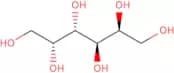
CAS:<p>A metabotoxin, a neurotoxin, and a hepatotoxin at high levels</p>Formula:C6H14O6Purity:Min. 98 Area-%Color and Shape:White PowderMolecular weight:182.17 g/mol4-Aminophenyl β-D-thiogalactopyranoside
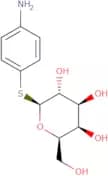
CAS:<p>4-Aminophenyl β-D-thiogalactopyranoside is a custom synthesis of a fluorinated saccharide. It is an oligosaccharide that has been modified with a click modification, which is an atom transfer radical polymerization. The chemical name for 4-aminophenyl β-D-thiogalactopyranoside is 2,5-difluorobenzoyl-(1→4)-4-(4'-aminophenoxy)butyryl-(1→2)-β-D-thiogalactopyranoside. The CAS number for 4-aminophenyl β-D-thiogalactopyranoside is 29558-05-2. This product has high purity and can be used as a substitute for saccharides in the synthesis of polysaccharides or oligosaccharides.</p>Formula:C12H17NO5SPurity:Min. 95%Color and Shape:PowderMolecular weight:287.33 g/mol2-Acetamido-2-deoxy-b-D-glucopyranosyl azide
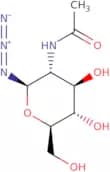
CAS:<p>2-Acetamido-2-deoxy-b-D-glucopyranosyl azide is a biodegradable, environmentally oriented compound that has been shown to be compatible with polylactic acid. This compound has shown unevenness in the hydroxy group and a functional group sensitive to hydrolysis. The molecular weight of 2-acetamido-2-deoxy-b-D-glucopyranosyl azide is 154.14 g/mol. It is soluble in water and has a natural environment frequency of 0.0005%.</p>Formula:C8H14N4O5Purity:Min. 95 Area-%Color and Shape:White PowderMolecular weight:246.22 g/mol1-Deoxy-1-nitro-D-iditol hemihydrate
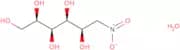
CAS:<p>1-Deoxy-1-nitro-D-iditol hemihydrate is a glycoconjugate that is used in the synthesis of complex carbohydrates, such as glycosylation and methylation. The chemical structure consists of a hydroxyl group linked to an alpha carbon atom with a terminal nitro group. 1-Deoxy-1-nitro-D-iditol hemihydrate can be used for fluorination, saccharide, or modification reactions. It is also used in the synthesis of oligosaccharides and monosaccharides. This product has CAS No. 96613-89-7 and is available in high purity.</p>Formula:C6H13NO7H2OPurity:Min. 95%Molecular weight:220.18 g/mol