


Monosaccharides
Monosaccharides are the simplest form of carbohydrates and serve as fundamental building blocks for more complex sugars and polysaccharides. These single sugar molecules play critical roles in energy metabolism, cellular communication, and structural components of cells. In this section, you will find a wide variety of monosaccharides essential for research in biochemistry, molecular biology, and glycoscience. These compounds are crucial for studying metabolic pathways, glycosylation processes, and developing therapeutic agents. At CymitQuimica, we offer high-quality monosaccharides to support your research needs, ensuring precision and reliability in your scientific investigations.
Subcategories of "Monosaccharides"
- Alloses(11 products)
- Arabinoses(21 products)
- Erythroses(11 products)
- Fructoses(9 products)
- Fucoses(36 products)
- Galactosamine(41 products)
- Galactose(260 products)
- Glucoses(365 products)
- Glucuronic Acids(51 products)
- Glyco-substrates for Enzyme(77 products)
- Guloses(6 products)
- Idoses(4 products)
- Inositols(15 products)
- Lyxoses(4 products)
- Mannoses(65 products)
- O-Glycans(48 products)
- Psicoses(3 products)
- Rhamnoses(10 products)
- Riboses(61 products)
- Sialic Acids(100 products)
- Sorboses(4 products)
- Sugars(173 products)
- Tagatoses(4 products)
- Taloses(8 products)
- Xyloses(20 products)
Show 17 more subcategories
Found 6088 products of "Monosaccharides"
Sort by
Purity (%)
0
100
|
0
|
50
|
90
|
95
|
100
2-Bromoethyl 2,3,4,6-tetra-O-acetyl-b-D-glucopyranoside
CAS:<p>2-Bromoethyl 2,3,4,6-tetra-O-acetyl-b-D-glucopyranoside is a modified form of D-(+)-glucose. The modification has been accomplished through the use of a click chemistry reaction with an azide and alkyne. This product is offered for custom synthesis and can be used in glycosylation reactions.</p>Formula:C16H23BrO10Purity:Min. 95%Molecular weight:455.25 g/molBenzyl b-D-xylopyranoside
CAS:<p>Benzyl b-D-xylopyranoside is an inorganic compound that is used as a radioactive tracer to study the movement of fluid and macromolecules in the apical membrane of the chondrocyte. It was shown to be effective in preventing the formation of tissue-damaging acute phase proteins when administered at a time point corresponding to the onset of an acute inflammatory response. Benzyl b-D-xylopyranoside has also been shown to have regulatory effects on untreated control cells, but not on untreated control cells. This drug inhibits biosynthesis of GAGs, which are molecules that provide structural support for cells and tissues. The mechanism by which benzyl b-D-xylopyranoside exerts its effect is not yet known.</p>Formula:C12H16O5Purity:Min. 95%Molecular weight:240.25 g/molFusidic acid acyl glucuronide
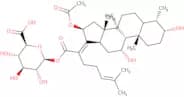
CAS:<p>Fusidic acid acyl glucuronide is a high purity, custom synthesis, click modification of fusidic acid. It has been modified by fluorination and methylation. Fusidic acid acyl glucuronide is an Oligosaccharide, Polysaccharide, saccharide, sugar with a CAS No. 13013-66-6. It is a complex carbohydrate that has been synthesized using high purity, monosaccharides and polysaccharides.</p>Formula:C37H56O12Purity:Min. 95%Molecular weight:692.83 g/molPentaric acid
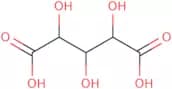
CAS:<p>Pentaric acid is a crystalline, monocarboxylic acid with a hydroxyl group. It is used as an inhibitor of corrosion in metal and as a disinfectant. Pentaric acid can be found in urine samples and has been shown to be an effective inhibitor of the enzymatic reaction that produces azobenzene, which is associated with the development of bladder cancer. This compound also inhibits the growth of bacteria. Pentaric acid is used as an additive in some detergents and soaps because it can inhibit the growth of bacteria on surfaces. <br>Pentaric acid was first synthesized by German chemist Otto Wohlert in 1834. Hydrogen ions are released when pentaric acid dissolves in water, lowering the pH level and causing corrosion to metal surfaces. The corrosion inhibition properties of pentaric acid have been known since its discovery, but its anti-bacterial properties were not discovered until recently when researchers found that pentar</p>Formula:C5H8O7Purity:Min. 95%Molecular weight:180.11 g/molScopoletin b-D-glucuronide
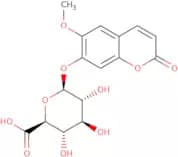
CAS:<p>Scopoletin b-D-glucuronide is a synthetic compound that is modified by the addition of a fluorine atom to the methyl group in scopoletin. Scopoletin b-D-glucuronide has shown antiviral activity against herpes simplex virus type 1 and 2, with an IC50 value of 1.6 μM. It also has antiviral activity against HIV type 1 and HIV type 2, with an IC50 value of 0.5 μM. This compound also inhibits viral DNA synthesis, which may be due to its inhibition of host cell protein synthesis and subsequent inhibition of viral protein synthesis. Scopoletin b-D-glucuronide has been shown to have anti-inflammatory effects in a mouse model for rheumatoid arthritis, and it may be due to its suppression of prostaglandin synthesis or interference with leukocyte chemotaxis.</p>Formula:C16H16O10Purity:Min. 95%Molecular weight:368.29 g/molNaltrexone 3-D-glucuronide-D4
<p>Naltrexone 3-D-glucuronide-D4 is a carbohydrate. It is a glycosylation product of naltrexone. The compound has been synthesized by the methylation of naltrexone and the glycosylation of the resultant product with glucose. Naltrexone 3-D-glucuronide-D4 is a high purity, custom synthesis, synthetic carbohydrate with a CAS number.</p>Purity:Min. 95%Ethyl b-D-fructofuranoside
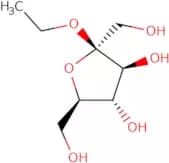
CAS:<p>Ethyl b-D-fructofuranoside is a synthetic compound that is used in the synthesis of oligosaccharides and polysaccharides. It can be custom synthesized to suit the needs of the customer. This product is available for sale as a white powder with a purity of at least 99%.</p>Formula:C8H16O6Purity:Min. 95%Molecular weight:208.21 g/mol(-)-Lyoniresinol 9'-O-glucoside
CAS:<p>This chemical is a custom synthesis of (-)-Lyoniresinol 9'-O-glucoside. The chemical is a modification of (-)-Lyoniresinol 9'-O-glucoside and fluorinated at the C2 position. It is also methylated on the C3 position. The chemical is synthesized by click chemistry, which involves the use of copper(II) ions as catalysts to generate covalent bonds between two molecules. This chemical has been shown to be an oligosaccharide with saccharide chains that are linked together by glycosylation. There are six sugar residues in this compound: glucose, galactose, rhamnose, xylose, glucuronic acid, and mannitol. This compound has CAS number 143236-02-6 and molecular weight of 881.5 g/mol (CAS No.).</p>Formula:C28H38O13Purity:Min. 95%Molecular weight:582.59 g/mol1,2,3,4-Tetra-O-acetyl-D-xylopyranose
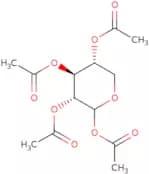
CAS:<p>1,2,3,4-Tetra-O-acetyl-D-xylopyranose is a molecule that is derived from D-xylose. It has been shown to inhibit the growth of fungi such as T. rubrum and L. candidum by acetylation of l-threonine at the C2 position. This molecule can be recycled and its inhibitory activity can be increased through acetylation of the hydroxymethyl group on the C4 position. The mechanism of inhibition is not known but it may be due to steric hindrance or peracylation.</p>Formula:C13H18O9Purity:Min. 95%Molecular weight:318.28 g/molEthyl a-D-thiomannopyranoside
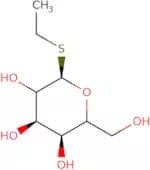
CAS:<p>Ethyl a-D-thiomannopyranoside is an oligosaccharide that is synthesized by the methylation of a-D-mannopyranoside. This product is also known as 3,6-O-(2-acetamido)-a-D-glucopyranose, which is a type of saccharide. It has been fluorinated for use in structural studies. The modification of this product includes click chemistry and glycosylation to produce a complex carbohydrate with high purity and high molecular weight. The monosaccharides include glucose, galactose, and mannose. This product has been used as a synthetic sugar to produce oligosaccharides or polysaccharides.</p>Formula:C8H16O5SPurity:Min. 95%Molecular weight:224.28 g/molD-Arabino-5-hexulosonic acid
CAS:<p>D-Arabino-5-hexulosonic acid is an intermediate in the pentose phosphate pathway. It is a component of the hexuronate, which is an important precursor for galactitol, 6-phosphate, and acid dehydrogenase. D-Arabino-5-hexulosonic acid is also an important intermediate in the glycolytic pathway for ATP production. The gene product has been shown to be involved in aerobic glycolysis, which is utilized by Staphylococcus aureus to produce energy from glucose fermentation. D-Arabino-5-hexulosonic acid plays a role in ion exchange and mitochondrial metabolism as well.</p>Formula:C6H10O7Purity:Min. 95%Molecular weight:194.14 g/mol2,3,5-Tri-O-benzoyl-b-D-ribofuranose
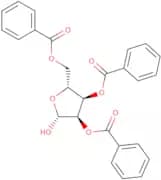
CAS:<p>2,3,5-Tri-O-benzoyl-b-D-ribofuranose is a custom synthesis of an oligosaccharide. It has been modified with fluorination and methylation. This is a synthetic carbohydrate that belongs to the class of saccharides. It has been synthesized from a monosaccharide and has glycosylation. The chemical formula for 2,3,5-Tri-O-benzoyl-b-D-ribofuranose is C10H14O7.</p>Formula:C26H22O8Purity:Min. 95%Molecular weight:462.45 g/molN-Nonyldeoxygalactonojirimycin
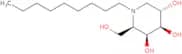
CAS:<p>N-Nonyldeoxygalactonojirimycin (NDGJ) is a novel antiviral agent that inhibits the activity of viral enzymes, such as polymerase chain reaction and reverse transcriptase. NDGJ has been shown to inhibit the replication of hepatitis viruses in primary cells and human macrophages. The drug also inhibits the replication of human pathogens, such as HIV-1, herpes simplex virus type 1, and cytomegalovirus in cell culture. NDGJ has an effect on hydrophobic amino acids in protein synthesis by binding to them and preventing their attachment to the ribosomal surface. This leads to cell lysis through a process called osmotic shock.</p>Formula:C15H31NO4Purity:Min. 95 Area-%Color and Shape:White Off-White PowderMolecular weight:289.41 g/molUDP-β-D-glucose sodium
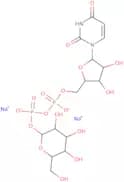
CAS:<p>UDP-β-D-glucose sodium is an oligosaccharide that can be used to synthesize glycoproteins and glycolipids. UDP-β-D-glucose sodium is a synthetic compound that contains one β-D-glucose moiety, which is attached to the molecule via a β-(1→4) linkage. This product can be custom synthesized and modified to suit customer needs. It has been shown to have high purity, chemical stability, and good solubility in water. The synthesis of UDP-β-D-glucose sodium has been modified by click chemistry to produce a variety of different products with new properties.</p>Formula:C15H22N2Na2O17P2Purity:Min. 95%Color and Shape:PowderMolecular weight:610.27 g/molPalatinose monohydrate
CAS:<p>Palatinose monohydrate is a hydrogenated form of the natural disaccharide palatinose. It is often used as a solid catalyst in pharmaceutical preparations and has been shown to have a lower molecular weight than sucrose. Palatinose monohydrate may have beneficial effects on postprandial plasma glucose, protein data, and lipid metabolism. The hydrogenation process also produces fatty acids that are less reactive than those found in other sugars. Amine groups are also reduced in palatinose monohydrate, which may improve its taste. Palatinose monohydrate is not toxic at high doses and has been shown to be safe for use in toxicity studies. Surface methodology has been used to characterize the surface properties of palatinose monohydrate crystals, which can be used as a model for other sugar crystals.</p>Formula:C12H24O12Purity:Min. 95%Molecular weight:360.31 g/mol1,3,6-Tri-O-acetyl-2,4-dideoxy-2-phthalimido-b-D-glucopyranose
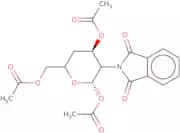
CAS:<p>1,3,6-Tri-O-acetyl-2,4-dideoxy-2-phthalimido-b-D-glucopyranose is a modification of the sugar molecule. This product is a custom synthesis and can be used in research to synthesize complex carbohydrates. It is also a synthetic carbohydrate that has been fluorinated and saccharides have been methylated and glycosylated. It has CAS No. 1260591-45-4 and can be used as a monosaccharide or polysaccharide.</p>Formula:C20H21NO9Purity:Min. 95%Molecular weight:419.38 g/molNicotine-N-b-D-glucuronide hydrate
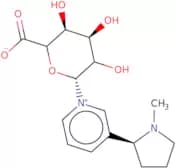
CAS:<p>Nicotine-N-b-D-glucuronide hydrate is a metabolite of nicotine that is excreted in the urine as an organic anion. It has been shown to have anticancer activity against a variety of human cancer cell lines, including lung, stomach, colon, and prostate. Nicotine-N-b-D-glucuronide hydrate has also been shown to inhibit protein synthesis in vitro by interfering with the ability of cells to import amino acids such as tryptophan and phenylalanine. The same study also showed that this metabolite can cause symptoms similar to those caused by nicotine withdrawal.</p>Formula:C16H22N2O6·xH2OPurity:Min. 95%Molecular weight:338.36 g/mol(R)-Naproxen acyl-b-D-glucuronide benzyl ester
<p>(R)-Naproxen acyl-b-D-glucuronide benzyl ester is a custom-synthesized molecule. The synthesis of this compound is accomplished by the modification of naproxen, which is a commercially available drug. The fluorination and methylation steps are accomplished to provide a more potent drug. This compound exhibits anti-inflammatory properties that may be due to its inhibition of prostaglandin synthesis.</p>Formula:C27H28O9Purity:Min. 95%Molecular weight:496.51 g/molD-[UL-13C6,15N]Glucosamine HCl
<p>D-[UL-13C6,15N]Glucosamine HCl is a complex carbohydrate that can be custom synthesized to order. It is a synthetic sugar that has been modified by Click chemistry. The synthesis of this product requires the use of fluorination and glycosylation reactions. This product can be used in a variety of applications including methylation, modification, or oligosaccharide synthesis. D-[UL-13C6,15N]Glucosamine HCl is also known as glucosamine hydrochloride and has CAS number 1088-96-4.</p>Formula:C6H13NO5·HClPurity:Min. 95%Color and Shape:White PowderMolecular weight:222.58 g/mol6-Azido-6-deoxy-D-mannose
CAS:<p>6-Azido-6-deoxy-D-mannose is a hexose sugar that has been implicated in the binding of lectins to glycoclusters. Lectins are carbohydrate binding proteins found on the surface of cells and some viruses, which bind to specific carbohydrates via their sugar moieties. This process is called lectinosis and it is sometimes used as a form of immune evasion by pathogens. 6-Azido-6-deoxy-D-mannose can be used as a linker to attach affinity ligands or affinity tags to glycoclusters, which are clusters of glycoconjugates that have an important biological function. 6AoDM also has anti-microbial properties, making it an opportunistic pathogen.</p>Formula:C6H11N3O5Purity:Min. 95%Molecular weight:205.17 g/mol





![D-[UL-13C6,15N]Glucosamine HCl](/_next/image/?url=https%3A%2Fstatic.cymitquimica.com%2Fproducts%2F3D%2Fthumb-webp%2FMG15630.webp&w=3840&q=75)
