Monosaccharides
Subcategories of "Monosaccharides"
- Alloses(11 products)
- Arabinoses(21 products)
- Erythroses(11 products)
- Fructoses(9 products)
- Fucoses(36 products)
- Galactosamine(41 products)
- Galactose(261 products)
- Glucoses(365 products)
- Glucuronic Acids(52 products)
- Glyco-substrates for Enzyme(78 products)
- Guloses(6 products)
- Idoses(4 products)
- Inositols(15 products)
- Lyxoses(4 products)
- Mannoses(65 products)
- O-Glycans(48 products)
- Psicoses(3 products)
- Rhamnoses(10 products)
- Riboses(61 products)
- Sialic Acids(100 products)
- Sorboses(4 products)
- Sugars(173 products)
- Tagatoses(4 products)
- Taloses(8 products)
- Xyloses(20 products)
Found 6088 products of "Monosaccharides"
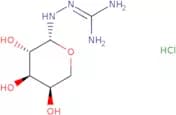
N1-β-D-Arabinopyranosylamino-guanidine hydrochloride
CAS:N1-b-D-arabinopyranosylamino-guanidine HCl is a modified carbohydrate. It is a synthetic monosaccharide that is custom synthesized by methylation and glycosylation. This product has high purity and can be used for modification of saccharides or oligosaccharides to create new carbohydrates with desired properties.Formula:C6H14N4O4•HClPurity:Min. 95%Color and Shape:White to light beige solid.Molecular weight:242.66 g/molD-Lyxonic acid potassium
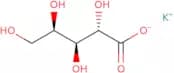
CAS:D-Lyxonic acid potassium salt is a pentitol that is a stereospecific, aldonic, and nature D-glycosylamine. It can be synthesized by reacting phenylhydrazine with glycolic acid chloride in the presence of catalytic amounts of sodium hydroxide. The yield is about 98%. This compound has been shown to have anti-inflammatory properties when it reacts with hydrogen chloride to form D-lyxonic acid chloride. It also has been shown to inhibit the growth of bacteria and fungi by binding to the cell wall and inhibiting protein synthesis.
Formula:C5H9KO6Purity:Min. 95%Color and Shape:PowderMolecular weight:204.22 g/mol2,3,5-Tri-O-benzyl-L-xylofuranose
CAS:2,3,5-Tri-O-benzyl-L-xylofuranose is a sugar molecule that has been modified to inhibit glycosidases. 2,3,5-Tri-O-benzyl-L-xylofuranose is an iminosugar that inhibits the enzyme β-glucosidase and α-galactosidase. The compound is not metabolized and it binds to the enzyme's active site. 2,3,5-Tri-O-benzyl L xylofuranose has been shown to be effective at inhibiting all of the glycosidases tested in this study with inhibition potencies ranging from 0.1 mM to 10 mM. This compound also inhibits epoxides and cyclic enzymes such as azido reductase and dihydropyrimidine dehydrogenase.Formula:C26H28O5Purity:Min. 95%Color and Shape:PowderMolecular weight:420.5 g/molD-Xylulose - Aqueous solution
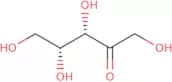
CAS:D-Xylulose is a sugar monomer found in the cell walls of bacteria. It is also present in human blood, where it is converted to xylitol. D-Xylulose has been shown to be an important component of bacterial cell wall synthesis and can be used as a probiotic for humans. The enzyme xylitol dehydrogenase catalyses the conversion of D-xylulose to xylitol. The reaction mechanism is thought to be similar to that of other enzymes in the glycolysis pathway, such as ribitol dehydrogenase, which converts ribitol to ribose 5-phosphate. This conversion can be achieved through two different methods: hydrogen fluoride or sodium hydroxide. D-Xylulose can also be used for analytical purposes, such as in the detection of trifluoroacetic acid (TFA) by gas chromatography and mass spectrometry.Formula:C5H10O5Purity:Min. 99 Area-%Color and Shape:Clear LiquidMolecular weight:150.13 g/mol1,2,3,5-Tetra-O-benzoyl-a-D-xylofuranose
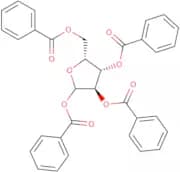
CAS:1,2,3,5-Tetra-O-benzoyl-a-D-xylofuranose is a glycosylated oligosaccharide with a tetra-O-benzoyl group at the nonreducing end. It can be synthesized by reacting benzaldehyde with 1,2,3,5-tetraacetyl xylose in the presence of sodium methoxide and acetic acid. The product can be fluorinated or methylated to produce other derivatives. This product is soluble in water and methanol and has a CAS number of 5432-87-1. It is available as a custom synthesis from catalog number SYN0000011. !-- -->!-- -->!-- -->!-- --> !-- -->!-- -->!-- -->!-- --> !-- -->!-- -->!--Formula:C33H26O9Purity:Min. 95%Color and Shape:White PowderMolecular weight:566.55 g/molPropargyl β-D-glucopyranoside
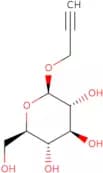
CAS:A beta glycoside with an alkyne handle suitable to click chemistry
Formula:C9H14O6Purity:Min. 95%Color and Shape:PowderMolecular weight:218.2 g/mol2,3:4,5-Di-O-isopropylidene-D-arabitol
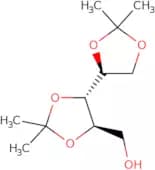
CAS:2,3:4,5-Di-O-isopropylidene-D-arabitol is a synthetic sugar that is used for glycosylation, methylation, and fluorination. The compound is an oligosaccharide that has been modified with methyl groups and activated monosaccharides. 2,3:4,5-Di-O-isopropylidene-D-arabitol is white in color and has a melting point of 109°C. It can be synthesized from D-mannitol with the help of sodium methoxide in methanol. 2,3:4,5-Di-O-isopropylidene-D-arabitol is also known as 1-(2,3:4,5) triose; 1-(2,3:4)-diose; 1-(2,3:4)-triose; 1-(2,3:4)-Formula:C11H20O5Purity:Min. 95%Color and Shape:Colorless PowderMolecular weight:232.27 g/mol4-Methylphenyl 2,3,4-tri-O-benzyl-β-L-thiofucopyranoside
4-Methylphenyl 2,3,4-tri-O-benzyl-b-L-thiofucopyranoside is a custom synthesis of an oligosaccharide. It is a complex carbohydrate with CAS No. that belongs to the class of saccharide and sugar. Polysaccharides are made up of several monosaccharides linked together by glycosidic bonds, which are formed by the action of enzymes called glycosyltransferases or glycosidases. Glycosylation is the process in which a sugar molecule (usually glucose) is added to another molecule by means of a glycosidic bond. Carbohydrates are one type of macromolecule and they are important sources of energy in living things. They also play important roles in cell walls and as structural components in plants and animals. The chemical modification carried out on this compound is methylation, which refers to the addition of one or more methylFormula:C34H36O4SPurity:Min. 95%Molecular weight:540.71 g/molPhenyl 2-acetamido-3,4,6-tri-O-acetyl-2-deoxy-α-D-galactopyranoside
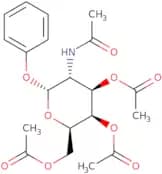
CAS:Phenyl 2-acetamido-3,4,6-tri-O-acetyl-2-deoxy-a-D-galactopyranoside is a sugar that is used in the synthesis of oligosaccharides and polysaccharides. This compound has an acetamido group on the phenyl ring, which reacts with the aldehyde group of galactose to form an ether bond. The glycosylation reaction can be carried out using either an acid or base catalyst. Acetal formation is also possible when this compound reacts with alcohols. Phenyl 2-acetamido-3,4,6-tri-O-acetyl-2-deoxygalactopyranoside is soluble in water and other polar solvents. It has a CAS number of 130894350 and can be found under the name Oligosaccharide, Monosaccharide, saccharide, CarbohydrateFormula:C20H25NO9Purity:Min. 95%Color and Shape:White to off-white solid.Molecular weight:423.41 g/molD-ido-Heptono-1,4-lactone
D-ido-Heptono-1,4-lactone is a glycosylation product of heptose with d-ido-D-glucofuranose and is a synthetic sugar. It has an Oligosaccharide, sugar, Synthetic, Fluorination, Custom synthesis, Methylation, Monosaccharide, Polysaccharide, saccharide Click modification. It has CAS No., Modification.
Purity:Min. 95%Raloxifene 6-D-glucuronide
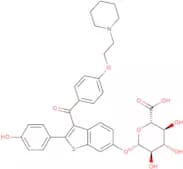
CAS:Raloxifene 6-D-glucuronide is a synthetic compound that consists of the sugar raloxifene and the sugar glucuronic acid. It is a complex carbohydrate with a molecular weight of 569. Raloxifene 6-D-glucuronide is soluble in water and insoluble in most organic solvents. The compound has been modified by fluorination, which increases its stability in water, and by click modification. This compound has been shown to inhibit the activity of bacterial enzymes that are responsible for the synthesis of saccharides, such as oligosaccharides and polysaccharides.Formula:C34H35NO10SPurity:Min. 95%Color and Shape:SolidMolecular weight:649.71 g/molMethyl 2,3,4-tri-O-benzyl-α-D-glucuronide benzyl ester
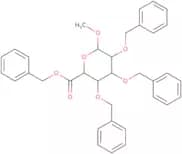
CAS:Methyl 2,3,4-tri-O-benzyl-α-D-glucuronide benzyl ester is a Carbohydrate. It is soluble in water and insoluble in alcohol. The molecular weight of Methyl 2,3,4-tri-O-benzyl-α-D-glucuronide benzyl ester is 584.1 g/mol. The CAS Registry Number for Methyl 2,3,4-tri-O-benzyl-α-D-glucuronide benzyl ester is 14279733.Formula:C35H36O7Purity:Min. 95%Color and Shape:Colorless Clear LiquidMolecular weight:568.66 g/mol4-Methoxyphenyl 3,4-di-O-benzyl-α-D-mannopyranoside
4-Methoxyphenyl 3,4-di-O-benzyl-a-D-mannopyranoside is a glycosylated, complex carbohydrate with a methylated and fluorinated saccharide. This product is available for custom synthesis and can be ordered in high purity.Purity:Min. 95%D-Ribose-1-phosphate bis(cyclohexylammonium)
CAS:D-Ribose-1-phosphate bis(cyclohexylammonium) salt is a custom synthesis of D-ribose. It is a monosaccharide that has been fluorinated, methylated, and glycosylated. The chemical modification of the sugar allows for it to have properties such as high purity and custom synthesis. This product can be used in a number of applications including complex carbohydrate, glycosylation, Methylation, and click modification.Formula:C5H11O8P•(C6H13N)2Purity:Min. 97 Area-%Color and Shape:PowderMolecular weight:428.46 g/molEthyl 2,3,4-tri-O-benzyl-b-L-thiofucopyranoside
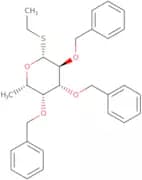
CAS:Synthetic building block. Glycosyl donor used in oligosaccharide chemistry to incorporate L-fucose into a structure.Formula:C29H34O4SPurity:Min. 98 Area-%Color and Shape:White PowderMolecular weight:478.64 g/mol6-Deoxy-D-lactose
CAS:6-Deoxy-D-lactose is a custom synthesized, complex carbohydrate that is an Oligosaccharide. It is a polysaccharide with a CAS number of 52689-62-0. 6-Deoxy-D-lactose has been modified by methylation and glycosylation and can be used as a Modification of saccharides. 6-Deoxy-D-lactose has been fluorinated and it can be synthesized by Click modification of sugar or high purity. 6-Deoxy-D-lactose is a white, crystalline powder that is soluble in water, ethanol, and acetone.br> 6 Deoxy Lactose (6DL) is an oligosaccharide that consists of one glucose molecule linked to one galactose molecule via alpha 1-->4 glycosidic linkage. The chemical formula for 6DL is C 12 H 22 O 11 . 6DLFormula:C12H22O10Purity:Min. 95%Color and Shape:Off-White PowderMolecular weight:326.3 g/molPropofol-4-Hydroxy-4-D-glucuronide
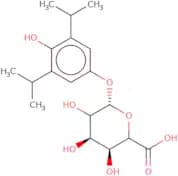
Propofol-4-Hydroxy-4-D-glucuronide is a fluorinated monosaccharide that has been synthesized using the glycosylation, polysaccharide and modification methods. This compound is a custom synthesis that has been modified with methylation and click chemistry. The CAS number for this product is 54910-87-6. This product is a complex carbohydrate with high purity.
Formula:C18H26O8Purity:Min. 95%Molecular weight:370.39 g/molN-Ethyldeoxynojirimycin hydrochloride
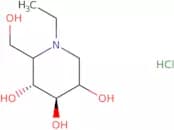
CAS:N-Ethyldeoxynojirimycin hydrochloride is a mutant of the natural compound, deoxynojirimycin. The chemical structure of this compound is similar to that of the natural product and its molecular weight is 547.7 g/mol. N-Ethyldeoxynojirimycin hydrochloride has been shown to interact with the bacterial chaperone GroEL and enhance the activity of this protein. Further study has shown that this agent binds to GroEL in a manner that allows it to bind directly to ATPase domains I and II, leading to an increase in ATPase activity.Formula:C8H17NO4·HClPurity:(%) Min. 95%Color and Shape:White Off-White PowderMolecular weight:227.69 g/mol1,6-Anhydro-beta-D-glucopyranose
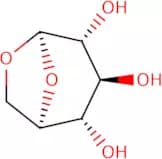
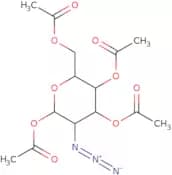
CAS:Used for preparation of biologically active compoundsFormula:C6H10O5Purity:Min. 98 Area-%Color and Shape:White PowderMolecular weight:162.14 g/mol1,3,4,6-Tetra-O-acetyl-2-azido-2-deoxy-b-D-galactopyranose
CAS:1,3,4,6-Tetra-O-acetyl-2-azido-2-deoxy-b-D-galactopyranose (TAZ) is an aromatic heterocyclic sugar compound that is used in pharmaceutical formulations. It has low toxicity and can be synthesized using a number of methods. TAZ has been shown to have antifungal effects against Candida albicans and antitumor effects against cancer cells. TAZ also inhibits the activity of teniposide, which is a drug used for the treatment of leukemia. TAZ may be effective against cancer cells by acting as an amido donor and changing the conformation of the cyclic peptide.Formula:C14H19N3O9Purity:Min. 95%Color and Shape:PowderMolecular weight:373.32 g/mol