APIs for research and impurities
Active Pharmaceutical Ingredients (APIs) are the substances in drugs responsible for their therapeutic effects. In this section, you will find a wide variety of APIs intended for research use. These compounds are essential for the development, testing, and validation of new pharmaceutical formulations. CymitQuimica offers high-quality APIs to support research in drug discovery and development.
Subcategories of "APIs for research and impurities"
- Aminoacids and derivatives(12,241 products)
- Anthraquinones and derivatives(401 products)
- Benzimidazole and Imidazole Derivatives(10,345 products)
- Benzodiazepine Derivatives(332 products)
- Carbohydrates and glycoconjugates(5,006 products)
- Esters and Derivatives(42,023 products)
- Fatty Acids and Lypidic Derivatives(32,187 products)
- Flavonoids and Polyphenols(16,990 products)
- Free Radicals and Oxidant/Reducing Agents(213 products)
- Ketones and derivatives(2,393 products)
- Natural and semi-synthetic antibiotics(6,335 products)
- Nitriles and Cyano Derivatives(3,042 products)
- Nitrosamines and Derivatives(55 products)
- Nucleosides and Nucleotides(3,413 products)
- Organic Phosphates and Phosphonates(1,191 products)
- Organic Sulphonates and Sulphates(10,370 products)
- Organometallics(4,396 products)
- Others(6,270 products)
- Peptides and Proteins(3,116 products)
- Polymers and Derivatives(99 products)
- Purines and Pyrimidine Derivatives(8,888 products)
- Quinazoline and Quinoline Derivatives(65,497 products)
- Quinones and Derivatives(24,191 products)
- Salts and Derivatives of Active Pharmaceutical Ingredients (API)(79,238 products)
- Steroids and Derivatives(4,949 products)
- Sulfonamides and Derivatives(2,584 products)
- Terpenoids and Derivatives(3,835 products)
- Thiazolidinediones and Thiopyrans(2,733 products)
- β-Adrenergic Compounds(228 products)
Show 21 more subcategories
Found 56511 products of "APIs for research and impurities"
Sort by
Purity (%)
0
100
|
0
|
50
|
90
|
95
|
100
Benz[A]anthracene-7-acetonitrile
CAS:<p>Please enquire for more information about Benz[A]anthracene-7-acetonitrile including the price, delivery time and more detailed product information at the technical inquiry form on this page</p>Formula:C20H13NPurity:Min. 95%Molecular weight:267.3 g/mol2-(3-Nitrophenyl)-2,3-dihydro-1H-benzo[D]imidazole
CAS:<p>Please enquire for more information about 2-(3-Nitrophenyl)-2,3-dihydro-1H-benzo[D]imidazole including the price, delivery time and more detailed product information at the technical inquiry form on this page</p>Formula:C13H11N3O2Purity:Min. 95%Molecular weight:241.24 g/molAT-406 hydrochloride
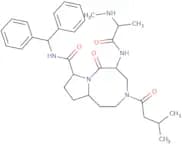
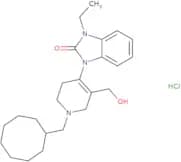
CAS:<p>AT-406 hydrochloride is an analog of the anticancer protein kinase inhibitor, SMAC. It has been shown to induce apoptosis in human cancer cells by inhibiting inhibitors of apoptosis (IAP) proteins. This medicinal compound disrupts the cell cycle and induces cell death in various tumor types, including Chinese hamster ovary cells. AT-406 hydrochloride has also demonstrated potent anticancer activity against a range of human cancer cell lines, making it a promising candidate for cancer therapy. Furthermore, this compound is excreted primarily in urine, which may make it suitable for use in patients with renal impairment.</p>Formula:C32H43N5O4Purity:Min. 95%Molecular weight:561.7 g/molTrap 101
CAS:<p>Trap 101 is a potent anticancer agent that is derived from xylose. This compound has been shown to induce apoptosis in cancer cells by inhibiting kinases, which are enzymes that play a key role in tumor growth and progression. Trap 101 specifically targets Chinese hamster ovary cells and human cancer cell lines, making it a promising candidate for the treatment of various cancers. In addition, Trap 101 acts as a kinase inhibitor and has been shown to be effective against several types of tumors. This compound can be detected in urine samples, making it an attractive candidate for non-invasive diagnostic tests for cancer patients. Overall, Trap 101 holds great potential as a novel therapeutic agent for cancer treatment.</p>Formula:C24H36ClN3O2Purity:Min. 95%Molecular weight:434 g/molClofedanol o-β-D-glucuronide
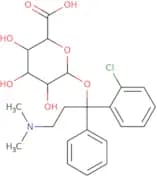
CAS:<p>Please enquire for more information about Clofedanol o-β-D-glucuronide including the price, delivery time and more detailed product information at the technical inquiry form on this page</p>Formula:C23H28ClNO7Purity:Min. 95%Molecular weight:465.9 g/molMicafungin Metabolite M1
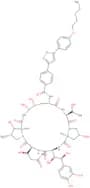
CAS:<p>Micafungin Metabolite M1 is a metabolite of Micafungin. It is an impurity in the drug product and is not active. Micafungin Metabolite M1 has been proposed as a pharmacopoeia reference standard for HPLC quantification of Micafungin.</p>Formula:C56H71N9O20Purity:Min. 95%Molecular weight:1,190.21 g/molDesoxo-palbociclib
CAS:<p>Desoxo-palbociclib is a drug product that has been custom synthesized. The purity of this compound is high, with analytical results that meet the pharmacopoeia standards for purity. Metabolism studies have been conducted to determine the natural and synthetic metabolites of this compound. Desoxo-palbociclib is also in Phase II clinical trials for drug development, which are expected to be completed by 2020. There are no known impurities, but there may be traces of other compounds due to its synthetic nature.</p>Formula:C24H29N7OPurity:Min. 95%Molecular weight:431.5 g/mol1-(4-((2,4-Dimethylphenyl)thio)phenyl)piperazine hydrobromide
<p>1-(4-((2,4-dimethylphenyl)thio)phenyl)piperazine hydrobromide is a synthetic drug that has been used in the research and development of drugs. It is a metabolite of 1-(4-((2,4-dimethylphenyl)thio)-phenyl)piperazine (1DMPP). The impurity standard for 1-(4-((2,4-dimethylphenyl)thio)-phenyl)piperazine hydrobromide is 0.5% (w/w). It has been shown to be effective in metabolism studies.</p>Purity:Min. 95%[5-L-Aspartic Acid]-desmopressin
<p>Desmopressin is a synthetic drug that is used to treat diabetes insipidus and bleeding in patients who are on anticoagulants. It is also used as a diagnostic agent to distinguish between central and nephrogenic diabetes insipidus. Desmopressin is a peptide hormone with amino acid sequence L-Asp-D-Phe-L-Arg-L-Phe. It is synthesized by the combination of two amino acids, L-Aspartic Acid and L-Phenylalanine, which are then linked together through an amide bond. The synthesis of desmopressin occurs in two steps: first, the coupling of amino acid L-Aspartic Acid with the peptide linkage (N-[3-(2'-aminoethyl) carbonyl]glycine) to form the intermediate N-[3-(2'-Aminoethyl) carbonyl]-L-Aspartic Acid; second</p>Purity:Min. 95%3-[(4-Amino-2-methylpyrimidin-5-yl)methyl]-5-(2-chloroethyl)-4-methyl-1,3-thiazol-3-ium
CAS:<p>3-[(4-Amino-2-methylpyrimidin-5-yl)methyl]-5-(2-chloroethyl)-4-methyl-1,3-thiazol-3-ium is a drug product that belongs to the group of synthetic drugs. It is metabolized by the liver and has an oral bioavailability of 100%. 3-[(4-Amino-2-methylpyrimidin-5-yl)methyl]-5-(2-chloroethyl)-4-methylthiazol 3 -ium is used in research and development for pharmacopoeia standard. This compound is an impurity in the synthesis of other compounds, such as quetiapine.</p>Formula:C12H16ClN4SPurity:Min. 95%Color and Shape:PowderMolecular weight:283.8 g/molPaliperidone Z-oxime
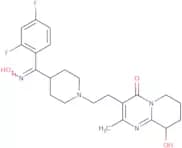
CAS:<p>Paliperidone Z-oxime is a metabolite of paliperidone that is used as an impurity standard. It is a white crystalline powder with a molecular weight of 437.2 g/mol. Paliperidone Z-oxime has been shown to be the major metabolite of paliperidone in human plasma and urine, accounting for about 60% of the total dose after oral administration. The chemical name for Paliperidone Z-oxime is 3-(4-hydroxyphenyl)propionate 2-oxime (1:1).</p>Formula:C23H28F2N4O3Purity:Min. 95%Molecular weight:446.5 g/molNabumetone dimer
CAS:<p>Nabumetone is a nonsteroidal anti-inflammatory drug that is metabolized by the liver to form a dimer. The major metabolite of nabumetone is the dimer, which has been used as an impurity standard for this drug. Nabumetone has been shown to inhibit prostaglandin synthesis, and its metabolites have been studied for their effects on various enzymes.</p>Formula:C27H26O3Purity:Min. 95%Molecular weight:398.49 g/mol2,5-Thiazolylmethyl diacarbonate
CAS:<p>2,5-Thiazolylmethyl diacarbonate is a pure chemical intermediate used in the manufacture of pharmaceuticals. It has been shown to inhibit the growth of bacteria and fungi. This product is an impurity in some drugs and is also used as a reference material for HPLC analysis. 2,5-Thiazolylmethyl diacarbonate is manufactured synthetically or it can be isolated from natural sources such as plants.</p>Formula:C28H30N4O5S2Purity:Min. 95%Molecular weight:566.70 g/molFluticasone propionate dithioacid
<p>Fluticasone propionate dithioacid is a synthetic corticosteroid that has anti-inflammatory and anti-allergic effects. It binds to the glucocorticoid receptor, which prevents the release of inflammatory mediators. Fluticasone propionate dithioacid is used in research and development, as well as for custom synthesis and drug product development. This compound has been shown to have high purity and is often used as a pharmacopoeia or drug development standard. Metabolism studies have also been conducted on this compound.</p>Formula:C24H30F2O4S2Purity:Min. 95%Molecular weight:484.62 g/molDes(2-methylbutyryl) pravastatin
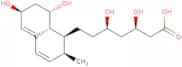
CAS:<p>Des(2-methylbutyryl) pravastatin is a synthetic allylic alcohol that is synthesized from the natural product, pravastatin. It has been shown to have carboxylic acid and carboxylic functional groups as well as two hydrogens on the allylic side of the molecule. In addition, des(2-methylbutyryl) pravastatin has two allylic alcohols with two hydrogens on the allylic side of the molecule. The synthesis of this compound is done by reacting 2-methylbutanoic acid with an allyl bromide in a reaction catalyzed by sodium methoxide. This reaction produces a mixture of products that includes des(2-methylbutyryl)pravastatin.</p>Formula:C18H28O6Purity:Min. 95%Molecular weight:340.41 g/molN-(2,2-Dimethoxyethyl)-3,4-dimethoxybenzeneacetamide(ivabradine impurity)
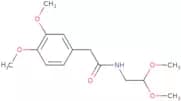
CAS:<p>N-(2,2-dimethoxyethyl)-3,4-dimethoxybenzeneacetamide is a drug impurity that is used as a research and development or impurity standard. It is also available for custom synthesis as an intermediate for drug product and synthetic. This product has high purity, with a purity of 99%. The CAS number for this compound is 73954-34-4. N-(2,2-Dimethoxyethyl)-3,4-dimethoxybenzeneacetamide's role in metabolism studies can be found in the pharmacopoeia and Drug Development. Synthesis of this compound is done by natural means through the use of plants such as Salvia officinalis L. (sage).</p>Formula:C14H21NO5Purity:Min. 95%Molecular weight:283.32 g/mol1,3-Bis[4-(2-methoxyethyl)phenoxy]-2-propanol
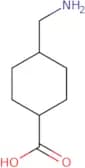
CAS:<p>1,3-Bis[4-(2-methoxyethyl)phenoxy]-2-propanol is a synthetic compound that is used as an impurity standard in the manufacture of drug products. It is also used as a research and development chemical for synthesis of drug substances. 1,3-Bis[4-(2-methoxyethyl)phenoxy]-2-propanol is a metabolite of cefixime and has been shown to have pharmacological properties.</p>Formula:C21H28O5Purity:Min. 95%Molecular weight:360.4 g/moltrans-4-(Aminomethyl)cyclohexanecarboxylic acid
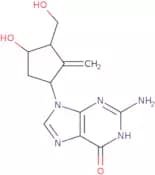
CAS:<p>Trans-4-(aminomethyl)cyclohexanecarboxylic acid (AMCA) is a histamine antagonist that is used to treat bowel disease. It may also be useful for the treatment of other inflammatory diseases and as an anticoagulant. AMCA has been shown to be safe and effective for the prevention of postoperative bleeding in patients who are undergoing major surgery. This drug is a potent inhibitor of platelet aggregation, but does not affect the function of erythrocytes or leukocytes. AMCA inhibits platelet aggregation by blocking the binding of adenosine diphosphate (ADP) to its receptor on platelets, thus inhibiting ADP-mediated activation of phospholipase A2 and arachidonic acid release from membranes. An increase in blood levels of AMCA may lead to cardiac toxicity and bleeding events.</p>Formula:C8H15NO2Purity:Min. 95%Molecular weight:157.21 g/molEntecavir (1R,3R,4S) diastereomer
CAS:<p>Entecavir (1R,3R,4S) diastereomer is a synthetic compound and is an analytical standard for HPLC. This product is an impurity of the drug Entecavir. The impurity is characterized by a retention time of 17.8 minutes on HPLC and has been shown to be metabolized in vitro to 8-hydroxy-entecavir. The purity of this product is 98% with a CAS number of 1367369-78-5.</p>Formula:C12H15N5O3Purity:Min. 95%Molecular weight:277.28 g/molPitavastatin Z-isomer impurity
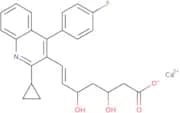
CAS:<p>The Z-isomer impurity of pitavastatin is a synthetic compound that has been used as an analytical standard and pharmacopoeia reference. The Z-isomer impurity is not found in nature, but is generated by the hydrogenation of the natural product. It has been shown to be metabolized by CYP3A4 and CYP2C9 enzymes, which are the primary enzymes responsible for drug metabolism. This impurity does not have any therapeutic effect on the body, but can be used as a research and development standard for HPLC.</p>Purity:Min. 95%
![Benz[A]anthracene-7-acetonitrile](/_next/image/?url=https%3A%2Fstatic.cymitquimica.com%2Fproducts%2F3D%2Fthumb-webp%2FNCA01869.webp&w=3840&q=75)

![2-(3-Nitrophenyl)-2,3-dihydro-1H-benzo[D]imidazole](/_next/image/?url=https%3A%2Fstatic.cymitquimica.com%2Fproducts%2F3D%2Fthumb-webp%2FYHA06924.webp&w=3840&q=75)
![[5-L-Aspartic Acid]-desmopressin](/_next/image/?url=https%3A%2Fstatic.cymitquimica.com%2Fproducts%2F3D%2Fthumb-webp%2FIA173260.webp&w=3840&q=75)
![3-[(4-Amino-2-methylpyrimidin-5-yl)methyl]-5-(2-chloroethyl)-4-methyl-1,3-thiazol-3-ium](/_next/image/?url=https%3A%2Fstatic.cymitquimica.com%2Fproducts%2F3D%2Fthumb-webp%2FIA181779.webp&w=3840&q=75)

![1,3-Bis[4-(2-methoxyethyl)phenoxy]-2-propanol](/_next/image/?url=https%3A%2Fstatic.cymitquimica.com%2Fproducts%2F3D%2Fthumb-webp%2FFJA97530.webp&w=3840&q=75)