Polissacáridos
Foram encontrados 506 produtos de "Polissacáridos"
Laminaran - from Thallus laminariae
CAS:Laminaran is a polysaccharide that co-occurs with fucoidan and alginate in brown seaweeds such as Laminaria digitata, Laminaria cloustoni, Eisenia bicyclis and Thallus laminariae. It is a β-1,3-linked glucan which it is claimed stimulates the immune system in mammals and fish. The image was kindly provided by Prof Mike Guiry from Cork who runs ‘The Seaweed Site’.Cor e Forma:PowderHydroxypropyl cellulose - Average MW 370,000
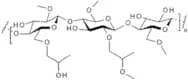
CAS:In water, hydroxypropyl cellulose forms liquid crystals with many mesophases depending on concentration. These mesophases include isotropic, anisotropic, nematic and cholesteric, the latter resulting in many colors such as violet, green and red. Pharmaceutical applications include treatments for medical conditions such as dry eye syndrome (keratoconjunctivitis sicca), recurrent corneal erosions, decreased corneal sensitivity, exposure and neuroparalytic keratitis. It is also used as a binder in tablets. Hydroxypropylcellulose is also used as a thickener, a binder and emulsion stabiliser in foods with E number E463. HPC is used as a support matrix for DNA separations by capillary and microchip electrophoresis.Pureza:Min. 95%Cor e Forma:PowderNigeran
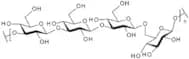
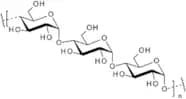
CAS:Nigeran is a polysaccharide found in the cell wall of lower fungi. In certain Aspergillus and Penicillium spp., nigeran was first isolated from Penicillium expansum and Aspergillus niger (illustrated). The polysaccharide contains unbranched α-D- glucopyranose residues linked 1,3 and 1,4. Nigeran is part of the hyphal cell wall, where it can contribute up to 40 % of the cell dry weight. The polysaccharide occupies several domains or location on the hyphal wall and is highly crystalline in vivo. Deposition of nigeran is primarily at the outer surface of the hyphal wall.
Pureza:Min. 95%Cor e Forma:PowderCurdlan
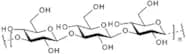
CAS:Curdlan is a microbial polysaccharide produced by a mutant strain of Alcaligenes faecalis var. myxogenes which was first shown to produce succinoglucan prior to mutation. Curdlan is a β-1,3 glucan forming clear solutions at about 55 °C which then gels (“low-set”) when cooled. Suspensions of curdlan at higher temperatures form firm resilient gels (“high set”) that melt at 140 - 160 °C.
The image was kindly provided by Dr. Chris Lawson.Pureza:Min. 95%Cor e Forma:White PowderHydroxyethyl cellulose, viscosity 1500 ~ 2500
CAS:Hydroxyethyl cellulose (EHEC) is a non-ionic, water-soluble cellulose derivative produced by introduction of ethylene oxide groups to the hydroxyl groups of the cellulose backbone. Hydroxyethyl cellulose is useful as a water thickener, rheological control additive, protective colloid, binder, stabilizer, suspending agent and film former. It is used in many industrial applications including latex paints, emulsion polymerization, petroleum, paper, pharmaceuticals, cosmetics and many other applications.Pureza:Min. 95%Cor e Forma:PowderKephir gum
CAS:‘Water kefir’ is a home-made beverage, which was thought to contain significant amounts of bacterial exopolysaccharides. It has now been reported that the exopolysaccharide fraction of this material contains dextrans with similar structures, having a number of (1,3) linkages, branched at positions O3 and position O2 and with a wide range of molecular weights. In addition, it was shown that a small amount of levan is also present.Pureza:Min. 95%Cor e Forma:PowderFucoidan - Sargassum
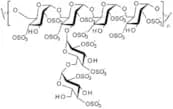
CAS:A fucan sulphate found in brown marine algae (Phaeophyta-typically Fucus vesiculotus, Sargassum (illustrated), Alaria and Cladosiphon) and has been shown to have anticoagulant activity. The main constituents are α-1,4 and α-1,2 linked L-fucose sulphates although galactose and L-fucose are also present, our product contains approximately 20% L-fucose, and there are many variations of the basic structure found in different species of Phaeophyta. The image was kindly provided by Prof Mike Guiry from Cork who runs ‘The Seaweed Site’.Pureza:Min. 95%Cor e Forma:PowderPeptidoglycan - from Staphylococcus aureus
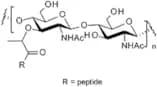
CAS:The sugar component consists of alternating residues of β-(1,4) linked N-acetylglucosamine and N-acetylmuramic acid. A peptide chain of three to five amino acids is attached to the N-acetylmuramic acid. The peptide chain can be cross-linked to the peptide chain of another strand forming the 3D mesh-like layer.Cor e Forma:PowderPectic acid
CAS:Pectic acid is non water-soluble β (1,4)-linked polygalacturonic acid. In its gel form, is water-soluble, transparent and gelatinous, and exists in ripe fruit and some vegetables. It is a product of pectin degradation in plants, and is produced via the interaction between pectinase and pectin (the latter being common in the wine-making industry).Pureza:Min. 95%Cor e Forma:PowderDextran sulfate sodium, MW 20,000
CAS:Sodium carboxymethyl dextran (CM-dextran) is a white, odourless and tasteless powder, which is freely soluble in water or electrolyte solutions. The product has a pronounced polyanionic character, due to the high degree of carboxyl substitution. Applications that have been described for CM-dextran include carriers of paramagnetic contrast agents, preparation of conjugates of pharmacologically active compounds and CM-dextrans in biosensors. A number of other uses in cosmetics, agriculture, foods, paints and textiles have been the subject of patent applications.Cor e Forma:PowderArabinan
CAS:Sugar beet arabinan consists of a 1,5 α-linked arabinose backbone to which 1,3 α-linked (and possibly some 1,2 α-linked) L-arabinofuranosyl residues are attached. Approximately 60% of the main-chain arabinofuranosyl residues are substituted by single 1,3-linked arabinofuranosyl groups. The reducing terminal arabinosyl residue is attached through rhamnose to fragments of the rhamnogalacturonan backbone of the native pectin molecule.
Cor e Forma:White PowderAmylopectin - from potato starch
CAS:Starch component; highly branched glucanCor e Forma:White Off-White PowderTamarind gum
CAS:Tamarind gum comes from the seed of the tamarind tree Tamarindus indica and is used in the food industry as a stabiliser and an emulsifier. It has been suggested that the structure is a main chain of cellulose with frequent branching at the O-6 positions with short side chains of one or two D-xylopyranosyl capped with D-xylopyranosyl, D-galactopyranosyl or L-arabinofuranosyl units. In application, tamarind finds use in the sizing of jute and as a stabilizer and thickener in the food industry.Cor e Forma:PowderHyaluronic acid sodium salt - Extra low molecular weight 8,000-15,000
CAS:Gycosaminoglycan in many organs; joint lubricant and shock absorberFórmula:(C14H20NO11Na)nPureza:Min. 91 Area-%Cor e Forma:PowderRhodamine B isothiocyanate-dextran - Average MW 70,000
The fluorescence intensity of these Rhodamine B isothiocyanate-dextrans varies much less than with FITC-dextrans.Cor e Forma:PowderPeso molecular:7,000 g/molTragacanth gum
CAS:Gum tragacanth is an exudate gum from species of Astragalus trees mainly grown in Iran and Turkey. Tragacanth finds applications as an effective emulsifying and thickening agent in the food and pharmaceutical industries. The gum is a slightly acidic salt consisting of two fractions namely the water soluble tragacanthin and the fraction bassorin which swells in water to form a gel. Water soluble tragacanthin is reported as a branched arabiogalactan which is soluble in 70% ethanol. The acidic bassorin has a chain of (1,4)-linked a-D-galacturonic acid units some of which are substituted at O-3 with β-D-xylopyranosyl units and some of these being terminated with galactose or fucose.Cor e Forma:White PowderHyaluronic acid sodium - Average MW 1.8 - 2.5 million Da
CAS:Gycosaminoglycan in many organs; joint lubricant and shock absorberFórmula:(C14H20NO11Na)nPureza:Min. 95%Cor e Forma:Powderlambda-Carrageenan
CAS:Lambda-Carrageenan is a non-gelling sulphated galactan extracted from red seaweed (typically Gigartina stellata and Chondrus crispus). The structure of all carrageenans consists of a strictly alternating masked repeating unit of 1,3-linked α-D-galactose and 1,4-linked β-D-galactose. λ-Carrageenan has the α-linked unit 2-6-disulphated and the β-linked unit is 2-sulphated. The image was kindly provided by Prof Mike Guiry from Cork who runs ‘The Seaweed Site’.Cor e Forma:PowderPeso molecular:1140.92Glycogen - from rabbit liver
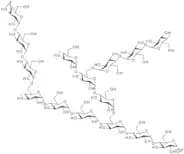
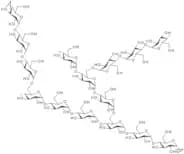
CAS:Glycogen is a highly branched polysaccharide of glucose that serves as a form of energy storage in animals and fungi. It is the main storage form of glucose in the body. In humans, glycogen is made and stored primarily in liver and muscle cells and functions as the second most important energy storage molecule to fat, which is held in adipose tissue. Glycogen is analogous to starch and has a structure similar to amylopectin, but is more extensively branched and compact than starch. It occurs as granules in the cytosol/cytoplasm in many cell types, and plays an important role in the glucose cycle.Fórmula:C24H42O21Pureza:Min. 85%Cor e Forma:White PowderPeso molecular:666.6 g/molCarboxymethyl cellulose sodium - Viscosity 1000 - 1300 mPa·s
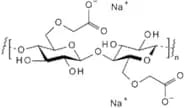
CAS:Carboxymethyl cellulose is used in food as a viscosity modifier, thickener, to stabilise emulsions and are found in gluten-free and reduced-fat products. It is also a constituent of toothpaste, laxatives, diet pills, water-based paints, detergents, textile sizing, and various paper products. In laundry detergents, it is used as a soil suspension polymer. It is also used in pharmaceuticals as a thickening agent and in the oil-drilling industry as a viscosity modifier and water-retaining agent.Pureza:Min. 95%Cor e Forma:White Powder