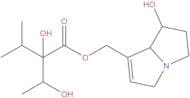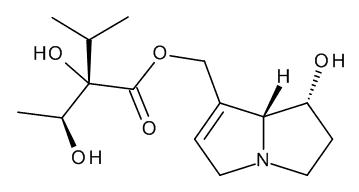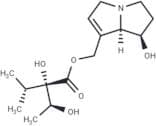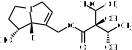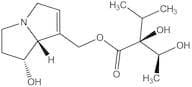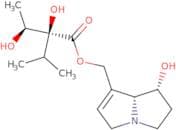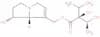
CAS 10285-07-1
:(+)-Lycopsamine
Description:
(+)-Lycopsamine is a naturally occurring alkaloid primarily found in certain plant species, particularly within the family Asteraceae. It is characterized by its complex bicyclic structure, which includes a pyrrolidine ring and a hydroxyl group, contributing to its biological activity. This compound exhibits a range of pharmacological properties, including potential neurotoxic effects, which have been studied in relation to its impact on cellular mechanisms. (+)-Lycopsamine is known for its role in traditional medicine, although its safety profile is a concern due to its toxicity in certain contexts. The compound is often analyzed for its presence in herbal supplements and plant extracts, where it may contribute to both therapeutic effects and adverse reactions. Its stereochemistry, indicated by the (+) designation, suggests that it is the optically active form of lycopsamine, which can influence its interaction with biological systems. As with many alkaloids, research continues to explore its potential applications and the mechanisms underlying its effects on human health.
Formula:C15H25NO5
InChI:InChI=1S/C15H25NO5/c1-9(2)15(20,10(3)17)14(19)21-8-11-4-6-16-7-5-12(18)13(11)16/h4,9-10,12-13,17-18,20H,5-8H2,1-3H3/t10-,12+,13+,15-/m0/s1
InChI key:InChIKey=SFVVQRJOGUKCEG-ZGFBFQLVSA-N
SMILES:C(OC([C@]([C@H](C)C)([C@H](C)O)O)=O)C=1[C@]2(N(CC1)CC[C@H]2O)[H]
Synonyms:- (1R-(1alpha,7(2S*,3S*),7abeta))-(2,3,5,7a-Tetrahydro-1-hydroxy-1H-pyrrolizin-7-yl)methyl 2,3-dihydroxy-2-(1-methylethyl)butanoate
- 3′-epi-Intermedine
- Butanoic acid, 2,3-dihydroxy-2-(1-methylethyl)-, ((1R,7aR)-2,3,5,7a-tetrahydro-1-hydroxy-1H-pyrrolizin-7-yl)methyl ester, (2S,3S)-
- Butanoic acid, 2,3-dihydroxy-2-(1-methylethyl)-, (2,3,5,7a-tetrahydro-1-hydroxy-1H-pyrrolizin-7-yl)methyl ester, (1R-(1alpha,7(2S*,3S*),7abeta))-
- Butanoic acid, 2,3-dihydroxy-2-(1-methylethyl)-, (2,3,5,7a-tetrahydro-1-hydroxy-1H-pyrrolizin-7-yl)methyl ester, [1R-[1α,7(2S*,3S*),7aβ]]-
- Ccirs 9199
- Ccris 9199
- Retronecine 9-((-)-viridiflorate)
- [(1R,7aR)-1-hydroxy-2,3,5,7a-tetrahydro-1H-pyrrolizin-7-yl]methyl (2S,3S)-2,3-dihydroxy-2-(propan-2-yl)butanoate
- Lycopsamine
- (+)-Lycopsamine
Sort by
Purity (%)
0
100
|
0
|
50
|
90
|
95
|
100
Found 9 products.
Lycopsamine 100 µg/mL in Water
CAS:Controlled ProductFormula:C15H25NO5Color and Shape:Single SolutionMolecular weight:299.363Lycopsamine
CAS:Lycopsamine is a bioactive chemical.Formula:C15H25NO5Color and Shape:SolidMolecular weight:299.36Lycopsamine
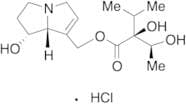
CAS:Natural alkaloidFormula:C15H25NO5Purity:≥ 95.0 % (HPLC)Color and Shape:PowderMolecular weight:299.37(+)-Lycopsamine Hydrochloride (~90%)
CAS:Applications (+)-Lycopsamine Hydrochloride, occurs in pyrrolizidine alkaloid-containing plants, which are the most common poisonous plants affecting livestock, wildlife, and humans. Thye are being known as hepatotoxins and tumorigens.It has been shown that pyrrolizidine Alkaloid-Derived DNA Adducts, are the common biological biomarker of pyrrolizidine alkaloid-induced liver tumor formation.
Not a dangerous good if item is equal to or less than 1g/ml and there is less than 100g/ml in the package
References Qingsu, X., et al.: Chem. Res. Toxic., 26, 1384 (2013); Bosi,, C. F., et al.: Revista Brasileira de Farmacognosia, 23, 425 (2013);Formula:C15H25NO5·HClPurity:~90%Color and Shape:NeatMolecular weight:335.82Lycopsamine
CAS:Lycopsamine is a pyrrolizidine alkaloid, which is a naturally occurring compound found in several plant species, particularly those within the Boraginaceae family. These alkaloids are primarily sourced from plants known for producing secondary metabolites as a defense mechanism against herbivores and pathogens. Lycopsamine's mode of action involves its biotransformation in the liver where it forms reactive metabolites that can bind to cellular macromolecules. This results in hepatotoxicity, disrupting liver function and potentially leading to conditions such as veno-occlusive disease.Formula:C15H25NO5Purity:Min. 95%Color and Shape:PowderMolecular weight:299.36 g/mol