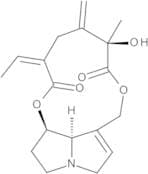
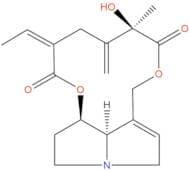
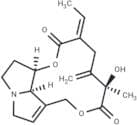
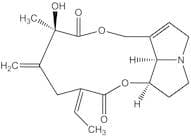
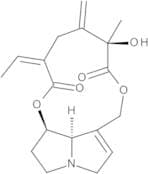
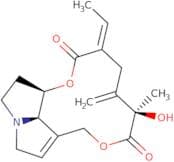
CAS 480-81-9
:Seneciphylline
Description:
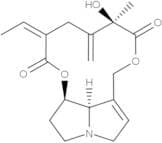
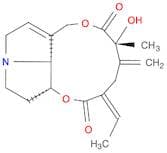
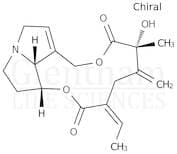
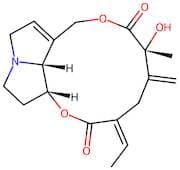
Seneciphylline is an alkaloid derived from plants in the Senecio genus, particularly known for its presence in certain species of the Asteraceae family. It is characterized by its complex bicyclic structure, which includes a pyrrolidine ring. Seneciphylline exhibits hepatotoxic properties, primarily due to its ability to form reactive metabolites that can damage liver cells. This compound has garnered interest in pharmacological research due to its potential effects on various biological systems, including its role in traditional medicine. However, its toxicity raises concerns regarding safety and therapeutic use. Seneciphylline is typically studied in the context of its effects on liver function and its potential implications in toxicology. As with many plant-derived alkaloids, the extraction and purification processes are critical for obtaining this compound in a laboratory setting, and its handling requires caution due to its toxic nature. Overall, while seneciphylline may have interesting biological activities, its safety profile necessitates careful consideration in any applications.
Formula:C18H23NO5
InChI:InChI=1S/C18H23NO5/c1-4-12-9-11(2)18(3,22)17(21)23-10-13-5-7-19-8-6-14(15(13)19)24-16(12)20/h4-5,14-15,22H,2,6-10H2,1,3H3/b12-4-/t14-,15-,18-/m1/s1
InChI key:InChIKey=FCEVNJIUIMLVML-QPSVUOIXSA-N
SMILES:O=C/1O[C@]2([C@@]3(N(CC2)CC=C3COC(=O)[C@](C)(O)C(=C)C\C1=C\C)[H])[H]
Synonyms:- (1,6)Dioxacyclododecino(2,3,4-gh)pyrrolizine-2,7-dione, 3-ethylidene-3,4,5,6,9,11,13,14,14a,14b-decahydro-6-hydroxy-6-methyl-5-methylene-, (3Z,6R,14aR,14bR)-
- (15Z)-12-hydroxy-13,19-didehydrosenecionan-11,16-dione
- (3Z,6R,14aR,14bR)-3-Ethylidene-3,4,5,6,9,11,13,14,14a,14b-decahydro-6-hydroxy-6-methyl-5-methylene[1,6]dioxacyclododecino[2,3,4-gh]pyrrolizine-2,7-dione
- 13,19-Didehydro-12-hydroxysenecionan-11,16-dione
- Ccris 4336
- Hsdb 5188
- Jacodine
- Nci-C61165
- Nsc 30622
- Senecionan-11,16-dione, 13,19-didehydro-12-hydroxy-
- Seneciophylline
- Seneciphyllin
- Seniciphylline
- [1,6]Dioxacyclododecino[2,3,4-gh]pyrrolizine-2,7-dione, 3-ethylidene-3,4,5,6,9,11,13,14,14a,14b-decahydro-6-hydroxy-6-methyl-5-methylene-, [6R-(3Z,6R*,14aR*,14bR*)]-
- trans-15-Ethylidene-12beta-hydroxy-12alpha-methyl-13-methylenesenec-1-enine
- α-Longilobine
- See more synonyms
Sort by
Purity (%)
0
100
|
0
|
50
|
90
|
95
|
100
Found 13 products.
Seneciphylline
CAS:Seneciphylline analytical standard provided with chromatographic purity, to be used as reference material for qualitative determination.Formula:C18H23NO5Purity:(GC) ≥90%Color and Shape:PowderMolecular weight:333.39(3Z,6R,14aR,14bR)-3-Ethylidene-3,4,5,6,9,11,13,14,14a,14b-decahydro-6-hydroxy-6-methyl-5-methylene[1,6]dioxacyclododecino[2,3,4-gh]pyrrolizine-2,7-dione
CAS:Formula:C18H23NO5Purity:99%Color and Shape:SolidMolecular weight:333.3789Seneciphylline
CAS:Seneciphylline, one of the hepatotoxic pyrolizidine alkaloids, has mutagenic activity in Drosophila and their transfer into rat milk.Seneciphylline can significantly increased the activities of epoxide hydrase and glutathione-S-transferase but cause reduction of cytochrome P-450 and related monooxygenase activities.Formula:C18H23NO5Purity:95%~99%Molecular weight:333.384Seneciphylline-d3
CAS:Formula:C18H20D3NO5Color and Shape:White To Off-White SolidMolecular weight:336.40Seneciphylline
CAS:Seneciphylline: hepatotoxic, mutagenic in Drosophila, passes into rat milk, affects key enzymes in rats.Formula:C18H23NO5Purity:99.53% - 99.84%Color and Shape:White PowderMolecular weight:333.38Seneciphylline
CAS:Natural alkaloidFormula:C18H23NO5Purity:≥ 98.0 % (HPLC)Color and Shape:PowderMolecular weight:333.39Seneciphylline 100 µg/mL in Water
CAS:Controlled ProductFormula:C18H23NO5Color and Shape:Single SolutionMolecular weight:333.38Seneciphylline
CAS:Seneciphylline is a pyrrolizidine alkaloid, which is a naturally occurring compound derived from plants of the Senecio genus. This compound is primarily found in various species within this genus, which are known for their toxic properties. Seneciphylline exerts its effects through the formation of metabolites that bind to cellular macromolecules, leading to the disruption of normal cell function and cell death. These toxic metabolites are primarily formed in the liver, where they can cause significant damage to liver cells.
Formula:C18H23NO5Purity:Min. 95%Color and Shape:PowderMolecular weight:333.38 g/molRef: 3D-FS161595
Discontinued product