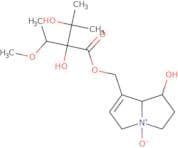
CAS 65582-53-8
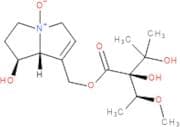
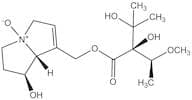
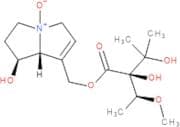
:(1-hydroxy-4-oxido-2,3,5,7a-tetrahydro-1H-pyrrolizin-7-yl)methyl 2,3-dihydroxy-2-(1-methoxyethyl)-3-methylbutanoate (non-preferred name)
Description:
The chemical substance known as (1-hydroxy-4-oxido-2,3,5,7a-tetrahydro-1H-pyrrolizin-7-yl)methyl 2,3-dihydroxy-2-(1-methoxyethyl)-3-methylbutanoate, with the CAS number 65582-53-8, is a complex organic compound characterized by its unique structural features. It contains a pyrrolizine ring, which contributes to its cyclic nature and potential biological activity. The presence of multiple hydroxyl groups indicates that it may exhibit significant polarity, potentially influencing its solubility and reactivity. The methoxyethyl group suggests that it may have ether characteristics, which can affect its interaction with other molecules. This compound may also possess functional groups that allow for hydrogen bonding, enhancing its potential for biological interactions. Given its intricate structure, it may be of interest in medicinal chemistry or as a synthetic intermediate. However, specific properties such as melting point, boiling point, and reactivity would require empirical data for precise characterization. Overall, this compound exemplifies the complexity often found in organic chemistry, particularly in the context of bioactive molecules.
Formula:C16H27NO7
InChI:InChI=1/C16H27NO7/c1-10(23-4)16(21,15(2,3)20)14(19)24-9-11-5-7-17(22)8-6-12(18)13(11)17/h5,10,12-13,18,20-21H,6-9H2,1-4H3
SMILES:CC(C(C(=O)OCC1=CCN2(=O)CCC(C12)O)(C(C)(C)O)O)OC
Sort by
Purity (%)
0
100
|
0
|
50
|
90
|
95
|
100
Found 7 products.
Europine-N-oxide 100 µg/mL in Water
CAS:Controlled ProductFormula:C16H27NO7Color and Shape:Single SolutionMolecular weight:345.388Europine n-oxide
CAS:Natural alkaloidFormula:C16H27NO7Purity:≥ 98.0 % (HPLC)Color and Shape:PowderMolecular weight:345.39Europine N-oxide
CAS:Europine N-oxide is a semi-synthetic chemical compound which originates from modified alkaloids found in various species of the pine tree. This compound is synthesized by oxidizing naturally occurring europine to produce the N-oxide form, which exhibits distinct physicochemical properties compared to its precursor. The mode of action involves interaction with specific biological targets, potentially influencing neural pathways and cellular processes, although the precise mechanisms can vary depending on the experimental context.Formula:C16H27NO7Purity:Min. 95%Color and Shape:Colorless PowderMolecular weight:345.39 g/mol