Fluorogenic Substrates
Found 217 products for "Fluorogenic Substrates".
- Lower prices
- Higher prices
- Lower purities
- Higher purities
- Faster estimated delivery
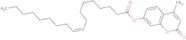
4-Methylumbelliferyl oleate
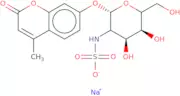
CAS:Methylumbelliferyl oleate is a MOSCERDAM® substrate targeting the lipase enzymeFormula:C28H40O4Purity:Min. 90 Area-%Color and Shape:White PowderMolecular weight:440.61 g/mol4-Methylumbelliferyl 2-deoxy-2-sulfamino-b-D-glucopyranoside sodium salt
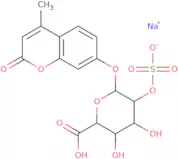
4-Methylumbelliferyl 2-deoxy-2-sulfamino-beta-D-glucopyranoside sodium salt is a fluorogenic substrate for N-sulfoglucosamine sulfohydrolase. After enzymatic cleaveage, free 4-methylumbelliferone (also known as hymecromone) is released, exhibiting blue fluorescence upon excitation with UV light. The strongest fluorescence of 4-methylumbelliferone requires deprotonation of the hydroxyl group (thus requires alkaline pH), with a maximal fluorescence intensity obtained with excitation at 350 to 370 nm and emission at 440 to 470 nm. The use of 4-methylumbelliferyl 2-deoxy-2-sulfamino-beta-D-glucopyranoside sodium saltas a substrate for measuring the N-sulfoglucosamine sulfohydrolase activity is used for screening of Mucopolysaccharidosis IIIA (MPS IIIA) and diagnosis of Sanfilippo A syndrome.Formula:C16H19NO10SNaPurity:Min. 95%Color and Shape:PowderMolecular weight:439.37 g/mol4-Methylumbelliferyl a-L-idopyranosiduronic acid 2-sulphate disodium salt - Moscerdam™ biochemical purity
CAS:PAIRED PRODUCT AVAILABLE: alpha-L-iduronidase Enzyme, FI1793834MU-alpha-L-iduronide-2-sulphate (M2) is a fluorogenic substrate of iduronate-2-sulphatase (IDS), used in a 2-step assay coupled with alpha-L-iduronidase. The assay is used in biochemical testing for Hunter syndrome (mucopolysaccharidosis II / MPS II). In a first step, IDS from biological samples cleaves the sulphate group from M2. In a second step, exogeneous alpha-L-iduronidase which cleaves the 4-MU moiety is added to the reaction, resulting in release of a fluorescent signal (Ex 360 nm / Em 455 nm). The reaction is stopped by the addition of sodium carbonate.Formula:C16H14Na2O12SPurity:Min. 99 Area-%Color and Shape:White PowderMolecular weight:476.32 g/mol4-Methylumbelliferyl a-D-glucosaminide
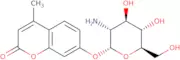
CAS:4-Methylumbelliferyl alpha-D-glucosaminide is a fluorogenic substrate for alpha-N-acetylglucosaminidase. After enzymatic cleaveage, free 4-methylumbelliferone (also known as hymecromone) is released, exhibiting blue fluorescence upon excitation with UV light. The strongest fluorescence of 4-methylumbelliferone requires deprotonation of the hydroxyl group (thus requires alkaline pH), with a maximal fluorescence intensity obtained with excitation at 350 to 370 nm and emission at 440 to 470 nm. The use of 4-methylumbelliferyl alpha-D-glucosaminideas a substrate for measuring the alpha-N-acetylglucosaminidase activity is used for Sanfilippo syndrome B and Mucopolysaccharidosis IIIB (MPS IIIB) diagnosis.Formula:C16H19NO7Purity:Min. 90 Area-%Color and Shape:White PowderMolecular weight:337.32 g/mol4-Methylumbelliferyl beta-D-lactoside
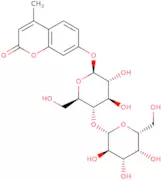
CAS:Fluorogenic substrate for beta-galactosidaseFormula:C22H28O13Purity:Min. 98 Area-%Color and Shape:White PowderMolecular weight:500.45 g/molFLsharp™ - Phosphate, disodium salt
FLsharp™ - Phosphate, disodium salt is a fluorogenic water-soluble substrate for phosphatase enzymes. Its chemical name is 6-Chloro-2-[5-chloro-2-(phosphonooxy)phenyl]-4(1H)-quinazolinone disodium salt and was developed by Molecular Probes in the 1990s. After cleavage of the substrate by phosphatase activity, an insoluble product is formed that is highly fluorescent in the solid state. Upon UV irradiation this very stable fluorophore emits green light in the 530 nm range for an extended period of time. FLsharp™ is a unique substrate - optimized for the detection of phosphatase activity in solid matrices such as agar media, tissue sections or microscopic preparations. FLsharp™ - Phosphate, disodium salt is used in microbiology as a substrate for bacterial phosphatases.
Purity:Min. 95%Fluorescein mono-b-D-galactopyranoside
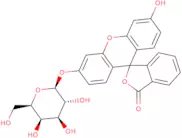
CAS:Fluorescein mono-b-D-galactopyranoside or FMG is a fluorogenic substrate for beta-galactosidase. The fluorophore fluorescein is released after enzymatic cleavage, exhibiting a greenish fluorescent. This substrate is particularly valuable in gene expression studies (e.g., lacZ reporter assays) and as a probe for cell-based assays for real-time monitoring.Purity:Min. 95%Color and Shape:PowderMolecular weight:494.45 g/molAcetyl-L-alanine 7-amido-4-methylcoumarin
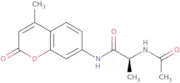
CAS:Acetyl-L-alanine 7-amido-4-methylcoumarin is a fluorogenic substrate for aminopeptidase. The enzyme cleaves the N-terminal amino acids, yielding a blue fluorescent solution.
Formula:C15H16N2O4Purity:Min. 98 Area-%Color and Shape:PowderMolecular weight:288.3 g/mol4-Methylumbelliferyl b-L-fucopyranoside
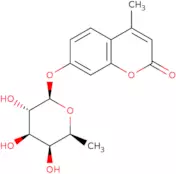
CAS:A MOSCERDAM® substrate targeting the fucosidase enzymeFormula:C16H18O7Purity:Min. 98 Area-%Color and Shape:PowderMolecular weight:322.31 g/mol4-Methylumbelliferyl b-D-cellotrioside
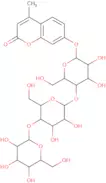
CAS:Fluorogenic cellulose analogueFormula:C28H38O18Purity:Min. 95%Color and Shape:PowderMolecular weight:662.6 g/molFluorescein diphosphate tetraammonium salt
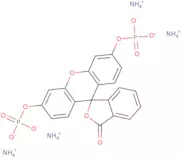
CAS:Fluorogenic substrate targeting phosphataseFormula:C20H14O11P2•(NH3)4Purity:Min. 90 Area-%Color and Shape:Yellow PowderMolecular weight:560.39 g/molL-Histidine 7-amido-4-methylcoumarin hydrochloride
CAS:L-Histidine 7-amido-4-methylcoumarin hydrochloride is a synthetic peptide substrate used as a fluorogenic substrate for histidine aminopeptidase.Formula:C16H17ClN4O3Purity:Min. 95%Molecular weight:348.79 g/mol4-Methylumbelliferyl 2-acetamido-2-deoxy-b-D-galactopyranoside-6-sulfate potassium salt
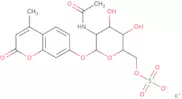
CAS:4-Methylumbelliferyl 2-acetamido-2-deoxy-beta-D-galactopyranoside-6-sulfate potassium salt is a fluorogenic substrate for N-acetylgalactosamine-6-sulfatase. After enzymatic cleaveage, free 4-methylumbelliferone (also known as hymecromone) is released, exhibiting blue fluorescence upon excitation with UV light. The strongest fluorescence of 4-methylumbelliferone requires deprotonation of the hydroxyl group (thus requires alkaline pH), with a maximal fluorescence intensity obtained with excitation at 350 to 370 nm and emission at 440 to 470 nm. The use of 4-methylumbelliferyl 2-acetamido-2-deoxy-beta-D-galactopyranoside-6-sulfate potassium saltas a substrate for measuring the N-acetylgalactosamine-6-sulfatase activity is used for diagnosis of Mucopolysaccharidosis IVA (MPS IVA) (a rare lysosomal storage disorder) and Morquio A syndrome screening.
Formula:C18H20KNO11SPurity:Min. 95%Color and Shape:PowderMolecular weight:497.52 g/mol4-Methylumbelliferyl b-D-cellotetraoside
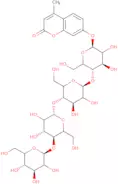
CAS:A fluorogenic MOSCERDAM® substrate targeting cellulasesFormula:C34H48O23Purity:Min. 95%Color and Shape:PowderMolecular weight:824.73 g/mol4-Methylumbelliferyl 2-acetamido-2-deoxy-β-D-glucopyranoside-6-sulfate potassium salt
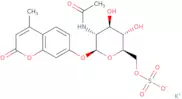
CAS:4-Methylumbelliferyl 2-acetamido-2-deoxy-beta-D-glucopyranoside-6-sulfate potassium salt is a fluorogenic substrate for beta-N-acetylglucosaminidase. After enzymatic cleaveage, free 4-methylumbelliferone (also known as hymecromone) is released, exhibiting blue fluorescence upon excitation with UV light. The strongest fluorescence of 4-methylumbelliferone requires deprotonation of the hydroxyl group (thus requires alkaline pH), with a maximal fluorescence intensity obtained with excitation at 350 to 370 nm and emission at 440 to 470 nm. The use of 4-methylumbelliferyl 2-acetamido-2-deoxy-beta-D-glucopyranoside-6-sulfate potassium saltas a substrate for measuring the beta-N-acetylglucosaminidase activity is used for diagnosis of Mucopolysaccharidosis IIIB (MPS IIIB) (a rare lysosomal storage disorder) and Sanfilippo B syndrome screening.
Formula:C18H20KNO11SPurity:Min. 95%Color and Shape:White Off-White PowderMolecular weight:497.52 g/molN-alpha-CBZ-L-Arginine 7-amido-4-methylcoumarin hydrochloride
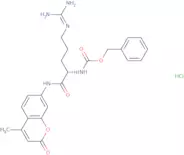
CAS:N-alpha-CBZ-L-Arginine 7-amido-4-methylcoumarin hydrochloride is a Ffluorogenic substrate used in protease activity assays.
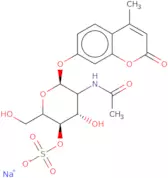
Formula:C24H27N5O5·ClHPurity:Min. 95%Color and Shape:PowderMolecular weight:501.96 g/mol4-Methylumbelliferyl 2-acetamido-2-deoxy-b-D-galactopyranoside-4-sulfate sodium salt
4-Methylumbelliferyl 2-acetamido-2-deoxy-beta-D-galactopyranoside-4-sulfate sodium salt is a fluorogenic substrate for N-acetylgalactosamine-4-sulfatase. After enzymatic cleaveage, free 4-methylumbelliferone (also known as hymecromone) is released, exhibiting blue fluorescence upon excitation with UV light. The strongest fluorescence of 4-methylumbelliferone requires deprotonation of the hydroxyl group (thus requires alkaline pH), with a maximal fluorescence intensity obtained with excitation at 350 to 370 nm and emission at 440 to 470 nm. The use of 4-methylumbelliferyl 2-acetamido-2-deoxy-beta-D-galactopyranoside-4-sulfate sodium saltas a substrate for measuring the N-acetylgalactosamine-4-sulfatase activity is used for diagnosis of Mucopolysaccharidosis VI (MPS VI) (a rare lysosomal storage disorder) and Maroteaux-Lamy syndrome screening.Purity:Min. 95%Color and Shape:White PowderMolecular weight:481.41 g/molAc-Abu-Tle-Leu-Gln-AMC TFA salt
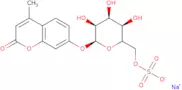
A fluorogenic substrate for detection of enzymatic activity of the SARS-CoV-2 Mpro protease. The fluorophore 7-Amino-4-methylcoumarin (AMC) is linked to the tetrapeptide via a peptide bond at the C-terminal of the glutamine residue. Following the hydrolytic activity of the Mpro protease, the fluorogenic AMC group get released from the substrate, generating a fluorescent signal (Ex 380 nm / Em 455 nm).Formula:C33H48N6O8(freebase)Purity:Min. 95.0 Area-%Molecular weight:656.77 g/mol4-Methylumbelliferyl b-D-galactopyranoside-6-sulphate sodium salt - Moscerdam™ biochemical purity
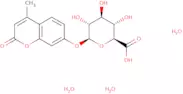
CAS:4-MU-Gal-6S (M4A) is a fluorogenic substrate of galactose-6-sulfate sulfatase (GALNS), used for the diagnosis of Mucopolysaccharidosis IV type A (MPS IV A). MPS IV, also known as Morquio syndrome, is a rare metabolic disorder in which the human body cannot process glycosaminoglycans (GAGs). MPS IV A is caused by the deficiency of the enzyme N-acetyl-galactosamine-6-sulfatase resulting in accumulation of keratan and chondroitin sulfate in tissues. M4A is used as the GALNS substrate in the anti-lysosomal enzyme antibody assay for the treatments of lysosomal storage disorders (LSDs) with enzyme replacement therapies (ERTs).Formula:C16H17NaO11SPurity:Min. 97 Area-%Color and Shape:White PowderMolecular weight:440.36 g/mol4-Methylumbelliferyl b-D-glucuronide trihydrate
CAS:Fluorogenic substrate for beta-glucuronidase GUS
Formula:C16H22O12Purity:Min. 98 Area-%Color and Shape:White PowderMolecular weight:406.34 g/mol