Fluorogenic Substrates
Found 217 products for "Fluorogenic Substrates".
- Lower prices
- Higher prices
- Lower purities
- Higher purities
- Faster estimated delivery
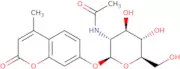
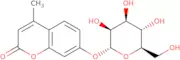
4-Methylumbelliferyl 2-acetamido-2-deoxy-b-D-glucopyranoside
CAS:Fluorogenic substrate for chitinaseFormula:C18H21NO8Purity:Min. 99 Area-%Color and Shape:White Off-White PowderMolecular weight:379.36 g/mol4-Methylumbelliferyl N,N',N''-triacetyl-b-D-chitotrioside
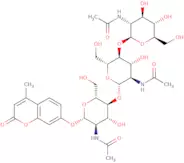
CAS:4-Methylumbelliferyl N,N',N''-triacetyl-beta-D-chitotrioside is a fluorogenic substrate for chitinase. After enzymatic cleaveage, free 4-methylumbelliferone (also known as hymecromone) is released, exhibiting blue fluorescence upon excitation with UV light. The strongest fluorescence of 4-methylumbelliferone requires deprotonation of the hydroxyl group (thus requires alkaline pH), with a maximal fluorescence intensity obtained with excitation at 350 to 370 nm and emission at 440 to 470 nm. The use of 4-methylumbelliferyl N,N',N''-triacetyl-beta-D-chitotriosideas a substrate for measuring the chitinase activity is used for fungal infection assays.Formula:C34H47N3O18Purity:Min. 95.0 Area-%Color and Shape:White Off-White PowderMolecular weight:785.75 g/molFluorescein diphosphate tetraammonium salt
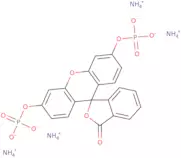
CAS:Fluorogenic substrate targeting phosphataseFormula:C20H14O11P2•(NH3)4Purity:Min. 90 Area-%Color and Shape:Yellow PowderMolecular weight:560.39 g/mol4-Methylumbelliferyl a-L-idopyranosiduronic acid sodium salt
CAS:PAIRED PRODUCT AVAILABLE: alpha-L-iduronidase Enzyme, FI179383.
4MU-alpha-L-idopyranosiduronic acid is a fluorogenic substrate for alpha-L-iduronidase. Active alpha-L-iduronidase cleaves the MU moiety from the synthetic substrate, which results in release of a fluorescent signal (Ex 360 nm / Em 455 nm). The reaction is stopped by the addition of sodium carbonate. 4MU-alpha-L-idopyranosiduronic acid is used in alpha-L-iduronidase assays in the context of biochemical characterisation of samples from patients affected by lysosomal storage disease mucopolysaccharidosis I (MPS I).Formula:C16H15NaO9Purity:Min. 98 Area-%Color and Shape:White PowderMolecular weight:374.27 g/mol4-Methylumbelliferyl acetate
CAS:Fluorogenic substrate for carboxylesteraseFormula:C12H10O4Purity:Min. 95%Color and Shape:White PowderMolecular weight:218.21 g/mol4-Methylumbelliferyl b-D-glucuronide trihydrate
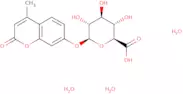
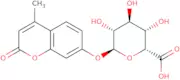
CAS:Fluorogenic substrate for beta-glucuronidase GUS
Formula:C16H22O12Purity:Min. 98 Area-%Color and Shape:White PowderMolecular weight:406.34 g/mol4-Methylumbelliferyl butyrate
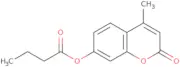
CAS:Methylumbelliferyl butyrate is structurally based on 4-methylumbelliferone and is a MOSCERDAM® substrate. It targets the esterase enzyme.
Formula:C14H14O4Purity:Min. 95%Color and Shape:White PowderMolecular weight:246.26 g/mol4-Methylumbelliferyl 2-deoxy-2-sulfamino-a-D-glucopyranoside sodium salt - Moscerdam™ biochemical purity
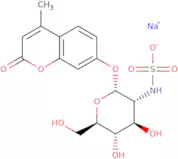
CAS:4-Methylumbelliferyl 2-deoxy-2-sulfamino-a-D-glucopyranoside sodium salt (M3A or MU-GlcNS) is a fluorogenic substrate of heparin sulfamidase, used in the diagnosis of Mucopolysaccharidosis III type A (MPS III A). MPS III A, also known as Sanfilippo syndrome type A, is caused by the deficiency of heparan N-sulfatase. Heparin sulfamidase in the assay desulfates MU-GlcNS to 4-methylumbelliferyl 2-amino-2-deoxy-α-D-glucopyranoside (MU-GlcNH2). To release fluorometrically measurable 4-methylumbelliferone (MU) and by-product glucosamine, MU-GlcNH2 is further hydrolysed by an enzyme such as yeast α-glucosidase during a second incubation.Formula:C16H18NO10SNaPurity:Min. 95 Area-%Color and Shape:White PowderMolecular weight:439.37 g/mol4-Methylumbelliferyl b-D-cellotetraoside
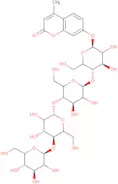
CAS:A fluorogenic MOSCERDAM® substrate targeting cellulasesFormula:C34H48O23Purity:Min. 95%Color and Shape:PowderMolecular weight:824.73 g/mol4-Methylumbelliferyl a-L-idopyranosiduronic acid
CAS:4-Methylumbelliferyl a-L-idopyranosiduronic acid is an ester that is used as a marker for the identification of glycolipids. It is a fluorogenic substrate for alpha-L-iduronidase used as a marker for the diagnosis of autoimmune diseases, including diabetic neuropathy. 4-Methylumbelliferyl a-L-idopyranosiduronic acid has been shown to inhibit inflammation and cancer, although it is not currently approved for this use. The mechanism by which 4-methylumbelliferyl a-L-idopyranosiduronic acid inhibits inflammation may be due to its ability to block cation channels on the surface of cells, thereby preventing inflammatory mediators from entering cells.Formula:C16H16O9Purity:Min. 97 Area-%Color and Shape:White Off-White PowderMolecular weight:352.29 g/mol4-Methylumbelliferyl a-D-mannopyranoside
CAS:4-Methylumbelliferyl alpha-D-mannopyranoside (4-MU-a-D-Man) is a fluorogenic substrate used in activity assays for alpha-mannosidase. When it is hydrolyzed by alpha-mannosidase, it produces a fluorescent compound, 4-methylumbelliferone (4-MU). 4-MU-a-D-Man is often used in medical research to monitor the activity of alpha-mannosidase, which is important in lysosomal storage diseases. In addition, 4-Methylumbelliferyl alpha-D-mannopyranoside has been used to study the the activity of concanavalin A, a lectin that specifically binds to alpha-D-mannopyranosyl and alpha-D-glucopyranosyl residues on various glycoproteins. The use of this fluorogenic enzyme substrate permits study the degree of alpha-D-mannosidic linkage cleavage by the enzyme.Formula:C16H18O8Purity:Min. 98 Area-%Color and Shape:White Off-White PowderMolecular weight:338.31 g/molN-Acetyl-3,7-dihydroxyphenoxazine
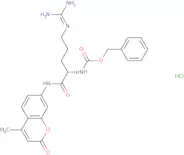
CAS:Fluorogenic substrate for peroxidaseFormula:C14H11NO4Purity:(1H-Nmr) Min. 95%Color and Shape:Slightly Brown PowderMolecular weight:257.24 g/molN-alpha-CBZ-L-Arginine 7-amido-4-methylcoumarin hydrochloride
CAS:N-alpha-CBZ-L-Arginine 7-amido-4-methylcoumarin hydrochloride is a Ffluorogenic substrate used in protease activity assays.
Formula:C24H27N5O5·ClHPurity:Min. 95%Color and Shape:PowderMolecular weight:501.96 g/mol4-Methylumbelliferyl 6-thio-palmitate-b-D-glucopyranoside - Moscerdam™ biochemical purity
CAS:4-Methylumbelliferyl 6-thio-palmitate-b-D-glucopyranoside (Mu-6S-Palm-β-Glc) is a fluorogenic substrate of palmitoyl-protein thioesterase 1 (PPT1), used in the diagnosis of infantile neuronal ceroid lipofuscinosis (INCL). INCL, also known as infantile CLN1 disease, is a rapidly progressing lysosomal storage disorder (LSD), caused by a deficiency of PPT1. Mu-6S-Palm-β-Glc is also used as the substrate in the PPT assay to investigate the retention of lysosomal enzyme activity of bi-functional IgG-PPT1 fusion protein in the delivery across blood-brain barrier.
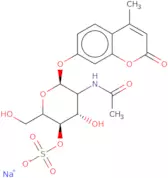
Formula:C32H48O8SPurity:Min. 95%Color and Shape:White PowderMolecular weight:592.78 g/mol4-Methylumbelliferyl 2-acetamido-2-deoxy-b-D-galactopyranoside-4-sulfate sodium salt
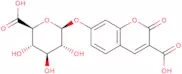
4-Methylumbelliferyl 2-acetamido-2-deoxy-beta-D-galactopyranoside-4-sulfate sodium salt is a fluorogenic substrate for N-acetylgalactosamine-4-sulfatase. After enzymatic cleaveage, free 4-methylumbelliferone (also known as hymecromone) is released, exhibiting blue fluorescence upon excitation with UV light. The strongest fluorescence of 4-methylumbelliferone requires deprotonation of the hydroxyl group (thus requires alkaline pH), with a maximal fluorescence intensity obtained with excitation at 350 to 370 nm and emission at 440 to 470 nm. The use of 4-methylumbelliferyl 2-acetamido-2-deoxy-beta-D-galactopyranoside-4-sulfate sodium saltas a substrate for measuring the N-acetylgalactosamine-4-sulfatase activity is used for diagnosis of Mucopolysaccharidosis VI (MPS VI) (a rare lysosomal storage disorder) and Maroteaux-Lamy syndrome screening.Purity:Min. 95%Color and Shape:White PowderMolecular weight:481.41 g/mol3-Carboxyumbelliferyl b-D-glucuronide
CAS:3-Carboxyumbelliferyl b-D-glucuronide serves as a highly sensitive fluorogenic substrate for detecting b-glucuronidase activity. Upon enzymatic cleavage, it generates a fluorescent product enabling easy and accurate monitoring of enzyme activity in various applications, such as diagnostics, drug discovery, and research.
Purity:Min. 95%Color and Shape:White to off-white solid.Molecular weight:382.28 g/mol4-Methylumbelliferyl a-D-arabinopyranoside
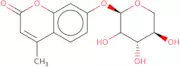
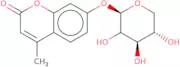
A fluorogenic MOSCERDAM® substrate targeting alpha-arabinofuranosidasePurity:Min. 95%Molecular weight:308.28 g/molAcetyl coenzyme A trilithium salt trihydrate
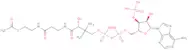
CAS:Acetyl coenzyme A trilithium salt trihydrate (ATC) is a glutathione-dependent enzyme that catalyzes the acetylation of compounds with a thiol group. Acetyl coenzyme A trilithium salt trihydrate has been shown to acetylate recombinant human and hek293 cells as well as xenobiotic compounds such as acetaminophen, chlorzoxazone, and phenacetin. The rate of acetylation depends on the concentration of glutathione and the availability of the substrate. There is no evidence that ATC conjugates or transfers acetyllysine to other proteins. It is excreted in the urine after being expressed by recombinant human and hek293 cells.END>Formula:C23H35N7O17P3S·3Li·3H2OPurity:Min. 95%Color and Shape:White PowderMolecular weight:881.42 g/mol4-Methylumbelliferyl b-L-arabinopyranoside
4-Methylumbelliferyl b-L-arabinopyranoside is a chemiluminescent substrate that is used in the detection of various enzymes and other proteins. It can be used as a fluorogenic substrate, chromogenic substrate, or enzyme substrate. 4-Methylumbelliferyl b-L-arabinopyranoside has been shown to be an effective probe for detecting catalase, cytochrome c oxidase, and peroxidase activity. This product also has applications in diagnostics and food testing.Purity:Min. 95%Molecular weight:308.28 g/mol6-Chloro-4-methylumbelliferyl b-D glucuronide
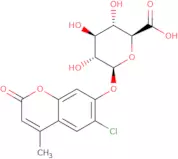
CAS:6-Chloro-4-methylumbelliferyl b-D glucuronide is a fluorogenic substrate for beta-glucuronidase that exhibits longer absorption/emission maxima (~385/500 nm) than typical 4MU-derived substrates.Formula:C16H15ClO9Purity:Min. 97 Area-%Color and Shape:White PowderMolecular weight:386.74 g/mol