Cell Cycle/Checkpoint
Cell cycle/checkpoint inhibitors are compounds that disrupt the normal progression of the cell cycle, particularly at key regulatory checkpoints. These inhibitors are crucial for studying cell division, understanding cancer cell proliferation, and developing anti-cancer therapies. By targeting specific phases of the cell cycle, these inhibitors can induce cell cycle arrest, leading to apoptosis or senescence in rapidly dividing cells. At CymitQuimica, we offer a diverse range of high-quality cell cycle/checkpoint inhibitors to support your research in cancer biology, cell biology, and drug development.
Subcategories of "Cell Cycle/Checkpoint"
- Aurora Kinase(116 products)
- CDK(547 products)
- Cell Cycle Arrest(5 products)
- Chk(48 products)
- DYRK(46 products)
- Dynamin(27 products)
- Ferroptosis(233 products)
- HSP(180 products)
- Integrin(276 products)
- Kinesin(87 products)
- LIM Kinase(21 products)
- Microtubule Associated(273 products)
- PKC(128 products)
- PLK(25 products)
- ROCK(61 products)
- Rho(6 products)
- Wee1(14 products)
- c-Myc(77 products)
Show 10 more subcategories
Found 3935 products of "Cell Cycle/Checkpoint"
Sort by
Purity (%)
0
100
|
0
|
50
|
90
|
95
|
100
ROCK-IN-5
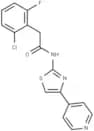
CAS:ROCK-IN-5 (I-B-37) inhibits kinases like ROCK/ERK/GSK; may aid in cardiac and neuro disease studies.Formula:C16H11ClFN3OSPurity:99.72% - 99.86%Color and Shape:SolidMolecular weight:347.791-(β-D-Xylofuranosyl)-N6-(m-methoxybenzyl)adenine
1-(β-D-Xylofuranosyl)-N6-(m-methoxybenzyl)adenine is an adenosine analog.Formula:C18H21N5O5Color and Shape:SolidMolecular weight:387.39CDK2/PIM1-IN-1
CDK2/PIM1-IN-1 is an inhibitor of the kinases CDK2 (IC50: 0.27 μM) and PIM1 (IC50: 0.67 μM). It can induce apoptosis (cell death) and reduce the expression of TNF-α, which promotes tumors. CDK2/PIM1-IN-1 exhibits antitumor activity.Color and Shape:Odour SolidN3,5-Dimethyl-2'-O-(2-methoxyethyl) uridine
N3,5-Dimethyl-2’-O-(2-methoxyethyl) uridine, a purine nucleoside analog, exhibits broad antitumor activity, particularly against indolent lymphoid malignancies.Formula:C14H22N2O7Color and Shape:SolidMolecular weight:330.33Stigmatellin
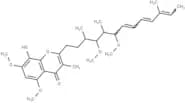
CAS:Stigmatellin is an antibiotic derived from the cell mass of the myxobacterium, effective against yeasts (yeasts), filamentous fungi (filamentous fungi), and several Gram-positive bacteria (Gram-positive bacteria). Additionally, it serves as a potent inhibitor of photosynthetic electron (photosynthetic electron) transfer. Stigmatellin utilizes various sugars, polysaccharides, and acids from the citric acid cycle as substrates, inhibiting RNA and protein synthesis. It has two different inhibitory sites: one located on the reducing side of photosystem II and the other at the cytochrome b6/f complex. Stigmatellin holds potential for use in antimicrobial and photosynthesis research.Formula:C30H42O7Color and Shape:SolidMolecular weight:514.65Ribonuclease T1
CAS:Rnase T1, an endonuclease, degrades single-stranded RNA to yield 3'-GMP oligonucleotides.
Color and Shape:SolidIRE1α kinase-IN-6
CAS:IRE1α kinase-IN-6 is a potent IRE1α inhibitor with an IC 50 value of 4.4 nM.Formula:C25H23Cl2FN6O3S2Color and Shape:SolidMolecular weight:609.522'-Chloro-N6-(3-trifluoromethyl)benzyl adenosine
2’-Chloro-N6-(3-trifluoromethyl)benzyl adenosine, a purine nucleoside analog, exhibits broad antitumor activity, particularly against indolent lymphoidFormula:C18H17ClF3N5O4Color and Shape:SolidMolecular weight:459.81LDV
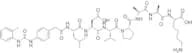
CAS:α4β1 integrin (VLA-4) ligand (Kd ~ 12 nM). Non-fluorescent derivative of LDV FITC.Formula:C48H70N10O12Purity:98%Color and Shape:SolidMolecular weight:979.13Remdesivir nucleoside monophosphate
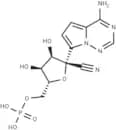
CAS:Remdesivir metabolite, antiviral nucleoside analog, effective against SARS-CoV and MERS-CoV.Formula:C12H14N5O7PColor and Shape:SolidMolecular weight:371.24N7-Methyl-guanosine-5'-triphosphate-5'-adenosine diammonium
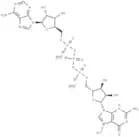
CAS:N7-Methylguanosine-5'-triphosphate-5'-adenosine (m7GpppA) diammonium, a dinucleotide cap analog, facilitates in vitro RNA transcription [1].
Formula:C21H35N12O17P3Color and Shape:SolidMolecular weight:820.49Eesperamicin A1
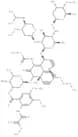
CAS:Esperamicin A1, a powerful antitumor drug, comes from Actinomadura verrucosospora.Formula:C59H80N4O22S4Color and Shape:SolidMolecular weight:1325.54Pseudouridimycin
CAS:Pseudouridimycin: a C-nucleoside antibiotic, inhibits bacterial RNAP, targets Gram-negative and Gram-positive bacteria.Formula:C17H26N8O9Purity:98%Color and Shape:SolidMolecular weight:486.446-Amino-3-(furan-2-yl)-4-methoxy-1-(β-D-ribofuranosyl)-1H-pyrazolo[3,4-d]pyrimidine
6-Amino-3-(furan-2-yl)-4-methoxy-1-(β-D-ribofuranosyl)-1H-pyrazolo[3,4-d]pyrimidine, a purine nucleoside analogue, exhibits broad antitumor activity byFormula:C15H17N5O6Color and Shape:SolidMolecular weight:363.33PKMYT1-IN-3
PKMYT1-IN-3 (compound 8ma) is a potent, selective inhibitor of PKMYT1, demonstrating an IC50 of 16.5 nM and exhibiting antitumor activity.Formula:C24H26FN5O2Color and Shape:SolidMolecular weight:435.49DSPE-PEG2000-iRGD
DSPE-PEG2000-iRGD is a PEG compound composed of DSPE and the αv-integrin targeting peptide (iRGD). The iRGD peptide binds to αv-integrins and subsequently undergoes proteolytic cleavage within tumors, producing CRGDK/R, which interacts with neuropilin-1. This compound is characterized by its tumor-targeting and tumor-penetrating properties, making DSPE-PEG2000-iRGD suitable for drug delivery applications.Color and Shape:Odour Solid2'-Deoxy-2'-fluoro-l-uridine
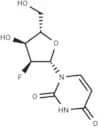
CAS:2'-Deoxy-2'-fluoro-1-uridine: an L-nucleoside, inhibits RNA viruses by blocking viral RNA polymerase.Formula:C9H11FN2O5Color and Shape:SolidMolecular weight:246.19Phen-DC3 Trifluoromethanesulfonate
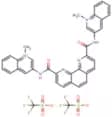
CAS:Phen-DC3 Trifluoromethanesulfonate targets G-quadruplexes and inhibits FANCJ/DinG helicases; IC50s: 65±6/50±10 nM.Formula:C36H26F6N6O8S2Purity:98%Color and Shape:SolidMolecular weight:848.75Anti-EMMPRIN/CD147 Antibody
Anti-EMMPRIN/CD147 Antibody is a human-derived antibody expressed in CHO cells, targeting Basigin. For an isotype control, refer to HumanIgG1kappa, Isotype Control.Color and Shape:Odour LiquidHDAC-IN-85
HDAC-IN-85 (Compound 1) is an HDAC inhibitor capable of crossing the blood-brain barrier. It exhibits inhibitory effects on brain tumor cell lines and can induce acetylation, resulting in DNA double-strand breaks and promoting RAD51 ubiquitination, which disrupts the DNA repair process. HDAC-IN-85 is applicable in studies of glioblastoma.Formula:C24H27FN4O5Color and Shape:SolidMolecular weight:470.49