Oligosaccharides
Subcategories of "Oligosaccharides"
- Aminoethyl Glycosides, Aminopropyl Glycosides(14 products)
- Asn Binding Glycans(33 products)
- Biotinated Oligosaccharides(13 products)
- Blood Groups and Lewis Antigens(11 products)
- Blood Type Oligosaccharides(13 products)
- Cellooligosaccharides(1 products)
- Cyclodextrins(183 products)
- Disaccharides(190 products)
- Epitope Oligosaccharides(19 products)
- Fructooligosaccharides(2 products)
- Functional Oligosaccharides(556 products)
- Functionalised Oligosaccharides(1 products)
- Galactosamine(41 products)
- Galactose(261 products)
- Galb(1-3)GalNAc(21 products)
- Ganglio-series(11 products)
- Globo- and Isoglobo-series(17 products)
- Glucosamine(128 products)
- Glucuronic Acids(52 products)
- Glycoproteins, Glycopeptides(59 products)
- Glycosaminoglycan(26 products)
- Human Milk Oligosaccharides(22 products)
- Labeled O-Glycans(9 products)
- Labeled Oligosaccharides(36 products)
- LacNAc(53 products)
- Lacto- and Neolacto-series(14 products)
- Lacto-N-biose(10 products)
- Lactooligosaccharides(7 products)
- Linker Attached Oligosaccharides(19 products)
- Maltooligosaccharides(6 products)
- Milk Oligosaccharides(31 products)
- N-Glycans(149 products)
- Natural Glycosides(177 products)
- Natural Oligosaccharides(103 products)
- O-Glycan(18 products)
- Oligosaccharide Building Blocks(7 products)
- Oligosaccharide Replacement(2 products)
- Oligosaccharides by Component Sugar(225 products)
- Oligoses(24 products)
- Other Oligosaccharides(14 products)
- PEG Oligomers(33 products)
- Phosphated Sugars(17 products)
- Protected Sugars(526 products)
- Reagents for Oligosaccharide Synthesis(254 products)
- Ser, Thr Binding Glycans(9 products)
- Sialylated Oligosaccharides(3 products)
- Sphingoglycolipids(42 products)
- Sugar Amino Acids, Sugar Peptides(20 products)
- Sugar Antigens(31 products)
- Sugar Building Blocks by Target Oligosaccharides(225 products)
- Sugar Conjugates(100 products)
- Sulfated Sugars(16 products)
- Tetrasaccharides(34 products)
- Trisaccharides and Above(95 products)
- Xylooligosaccharides(5 products)
Found 2294 products of "Oligosaccharides"
GD1a-Ganglioside sodium
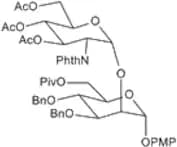
CAS:GD1a (shown as sodium salt) is one of the major gangliosides in neuronal and glial membranes. It has a core tetrasaccharide structure (Galβ1,3GalNAcβ1,4Galβ1,4Glc) with sialic acids linked α2,3/α2,8 to the inner galactose residue, α2,3 to the outer galactose residue and ceramide linked β to position 1 on the reducing terminal glucose residue (Ledeen, 2009). It interacts with myelin-associated glycoprotein (MAG) and is essential for long-term axon-myelin stability. It plays a role in viral infection as it is a receptor for viral glycoproteins in rotavirus and paramyxovirus 1. The hexasaccharide GD1a moiety was also found on a glycoprotein that acts as a receptor for adenovirus type 37. GD1a ganglioside also interacts with botulinum neurotoxin and is crucial for its entry into cells (Kolter, 2012).Formula:C84H148N4O39·xNaPurity:Min. 95%Color and Shape:White PowderMolecular weight:1,838.08 g/mol4-Methoxyphenyl 2-O-(3,4,6-tri-O-acetyl-2-deoxy-2-phthalimido-a-D-glucopyranosyl)-3,4-di-O-benzyl-6-O-pivaloy-a-D-mannopyranoside
CAS:The chemical name of the compound is 4-Methoxyphenyl 2-O-(3,4,6-tri-O-acetyl-2-deoxy-2-phthalimido-a-D-glucopyranosyl)-3,4-di-O-benzyl--6--O--pivaloyl-[a]-D--mannopyranoside. The molecular formula is C47H69NO17. The molecular weight is 838.10 g/mol. This product is a white to off white solid that has no odor and a sweet taste. Compound can be custom synthesized to customer's specification and purity requirements. The CAS number for this compound is 1820574-70-6.
Formula:C52H57NO17Purity:Min. 95%Molecular weight:968.01 g/molAgaroheptaose
CAS:Agarose is a polysaccharide found in red algae, typically Gelidium and Gracilaria. It is a strictly alternating polysaccharide of α-1,3 linked D-galactose and β-1,4 linked L-3,6 anhydrogalactose with occasional sulfation at position 6 of the anhydrogalactose residue. Agaro-oligosaccharides result from cleavage at galactose residues and neoagaro-oligosaccharides from cleavage at 3,6-anhydro residues. A number of publications have suggested that agaroheptaose has properties that include: anti-microbial, antiviral, prebiotic, anti-tumoral, immunomodulatory, anti-inflammatory, glucosidase inhibitory, and hepatoprotective properties.Formula:C42H66O33Purity:Min. 97 Area-%Color and Shape:White Off-White PowderMolecular weight:1,098.95 g/mol4'-Galactosyllactose
CAS:Galactosyllactose attenuated NF-κB inflammatory signaling in human intestinal epithelial cells and in human immature intestine. Thus, galactosyllactoses are strong anti-inflammatory agents in human colostrum and early milk, contributing to innate immune modulation. The potential clinical utility of galactosyllactose warrants investigation.Formula:C18H32O16Purity:Min. 90%Color and Shape:White PowderMolecular weight:504.44 g/mol4-Methoxyphenyl 4-O-(3,6-di-O-benzyl-2-deoxy-4-O-levulinoyl-2-phthalimido-b-D-glucopyranosyl)-3-O-benzyl-2-deoxy-2-phthalimido-b-D-g lucopyranoside
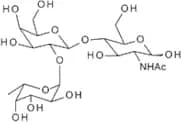
4-Methoxyphenyl 4-O-(3,6-di-O-benzyl-2-deoxy-4-O-levulinoyl-2-phthalimido-b-D-[1]glucopyranosyl)-3,6,6'-triphosphate (4MP) is a fluorinated monosaccharide that can be synthesized from 4,4'-dimethoxybenzophenone and 2,3,4,5',6'-pentachlorobenzene. This synthetic compound is used to prepare modified polysaccharides. 4MP has been shown to methylate glycoproteins and modify oligosaccharides. It has also been shown to inhibit the growth of Mycobacterium tuberculosis by inhibiting the synthesis of cell wall lipids.Formula:C61H58N2O16Purity:Min. 95%Molecular weight:1,075.12 g/molBlood group H type II trisaccharide
CAS:Core antigen fragment in ABO blood group systemFormula:C20H35NO15Purity:Min. 95%Color and Shape:White PowderMolecular weight:529.5 g/molD-Raffinose pentahydrate
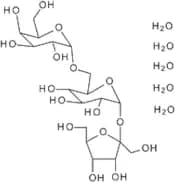
CAS:Raffinose is the most abundant of the family of oligosaccharides that are alpha-galactosyl derivatives of sucrose (Collins, 2006). The other main member of the group is the tetrasaccharide stachyose. Raffinose is found in sugar beet molasses and whole grains. Soybean oligosaccharides make up approximately 5% of dry matter in whole beans and up to 8% of dry matter in soybean meal. Together raffinose and stachyose rank second only to sucrose in abundance, as water-soluble carbohydrates (Kumar, 2010).
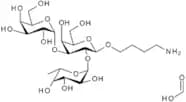
Formula:C18H32O16·5H2OPurity:Min. 98 Area-%Color and Shape:White PowderMolecular weight:594.51 g/molBlood Group B trisaccharide butylamine formate salt
Blood group antigen derivative for biochemical research
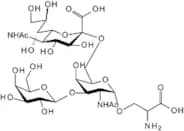
Formula:C22H41NO15·xCH2O2Purity:Min. 95%Color and Shape:White SolidMolecular weight:559.56 g/molD-Galactopyranosyl-(b1-3)-[N-acetylneuraminyl-(a2-6)]-D-N-acetylgalactosaminyl serine
D-Galactopyranosyl-(b1-3)-[N-acetylneuraminyl-(a2-6)]-D-N-acetylgalactosaminyl serine is a synthetic, fluorinated glycoside that has been modified with methylation and saccharide modifications. It is used in click chemistry to modify proteins and other biomolecules. This compound is available as a custom synthesis, and can be modified with various saccharides or oligosaccharides. D-Galactopyranosyl-(b1-3)-[N-acetylneuraminyl-(a2-6)]-D-N-acetylgalactosaminyl serine is an important carbohydrate in glycosylation reactions as it contains the sugar backbone needed for N-, O-, and S-glycosidic linkages. The CAS number for this compound is 514063-.Formula:C28H47N3O21Purity:Min. 95%Color and Shape:PowderMolecular weight:761.68 g/mol6-Sialylgalacto-N-biosyl-serine
6-Sialylgalacto-N-biosyl-serine is a custom synthesis product that has been fluorinated and modified. The material is an Oligosaccharide, Polysaccharide, saccharide, Carbohydrate, Fluorination, complex carbohydrate with a CAS number of 60919-07-2. It is highly pure with a purity of > 98% by HPLC analysis. The modification on the sugar molecule includes Click chemistry and Methylation. The monosaccharide sugar is the saccharide part of the molecule.
Formula:C28H47N3O21Purity:Min. 95%Color and Shape:White/Off-White SolidMolecular weight:761.68 g/molA1F N-Glycan
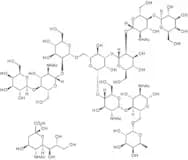
CAS:N-acetylglucosamine is a monosaccharide that is one of the building blocks of complex carbohydrates. It is found in the A1F N-glycan, which is located on the surface of cancer cells and may be a potential biomarker for endometrial cancer. A1F N-glycan has been detected in many types of cancer, including ovarian, breast, prostate, colorectal, lung, and pancreatic cancers. This glycan also has been shown to play a role in autoimmune diseases and cancer pathogenesis. The A1F N-glycan can be profiled by liquid chromatography with mass spectrometry (LC-MS).Formula:C68H114N4O50·C11H19NO9Purity:Min. 95%Color and Shape:PowderMolecular weight:2,096.9 g/molBlood group A hexasaccharide type II
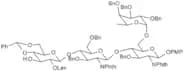
CAS:A antigen hexasaccharide Type II, possible use in antiviral developmentFormula:C40H68N2O30Purity:Min. 90 Area-%Color and Shape:White PowderMolecular weight:1,056.96 g/mol4-Methoxyphenyl 4-O-[4-O-(4,6-O-benzylidene-2-O-levulinoyl-β-D-glucopyranosyl)-3,6-di-O-benzyl-2-deoxy-2-phthalimido-β-D-glucopyrano syl]-3-O-benzyl-6-O-(2,3,4-tri-O-benzyl-α-L-fucopyranosyl)-2-deoxy-2-phthalimido-β-D-glucopyranoside
4-Methoxyphenyl 4-O-[4-O-(4,6-O-benzylidene-2-O-levulinoyl-b-D-glucopyranosyl)-3,6-di-O-benzyl-2-deoxy -2 -phthalimido -b -D -glucopyranoside] (MMPS) is a synthetic compound that has been modified for use as a fluorescent probe for the detection of saccharides. MMPS can be used to detect glycosylation or sugar modifications in proteins and carbohydrates. This compound has been shown to bind to saccharides containing a terminal glucose residue. The MMPS molecule was synthesized and found to be effective in detecting oligosaccharides with a high degree of accuracy. The MMPS molecule was also found to be useful in detecting glucose modifications on proteins and other carbohydrate structures, such as polysaccharides.Formula:C101H100N2O25Purity:Min. 95%Molecular weight:1,741.87 g/molManninotriose
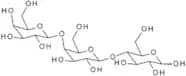
CAS:Manninotriose is a mannose-containing oligosaccharide that has been found to have high resistance against enzymes. This mannose-containing oligosaccharide can be used as a biomarker for the detection of activated macrophages in biological samples, such as serum and urine. It is also used as an activator of monoclonal antibodies, which are used in the diagnosis of autoimmune diseases. Manninotriose may act as a signal peptide for the activation of enzyme activities, such as glycosyl transferase reactions and caffeic acid hydrolase.
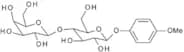
Formula:C18H32O16Purity:Min. 95 Area-%Color and Shape:White Off-White PowderMolecular weight:504.44 g/mol4-Methoxyphenyl 4-O-(b-D-galactopyranosyl)-b-D-glucopyranoside
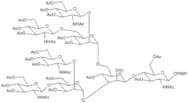
CAS:4-Methoxyphenyl 4-O-(b-D-galactopyranosyl)-b-D-glucopyranoside is a carbohydrate with the CAS number 150412-80-9. It is an Oligosaccharide that is synthesized from monosaccharides and saccharides. This product can be custom synthesized to produce high purity, methylated, glycosylated and fluorinated products. There are many modifications that can be made to this carbohydrate using Click chemistry.Formula:C19H28O12Purity:Min. 95%Color and Shape:PowderMolecular weight:448.42 g/mol4-Methoxyphenyl 2-acetamido-3,6-di-O-acetyl-4-O-{2,4-di-O-acetyl-3-O-[3,6-di-O-acetyl-2,4-di-O-(3,4,6-tri-O-acetyl-2-acetamido-2-deo xy-b-D-glucopyranosyl)-a-D-mannopyranosyl]-6-O-[3,4-di-O-acetyl-2,6-di-O-(3,4,6-tri-O-acetyl-2-acetamido-2-deoxy-b-D-g
4-Methoxyphenyl 2-acetamido-3,6-di-O-acetyl-4-O-[2,4-di-O-(3,6,9)-triacetyldi-O-(3,4,6)-triacetyldiacetamido]-bDglucopyranoside (MPPA) is a modification of the natural oligosaccharide 3,6,-di-O-(2,4-di-O-(3,6,9)-triacetyldiacyl)-bDmannopyranosyl. MPPA is synthesized by methylation and glycosylation of glucose residues in the backbone of the natural oligosaccharide. The methylated glycosidic linkages are substituted for acetamido groups in order to confer water solubility to the molecule. MPPA has been shown to be an effective inhibitor of influenza virus replication in vitro.
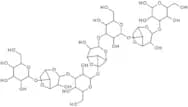
Formula:C105H143N5O62Purity:Min. 95%Molecular weight:2,467.26 g/molChitoheptaose 7HCl
CAS:Chitoheptaose 7HCl is a synthetic, complex carbohydrate with a CAS number of 68232-35-9. This product is custom synthesized to order and can be modified according to your specifications. It is available in high purity.
Formula:C42H79N7O29·7HClPurity:Min. 95 Area-%Color and Shape:PowderMolecular weight:1,401.34 g/molLacto-N-difucohexaose I
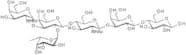
CAS:Fucosyloligosaccharide present in human milk and colostrumFormula:C38H65NO29Purity:Min. 95 Area-%Color and Shape:White PowderMolecular weight:999.91 g/molLactose - anhydrous
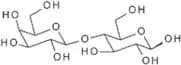
CAS:Anhydrous lactose is an excipient, filler, diluent, and bulking agent in a wide variety of pharmaceutical tablets, capsules, powders and other preparations. It also has applications as a nutrient and multi-functional ingredient in infant formulae, geriatric, dietetic and health foods and may be used as an ingredient in culture media.
Formula:C12H22O11Purity:Min. 98 Area-%Color and Shape:PowderMolecular weight:342.3 g/molMaltobionic acid
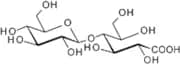
CAS:An antioxidant chelator used in skin care. Also used in organ transplantation preservation solutions, due to its ability to inhibit hydroxyl radical production, via the complexation of oxidation-promoting iron found in blood.Formula:C12H22O12Color and Shape:White PowderMolecular weight:358.3 g/mol


![D-Galactopyranosyl-(b1-3)-[N-acetylneuraminyl-(a2-6)]-D-N-acetylgalactosaminyl serine](/_next/image/?url=https%3A%2Fstatic.cymitquimica.com%2Fproducts%2F3D%2Fthumb-webp%2FOG15272.webp&w=3840&q=75)