Oligosaccharides
Subcategories of "Oligosaccharides"
- Aminoethyl Glycosides, Aminopropyl Glycosides(14 products)
- Asn Binding Glycans(33 products)
- Biotinated Oligosaccharides(13 products)
- Blood Groups and Lewis Antigens(11 products)
- Blood Type Oligosaccharides(13 products)
- Cellooligosaccharides(1 products)
- Cyclodextrins(183 products)
- Disaccharides(190 products)
- Epitope Oligosaccharides(19 products)
- Fructooligosaccharides(2 products)
- Functional Oligosaccharides(556 products)
- Functionalised Oligosaccharides(1 products)
- Galactosamine(41 products)
- Galactose(261 products)
- Galb(1-3)GalNAc(21 products)
- Ganglio-series(11 products)
- Globo- and Isoglobo-series(17 products)
- Glucosamine(128 products)
- Glucuronic Acids(52 products)
- Glycoproteins, Glycopeptides(59 products)
- Glycosaminoglycan(26 products)
- Human Milk Oligosaccharides(22 products)
- Labeled O-Glycans(9 products)
- Labeled Oligosaccharides(36 products)
- LacNAc(53 products)
- Lacto- and Neolacto-series(14 products)
- Lacto-N-biose(10 products)
- Lactooligosaccharides(7 products)
- Linker Attached Oligosaccharides(19 products)
- Maltooligosaccharides(6 products)
- Milk Oligosaccharides(31 products)
- N-Glycans(149 products)
- Natural Glycosides(177 products)
- Natural Oligosaccharides(103 products)
- O-Glycan(18 products)
- Oligosaccharide Building Blocks(7 products)
- Oligosaccharide Replacement(2 products)
- Oligosaccharides by Component Sugar(225 products)
- Oligoses(24 products)
- Other Oligosaccharides(14 products)
- PEG Oligomers(33 products)
- Phosphated Sugars(17 products)
- Protected Sugars(526 products)
- Reagents for Oligosaccharide Synthesis(254 products)
- Ser, Thr Binding Glycans(9 products)
- Sialylated Oligosaccharides(3 products)
- Sphingoglycolipids(42 products)
- Sugar Amino Acids, Sugar Peptides(20 products)
- Sugar Antigens(31 products)
- Sugar Building Blocks by Target Oligosaccharides(225 products)
- Sugar Conjugates(100 products)
- Sulfated Sugars(16 products)
- Tetrasaccharides(34 products)
- Trisaccharides and Above(95 products)
- Xylooligosaccharides(5 products)
Found 2294 products of "Oligosaccharides"
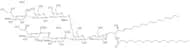
GT1b-Ganglioside ammonium
CAS:GT1b ganglioside (ammonium salt) has a core tetrasaccharide structure (Galβ1,3GalNAcβ1,4Galβ1,4Glc) with two sialic acids (NeuAc) linked α2,3/α2,8 to the inner galactose residue, sialic acid (NeuAc) linked α2,3 to the terminal galactose residue, and ceramide linked β to position 1 on the reducing terminal glucose residue (Ledeen, 2009). GT1b ganglioside is one of the major gangliosides in neuronal and glial membranes. It interacts with myelin-associated glycoprotein (MAG) and is essential for long-term axon-myelin stability. GT1b ganglioside also acts as a receptor for bacterial toxins, such as, tetanus and botulinum toxins (Nishiki, 1996), as well as for viruses. A few examples of which include: Merkel cell polyomavirus, JC virus, BK virus, norovirus, and others (Low, 2006).Formula:C95H165N5O48·xNH4Purity:Min. 95%Color and Shape:PowderMolecular weight:2,145.33 g/mol1,6-Anhydro-b-D-cellopentose
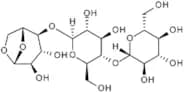
CAS:1,6-Anhydro-b-D-cellopentose is a synthetic cello-oligomerFormula:C30H50O25Purity:Min. 95%Color and Shape:PowderMolecular weight:810.7 g/molBenzyl 4-O-(b-D-galactopyranosyl)-b-D-xylopyranoside
CAS:Benzyl 4-O-(b-D-galactopyranosyl)-b-D-xylopyranoside is a synthetic monosaccharide that has been modified with fluorine. This compound is used to modify complex carbohydrates like glycosaminoglycans and glycoproteins. It is also used in the synthesis of oligosaccharides and polysaccharides, as well as in click chemistry. Benzyl 4-O-(b-D-galactopyranosyl)-b-D-xylopyranoside is available for custom synthesis, and can be ordered in high purity.Formula:C18H26O10Purity:Min. 95%Color and Shape:PowderMolecular weight:402.39 g/mol1,6-Anhydro-β-D-cellotriose
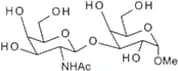
CAS:Produced by the fast pyrolysis of celluloseFormula:C18H30O15Purity:Min. 95%Color and Shape:PowderMolecular weight:486.42 g/molMethyl 3-O-(2-acetamido-2-deoxy-b-D-galactopyranosyl)-a-D-galactopyranoside
CAS:Methyl 3-O-(2-acetamido-2-deoxy-b-D-galactopyranosyl)-a-D-galactopyranoside is a sugar that is synthesized by the Click modification of 3,4,6-trihydroxybenzoic acid and 2,3,6,7,8-pentahydroxyacetophenone. This sugar is used in glycosylation reactions to modify proteins or peptides.Formula:C15H27NO11Purity:Min. 95%Color and Shape:White PowderMolecular weight:397.38 g/molN,N'-Diacetylchitobiose
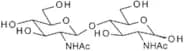
CAS:Carbon source for E. coli; inhibitor of lysozymesFormula:C16H28N2O11Purity:Min. 95%Color and Shape:White PowderMolecular weight:424.4 g/molLacto-N-biose
CAS:Neutral disaccharide naturally present in human breast milk and possible bifidus factor, acceptor for the Helicobacter pylori enzyme α1,2-fucosyltransferase and disaccharide involved in the expression of Lewis blood group antigens.Formula:C14H25NO11Purity:Min. 90%Color and Shape:White PowderMolecular weight:383.35 g/molTrehalose-6,6'-dibehenate
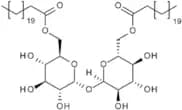
CAS:Trehalose-6,6'-dibehenate (TDB) is a novel synthetic lipid that has been shown to have beneficial effects in the treatment of inflammatory bowel disease. This compound may act as an anti-inflammatory agent by inhibiting toll-like receptor 4 (TLR4)-mediated signaling and TLR4-dependent production of proinflammatory cytokines. TDB also inhibits HIV infection by interfering with CD4+ T cell function and decreasing the number of CD4+ cells in the gut. In addition, TDB has been shown to be effective against lps-induced inflammatory response in cell culture.
Formula:C56H106O13Purity:One SpotColor and Shape:PowderMolecular weight:987.43 g/mol1,4-β-D-Xylobiitol
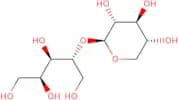
CAS:1,4-β-D-Xylobiitol is a monosaccharide that is synthesized by the glycosylation of β-D-xylose. It is an important component of complex carbohydrates found in plants and animals. Xylobiitol can be modified with methylation or Click chemistry to produce 1,4-β-D-xylopyranosiduronic acid and 1,4-β-D-xylopyranuronic acid respectively. In addition, it can be fluorinated to create 1,4-β-D-fluoroxylobiitol and modified with saccharide or oligosaccharides to produce 1,4-[α]-,1,3-[α]- or 1,3-[β]-linked xylobiitols. Xylobiitol can also be modified with polysaccharides to form xylanolybioside conjugates in which GlcUA residues are linked
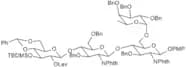
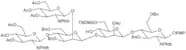
Formula:C10H20O9Purity:Min. 95%Color and Shape:PowderMolecular weight:284.26 g/mol4-Methoxyphenyl 4-O-[4-O-(4,6-O-benzylidene-3-O-tert-butyldimethylsilyl- 2-O-levulinoyl-β-D-glucopyranosyl)-3,6-di-O-benzyl-2-deoxy-2 -phthalimid o-β-D-glucopyranosyl]-3-O-benzyl-6-O-(tri-O-benzyl-α-L-fucopyranosyl)-2- deoxy-2-phthalimido-β-D-glucopyranos
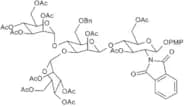
4-Methoxyphenyl 4-O-[4-O-(4,6-O-benzylidene-3-O-tert-butyldimethylsilyl-2-O -levulinoyl)-b,D,Glucopyranosyl]-3,6,-di-, Obenzyl 2deoxy 2phthalimido bDglucopyranosyl]-2deoxy 2phthalimido bDglucopyrano sugar is a complex carbohydrate that has been synthesized in a custom synthesis. It is composed of a glucose oligosaccharide with a methoxyphenol glycoside at the reducing terminus and an α-(1,6)-linked mannose at the nonreducing terminus. The carbohydrate has been modified by fluorination and methylation. The molecule contains an acetal bond between the carbonyl group of the terminal monosaccharide and theFormula:C107H114N2O25SiPurity:Min. 95%Molecular weight:1,856.13 g/mol4-Methoxyphenyl 4-O-[2-O-acetyl-3,4-di-O-(2,3,4,6-tetra-O-acetyl-α-D-mannopyranosyl)-6-O-benzyl-β-D-mannopyrannosyl]-3,6-di-O-acetyl -2-deoxy-2-phthalimido-β-D-glucopyranoside
This compound is a glycosylation product of 4-methoxyphenol, 4-O-[2-O-acetyl-3,4-di-O-(2,3,4,6-tetra-O-acetyl-aD-mannopyranosyl)-6-O-benzyl -bD -mannopyrannoside]-, 3,6 -di -O -acetyl-. It has been custom synthesized for your order. This product is offered at high purity and with low background fluorescence.
Formula:C68H79NO34Purity:Min. 95%Molecular weight:1,454.34 g/molBlood Group A pentasaccharide
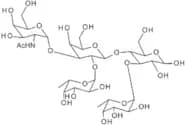
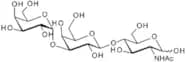
CAS:Core antigen fragment in ABO blood group systemFormula:C32H55NO24Purity:Min. 95%Color and Shape:White PowderMolecular weight:837.77 g/molBlood group B hexasaccharide type I
Gala1-3(Fuca1-2)Galb1-3GlcNAcb1-3Galb1-4Glc (B antigen hexasaccharide Type I)Formula:C38H65NO30Purity:Min. 90 Area-%Color and Shape:PowderMolecular weight:1,015.91 g/molLactose SPRAY-DRIED
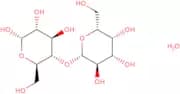
CAS:Lactose is the principal sugar in human and most other mammalian milks, ( 4-O-(beta-d-galactopyranosyl)-d-glucopyranose). Lactose undergoes mutarotation; it is a reducing sugar and is significantly less soluble in water than sucrose. Lactose is much less sweet than sucrose (at ~1% about 0.15 (sucrose=1). The enzyme lactase (beta-galactosidase), which is present in the small intestine, catalyzes hydrolysis of lactose to form glucose and galactose. Anhydrous lactose is an excipient, filler, diluent, and bulking agent in a wide variety of pharmaceutical tablets, capsules, powders and other preparations. Lactose also has applications as a nutrient and multi-functional ingredient in infant formulae, geriatric, dietetic and health foods.
Formula:C12H22O11·H2OPurity:Min. 96 Area-%Color and Shape:White Off-White PowderMolecular weight:360.31 g/molLinear B-2 trisaccharide
CAS:Linear B-2 trisaccharide is a human serum glycoprotein that belongs to the group of glycoconjugates. It has been shown to have clinical relevance in the detection of cancer and infectious diseases, as well as for use in the treatment of cancer. Linear B-2 trisaccharide can be used in combination with monoclonal antibodies for diagnosis and treatment of cancer. This molecule is also an inhibitor of both influenza virus hemagglutinin and HIV gp120, which may be due to its ability to react with specific carbohydrate structures on these proteins. Linear B-2 trisaccharide is biocompatible and can be used in the development of biodegradable polymers. The linearity of this molecule makes it more stable than other related molecules, such as glycopeptides.Formula:C20H35NO16Purity:Min. 95%Color and Shape:PowderMolecular weight:545.49 g/mol2-O-β-D-Galactopyranosyl-D-galactose
CAS:Please enquire for more information about 2-O-β-D-Galactopyranosyl-D-galactose including the price, delivery time and more detailed product information at the technical inquiry form on this pageFormula:C12H22O11Purity:Min. 95%Molecular weight:342.30 g/mol4-Methoxyphenyl 4-O-{2-O-acetyl-3-O-[2,4-di-O-(3,4,6-tri-O-acetyl-2-deoxy-2-phthalimido-β-D-glucopyranosyl)-3,6-di-O-benzyl-β-D-mann opyranosyl]-6-O-tert-butyldimethylsilyl-β-D-mannopyranosyl}-3,6-di-O-benzyl-2-deoxy-2-phthalimido-β-D-glucopyranoside
4-Methoxyphenyl 4-O-{2-O-acetyl-3-O-[2,4-di-O-(3,4,6-tri-O-acetyl-2,6 glycoside)-bDglucopyranosyl]-3,6 di -Obenzyl - bDmannopyranosyl} - 3,6 di -Obenzyl 2 deoxy 2 phthalimido bDglucopyranoside is a synthetic compound that belongs to the group of oligosaccharides. It is a modification of a monosaccharide with methylation and fluorination. The synthesis of this compound includes the use of Click chemistry for glycosylation. The CAS number is 766913–30–8.Formula:C109H119N3O37SiPurity:Min. 95%Molecular weight:2,091.19 g/molN,N',N'',N''',N'''',N''''',N''''''-Heptaacetylchitoheptaose
CAS:Chitinases are enzymes that hydrolyze chitin, a polysaccharide found in the exoskeleton of insects, fungi and other invertebrates. Chitohexaose is a sugar that has been shown to have anti-inflammatory properties. It is a carbohydrate with six acetyl groups attached to it. When this sugar reacts with ammonium bicarbonate (NH4HCO3) in an acidic environment, it produces N,N',N'',N''',N'''',N''''',N''''''-heptaacetylchitoheptaose. This reaction system can be used as a chitinase preparation for investigating the biological effects of chitohexaose. The magnetic resonance spectroscopy was used to study the reaction system and revealed that the product is a hexamer with six acetyl groups on each monomer.
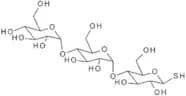
Formula:C56H93N7O36Purity:Min. 95%Color and Shape:PowderMolecular weight:1,440.36 g/mol4-O-(4-O-(α-D-Glucopyranosyl)-α-D-glucopyranosyl)-β-D-thioglucopyranose
4-O-(4-O-(a-D-Glucopyranosyl)-a-D-glucopyranosyl)-b-D-thioglucopyranose is a glycosylation product of the sugar 4-O-(4-O-(a-D-glucopyranosyl)-a-D-glucopyranosyl) b -D -thioglucopyranose. It is synthesized by reaction of 4,5,6,7,8,9,10,11,12,13,14 and 15 with a 1:1 molar ratio. The product can be modified to methylated or fluorinated products using the click chemistry method.Formula:C18H32O15SPurity:Min. 95%Molecular weight:520.5 g/mol2-Amino-2-deoxy-3-O-(b-D-glucopyranuronosyl)-D-galactopyranose monohydrate
CAS:2-Amino-2-deoxy-3-O-(b-D-glucopyranuronosyl)-D-galactopyranose monohydrate is a glycoside that is found in the testes. It has inhibitory properties on oligosaccharides and can be used to study the structure of glycoconjugates. 2-Amino-2-deoxy-3-O-(b-D-glucopyranuronosyl)-D-galactopyranose monohydrate has been shown to inhibit the enzyme hydrolase, which is involved in glycoprotein synthesis. 2ADOGP has also been shown to bind to human serum albumin, an abundant protein in human blood plasma that transports lipids, hormones, and other molecules throughout the body. This binding results in a decrease in the serum concentration of 2ADOGP after administration.Formula:C12H21NO11H2OColor and Shape:Off-White PowderMolecular weight:373.31 g/mol