Oligosaccharides
Oligosaccharides are carbohydrates composed of a small number of monosaccharide units linked by glycosidic bonds. These molecules play significant roles in various biological processes, including cell recognition, signaling, and immune responses. In this section, you will find a comprehensive selection of oligosaccharides essential for research in glycoscience, biochemistry, and molecular biology. These compounds are vital for studying complex carbohydrate structures, their functions, and their interactions with other biomolecules. At CymitQuimica, we provide high-quality oligosaccharides to support your research and development needs, ensuring accurate and reliable results in your experiments.
Subcategories of "Oligosaccharides"
- Aminoethyl Glycosides, Aminopropyl Glycosides(14 products)
- Asn Binding Glycans(33 products)
- Biotinated Oligosaccharides(13 products)
- Blood Groups and Lewis Antigens(11 products)
- Blood Type Oligosaccharides(13 products)
- Cellooligosaccharides(1 products)
- Cyclodextrins(183 products)
- Disaccharides(192 products)
- Epitope Oligosaccharides(19 products)
- Fructooligosaccharides(2 products)
- Functional Oligosaccharides(554 products)
- Functionalised Oligosaccharides(1 products)
- Galactosamine(41 products)
- Galactose(261 products)
- Galb(1-3)GalNAc(21 products)
- Ganglio-series(11 products)
- Globo- and Isoglobo-series(17 products)
- Glucosamine(128 products)
- Glucuronic Acids(51 products)
- Glycoproteins, Glycopeptides(59 products)
- Glycosaminoglycan(26 products)
- Human Milk Oligosaccharides(20 products)
- Labeled O-Glycans(9 products)
- Labeled Oligosaccharides(36 products)
- LacNAc(53 products)
- Lacto- and Neolacto-series(14 products)
- Lacto-N-biose(10 products)
- Lactooligosaccharides(7 products)
- Linker Attached Oligosaccharides(19 products)
- Maltooligosaccharides(6 products)
- Milk Oligosaccharides(31 products)
- N-Glycans(149 products)
- Natural Glycosides(177 products)
- Natural Oligosaccharides(103 products)
- O-Glycan(18 products)
- Oligosaccharide Building Blocks(7 products)
- Oligosaccharide Replacement(2 products)
- Oligosaccharides by Component Sugar(225 products)
- Oligoses(24 products)
- Other Oligosaccharides(14 products)
- PEG Oligomers(33 products)
- Phosphated Sugars(17 products)
- Protected Sugars(526 products)
- Reagents for Oligosaccharide Synthesis(254 products)
- Ser, Thr Binding Glycans(9 products)
- Sialylated Oligosaccharides(3 products)
- Sphingoglycolipids(42 products)
- Sugar Amino Acids, Sugar Peptides(20 products)
- Sugar Antigens(31 products)
- Sugar Building Blocks by Target Oligosaccharides(225 products)
- Sugar Conjugates(100 products)
- Sulfated Sugars(16 products)
- Tetrasaccharides(34 products)
- Trisaccharides and Above(95 products)
- Xylooligosaccharides(5 products)
Show 47 more subcategories
Found 2278 products of "Oligosaccharides"
Sort by
Purity (%)
0
100
|
0
|
50
|
90
|
95
|
100
1,5-a-L-Arabinoheptaose
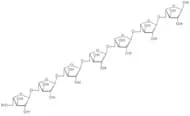
CAS:<p>1,5-a-L-Arabinoheptaose is a sugar that is found in the cell walls of bacteria. The chemical modification of this sugar has been studied extensively. The modification of this sugar with methyl groups and click chemistry has been shown to alter its properties, such as binding affinity and solubility. This modified sugar can be used for glycosylation reactions or custom synthesis. 1,5-a-L-Arabinoheptaose is also available in high purity and with a custom synthesis.</p>Formula:C35H58O29Purity:Min. 95%Color and Shape:PowderMolecular weight:942.82 g/mol4-O-(b-D-Galactopyranosyl)-D-glucosamine HCl
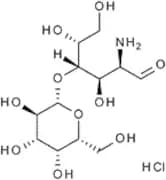
CAS:<p>4-O-(b-D-Galactopyranosyl)-D-glucosamine HCl is a synthetic, water soluble, non-digestible oligosaccharide. It has regulatory effects on the utilisation of glucose and lacto-n-neotetraose by various cells in vitro. This compound also inhibits the development of intestinal pathogens in humans and elucidates their sequence specificity. 4-O-(b-D-Galactopyranosyl)-D-glucosamine HCl is used to study the role of this molecule in infant nutrition.</p>Formula:C12H23NO10·HClPurity:Min. 95%Color and Shape:PowderMolecular weight:377.77 g/mol1,3:1,4 b-Glucotriose (A)
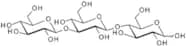
CAS:<p>1,3:1,4 b-Glucotriose (A) is a custom synthesis that is available with a purity of ≥98%. It is a fluorinated polysaccharide with a complex structure that can be modified to produce different variations. The methylation status of the compound can be customized as well. This product is an oligosaccharide and polysaccharide sugar that contains one glucose unit. It has been synthesized from the monosaccharide sugar and it can be used for chemical modification or for research purposes.</p>Formula:C18H32O16Purity:Min. 95%Color and Shape:White PowderMolecular weight:504.44 g/molHyaluronate biotin - Molecular Weight - 750kDa
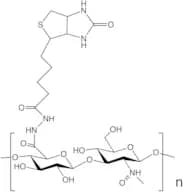
<p>Hyaluronate biotin is a custom synthesis of 750kDa. It has been modified with fluorination, methylation and click modification. This product is a glycosylation of saccharide, which is a carbohydrate that can be found in many foods and is used as a sweetener. The saccharides are complex carbohydrates that consist of long chains of monosaccharides or simple sugars. Click modification is the process by which a small molecule, usually an azide group or nitrenium ion, reacts with an electron-deficient alkyne group to produce a new covalent bond without breaking either existing bond.</p>Purity:Min. 95%Blood group B trisaccharide-GEL
<p>Gala1-3(Fuca1-2)Gal Conjugated to BSA on Fractogel with glycosylamine formation</p>Purity:Min. 95%Cellotrionic acid
CAS:<p>Cellotrionic acid is a biochemical that is found in the cell walls of bacteria. It is also known as Cellotriose, which is a type of sugar molecule. Cellotriose is composed of three molecules of glucose and it has reactive hydroxy groups. Hydroxy groups are reactive because they can form hydrogen bonds with other molecules. Cellotrionic acid has been shown to have a redox potential, which means that it can either accept or donate electrons. The crystalline structure of cellotrionic acid is similar to that of glucose and can be represented by the formula C6H8O6. Cellotrionic acid has been shown to have aerobic properties, meaning it requires oxygen for metabolism. One example of an aerobic process where cellotrionic acid participates in is the transfer of electrons during the oxidation-reduction reactions in photosynthesis. This biochemical also participates in glycolysis, which occurs during cellular respiration when sugars are broken down into smaller fragments</p>Formula:C18H32O17Purity:Min. 95%Molecular weight:520.44 g/mol6-O-Sulphated Lewisa-BSA
<p>Lewisa-BSA is a modified form of BSA that contains 6-O sulfated sugars. This carbohydrate is used in the treatment of diabetes and other metabolic disorders. Lewisa-BSA is synthesized by the modification of BSA with a series of oligosaccharide residues. The carbohydrate chains are then methylated, glycosylated, and finally sulfated. This process provides Lewisa-BSA with high purity and high stability.</p>Purity:Min. 95%3',4'-O-Carbonyl-6,6'-di-O-tert-butyldiphenylsilyl lactal
CAS:<p>3',4'-O-Carbonyl-6,6'-di-O-tert-butyldiphenylsilyl lactal is a synthetic oligosaccharide that has been modified with a click modification. It is comprised of 3 different monosaccharides, one saccharide, and one carbonyl group. This carbohydrate is synthesized from the natural sugar D-ribose, which is modified with an O-tert-butyldiphenylsilyl lactal. The synthesis begins with the addition of a methyl group to the sugar's primary hydroxyl group. Then the sugar is reacted with fluorine gas to form an ether bond between the sugar's primary hydroxyl and its secondary hydroxyl. The final step in the synthesis involves glycosylation of the terminal hydroxyl groups on each monosaccharide.</p>Formula:C45H54O10Si2Purity:Min. 95%Molecular weight:811.08 g/mol1,4-b-D-Cellohexaitol
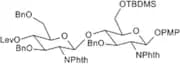
CAS:<p>1,4-B-D-cellobiohexaitol is a potent inhibitor of cellobiose phosphorylase and has been shown to inhibit the activity of this enzyme in a competitive manner. 1,4-B-D-cellobiohexaitol binds to cellulose and other sugars, which may be related to its toxicity. It is not toxic to animals because they do not have the same sugar binding sites as bacteria. 1,4-B-D-cellobiohexaitol has been shown to be effective against Streptomyces lividans and S. coelicolor. This substance inhibits Streptomyces growth by binding to glucose and galactose present in the cell wall of these organisms.</p>Formula:C36H64O31Purity:Min. 95%Molecular weight:992.87 g/mol4-Methoxyphenyl 4-O-(3,6-di-O-benzyl-2-deoxy-4-O-levulinoyl-2-phthalimido-b-D-glucopyranosyl)-3-O-benzyl-6-O-tert-butyldimethylsilyl -2-deoxy-2-phthalimido-b-D-glucopyranoside
<p>4-Methoxyphenyl 4-O-(3,6-di-O-benzyl-2-deoxy-4-O-levulinoyl-2-phthalimido-b-D-glucopyranosyl)-3,6,3'-tri O -benzylidene -2,4′-(1,3,5) triazine -6,7′-[1,3]dioxane</p>Formula:C67H72N2O16SiPurity:Min. 95%Molecular weight:1,189.38 g/molBlood group A trisaccharide-APE-[biotin]-BSA
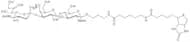
<p>ABO trisaccharide conjugated to BSA via Biotin & an aminophenyl ethyl spacer</p>Purity:Min. 95%3'-a-Sialyl-N-acetyllactosamine-sp-biotin
CAS:<p>3'-a-Sialyl-N-acetyllactosamine-sp-biotin is a custom synthesis, modification, fluorination, methylation, monosaccharide, synthetic, click modification, oligosaccharide, saccharide and polysaccharide. It has CAS No. 870892-22-1 and a molecular weight of 590. It is used to modify proteins with glycosylation sites.</p>Formula:C44H74N6O22SPurity:Min. 95%Color and Shape:White PowderMolecular weight:1,071.15 g/molAcarbose tridecaacetate
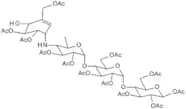
CAS:<p>Acarbose tridecaacetate is a bacterial extract that has been shown to inhibit the growth of various strains of bacteria. This extract was extracted from the fields and contains aluminum oxide impurities. Acarbose tridecaacetate has shown efficacy in seed culture and actinomyces, which are two types of bacteria. The sequence of this extract has been determined using aluminum oxide. Acarbose tridecaacetate is soluble in a variety of solvents, including organic solvents and solvents. It can be purified by chromatography to remove any bulk drug or organic solvent that may be present.</p>Formula:C51H69NO31Purity:Min. 95%Color and Shape:White PowderMolecular weight:1,192.08 g/molHyaluronate biotin - Molecular Weight - 10kDa
<p>Hyaluronate biotin is a custom synthesis of a 10kDa molecule. This product is modified and fluorinated, with methylation of the hydroxyl group and the glycosylation of the sugar monosaccharide. It is a synthetic oligosaccharide that is saccharide-containing. This product has CAS number and belongs to the group of polysaccharides or glycosylations. The carbohydrate in this product is complex.</p>Purity:Min. 95%Color and Shape:White PowderHeparin disaccharide II-H disodium salt
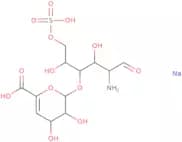
CAS:<p>Heparin disaccharide II-H disodium salt is a complex carbohydrate with the chemical formula C3H6Na2O14. It has a molecular weight of 617.8 and a melting point of 204.5°C. The compound has been modified by methylation, glycosylation, fluorination, and click modification. It is a synthetic oligosaccharide with high purity and custom synthesis.</p>Formula:C12H18NNaO13SPurity:Min. 95%Molecular weight:439.33 g/molAsialo-GM1-pentasaccharide-APD-HSA
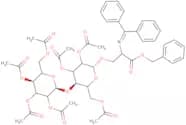
<p>Asialo-GM1-pentasaccharide-APD-HSA is a complex carbohydrate that is custom synthesized. It has high purity and CAS No. This product is a monosaccharide, methylated, glycosylated, polysaccharide with sugar and fluorinated saccharides.</p>Purity:Min. 95%N-Diphenylmethylene-O-(2,3,6,2',3',4',6'-hepta-O-acetyl-b-D-lactosyl)-L-serine, benzyl ester
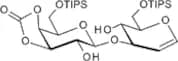
CAS:<p>N-Diphenylmethylene-O-(2,3,6,2',3',4',6'-hepta-O-acetyl-b-D-lactosyl)-L-serine, benzyl ester is a complex carbohydrate that is used for the modification of saccharides. This compound has been synthesized using Click chemistry and NMR spectroscopy. It has a CAS number of 337903-59-0 and is an off white solid with a melting point of 155°C to 158°C.</p>Formula:C49H55NO20Purity:Min. 95%Molecular weight:977.96 g/mol3',4'-O-Carbonyl-6,6'-di-O-triisopropylsilyl lactal
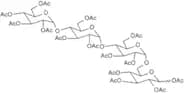
CAS:<p>3',4'-O-Carbonyl-6,6'-di-O-triisopropylsilyl lactal is a custom synthesis used for the modification of complex carbohydrates with glycosylation and methylation. It can be used to synthesize oligosaccharides or polysaccharides with high purity and good yield. 3',4'-O-Carbonyl-6,6'-di-O-triisopropylsilyl lactal is also an effective fluorinating agent that can be used in the synthesis of monosaccharides by click chemistry.</p>Formula:C31H58O10Si2Purity:Min. 95%Molecular weight:646.96 g/mol6-O-(a-D-Maltotriosyl)-D-glucopyranose tetradecaacetate
6-O-(a-D-Maltotriosyl)-D-glucopyranose tetradecaacetate is a carbohydrate that belongs to the class of saccharides. It is synthesized from D-glucose by glycosylation and methylation. 6-O-(a-D-Maltotriosyl)-D-glucopyranose tetradecaacetate is a complex carbohydrate with a high purity and custom synthesis. It can be used in click chemistry, due to its reactive group on the C6 position.Formula:C52H70O35Purity:Min. 95%Molecular weight:1,255.09 g/molb-D-Galactopyranosyl-(1,4)-O-b-D-glucopyranosyl-(1,4)-D-glucose
<p>This custom synthesis complex carbohydrate has a CAS number and is a polysaccharide. It is modified by methylation, glycosylation, click modification, and fluorination. This carbohydrate has high purity and is synthesized synthetically.</p>Purity:Min. 95%



![Blood group A trisaccharide-APE-[biotin]-BSA](/_next/image/?url=https%3A%2Fstatic.cymitquimica.com%2Fproducts%2F3D%2Fthumb-webp%2FOT02519.webp&w=3840&q=75)