Dyes, Stains and Tinctures
Subcategories of "Dyes, Stains and Tinctures"
- Acid Dyes(49 products)
- Azobenzenes(270 products)
- Azoic Dyes(7 products)
- Basic Dyes(27 products)
- Coumarin Dyes(72 products)
- Cyanine Dyes, Squarylium Dyes(53 products)
- DCM Dyes(4 products)
- Diarylethenes(12 products)
- Dipyrromethene Dyes(26 products)
- Direct Dyes(17 products)
- Disperse Dyes(2 products)
- Dye Sensitizers(12 products)
- Dyes(418 products)
- Dyes & Stains(911 products)
- Generating Insoluble Dyes(14 products)
- Generating Soluble Dyes(11 products)
- Hexaarylbiimidazole(4 products)
- Indicators(575 products)
- Mordant Dyes(10 products)
- Near-Infrared (NIR) Dyes(28 products)
- Oil Dyes(15 products)
- Other Stains and Dyes(2 products)
- Perylene Dyes(17 products)
- Photochromic Dyes(40 products)
- Phthalocyanine Dyes, Porphyrin Dyes(101 products)
- Quinacridone Dyes(8 products)
- Spiropyrans(16 products)
- Stains and Dyes(243 products)
- Stains and Dyes for Microscopy(5 products)
- Vat Dyes(5 products)
- Xanthene Dyes(67 products)
Found 758 products of "Dyes, Stains and Tinctures"
Bis(5-bromo-6-chloro-3-indoxyl)pyrophosphoric acid, disodium salt
Bis(5-bromo-6-chloro-3-indoxyl)pyrophosphoric acid, disodium salt is a versatile building block that can be used to synthesize complex compounds. This compound is a reagent for research and also has many uses in the pharmaceutical industry as a useful intermediate and scaffold. Bis(5-bromo-6-chloro-3-indoxyl)pyrophosphoric acid, disodium salt is an excellent high quality product that can be used in many reactions.Formula:C16H8Br2Cl2N2Na2O7P2Molecular weight:678.90 g/molRef: 3D-B-3370
1gTo inquire5gTo inquire10gTo inquire500mgTo inquire2500mgTo inquire-Unit-ggTo inquireIohexol
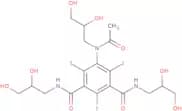
CAS:a contrast agent used in medical imaging such as angiography, CT scans, and MRI.
Formula:C19H26I3N3O9Purity:98.0 To 102.0%Color and Shape:White PowderMolecular weight:821.14 g/molC.I.Reactive Red 223
CAS:Please enquire for more information about C.I.Reactive Red 223 including the price, delivery time and more detailed product information at the technical inquiry form on this pagePurity:Min. 95%Orange G, Technical grade
CAS:Orange G is a quaternary ammonium salt that can be used for the treatment of wastewater. It has been shown to adsorb to the surface of bacterial cells and inhibit their growth by preventing enzyme activity. Orange G has also been shown to have carcinogenic potential in experimental models, although it is less potent than dimethylhydrazine or N-nitrosodiethylamine. Orange G has genotoxic effects on human serum, as seen by increased DNA fragmentation and chromosomal aberrations. The kinetic and redox properties of Orange G are still being investigated.Formula:C16H10N2Na2O7S2Purity:Min. 95 Area-%Color and Shape:Orange PowderMolecular weight:452.37 g/molDisperse Orange 3
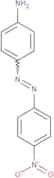
CAS:Disperse Orange 3 is a diazonium salt that has been used in the textile industry as a dye, but has also been used as a reagent for the synthesis of organic compounds. Disperse Orange 3 is synthesized by reacting an azobenzene with a fatty acid, which yields an unstable intermediate. The intermediate undergoes photochemical reactions when exposed to ultraviolet light or moisture. This reaction produces benzalkonium chloride and ft-ir spectroscopy, which confirms the identity of Disperse Orange 3. Disperse Orange 3 is used in biological treatment and binding constants experiments to measure the strength of interactions between molecules. It has clinical relevance in magnetic resonance spectroscopy because it can be used to probe molecular interactions with proteins or nucleic acids. It also has solubility data that can be used to determine its solubility in water and other solvents.
Disperse Orange 3 is soluble in supercritical carbon dioxide at high temperatures, but insoluble at room temperatureFormula:C12H10N4O2Purity:Min. 65%Color and Shape:PowderMolecular weight:242.23 g/mol6-Carboxy-X-rhodamine
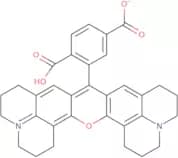
CAS:Single isomer of 5(6)-ROX. It is a fluorescent dye used in RT-PCR methods as an internal reference to determine fluorescence variation that is not associated with the amplification process (plastic of the wells, small differences in concentration or volume, instrument measurements). It produces a constant fluorescence emission signal during the PCR process that is used to normalise the emission produced by the reporter. The fluorescence signal is compatible with most reporters. It is used to label the 5â end of oligonucleotides as a reporter in the presence of a quencher at the 3â end (dual labelled probe). During the amplification, the dye is cleaved, and the fluorescence increases proportionally with the amount of the specific sequence amplified during the PCR process. The development of the fluorescence signal is therefore specifically related to the amplification of the target sequence. 6-ROX with NHS-activated carboxylic acids reacts with primary amines.
Formula:C33H30N2O5Purity:Min. 95%Color and Shape:Red PowderMolecular weight:534.6 g/molDirect Yellow 96, Technical grade
CAS:Direct Yellow 96 is a Direct Fast to Light dye (DFL) also known as diphenyl Brilliant Flavine 7GFF, direct Yellow 7GFF, Solophenyl Flavine 7GFE and Solophenyl Flavine 7GFE 500. Direct Yellow 96 is ideal for application on cellulosic fibres, making it suitable for textile and paper colouring. Solophenyl Flavine 7GFE 500 has been described as useful dye of fungal cell walls. The dye yields fluorescently stained material generally in the blue to green wavelengths and provides an excellent alternative to the more commonly used fluorophore, Calcofluor White M2R.
Formula:C39H34N10O13S4Color and Shape:PowderMolecular weight:979.01 g/molC.I.Reactive Yellow 162
CAS:Please enquire for more information about C.I.Reactive Yellow 162 including the price, delivery time and more detailed product information at the technical inquiry form on this pagePurity:Min. 95%Acid Red 266
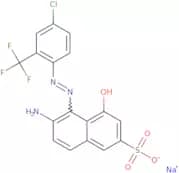
CAS:Acid Red 266 is a hydroxyl-containing polymeric dye that is used in the textile and paper industries as a colorant, pigment, or dye. It has been shown to be an efficient control agent for the polymerization of polyvinyl acetate. Acid Red 266 can also be used to form films with high light stability and good mechanical properties. The hydroxyl group present in this molecule causes it to have a polarizing effect on UV absorption. Acid Red 266 is made of particles that are soluble in water and alcohols, but insoluble in oils. This acid dye is also sensitive to heat, so it should not be exposed to temperatures over 60°C.Formula:C17H10ClF3N3O4S•NaPurity:Min. 95%Molecular weight:467.78 g/mol5-Cyano-2,3-di-(p-tolyl)tetrazolium chloride
CAS:5-Cyano-2,3-di-(p-tolyl)tetrazolium chloride is a tetrazolium dye used as an indicator of eukaryotic cells in a range or media including waste water resulting in a cyan color. It is commonly used in microbiology laboratories to measure the viability of cells. The redox potentials of 5-Cyano-2,3-di-(p-tolyl)tetrazolium chloride are reduced by the presence of active respiratory cells, resulting in fluorescent formazan.
Formula:C16H14ClN5Color and Shape:PowderMolecular weight:311.77 g/molC.I.Acid Yellow 42
CAS:C.I.Acid Yellow 42 is a reactive dye that belongs to the class of chromatic compounds. It is used in photolithography and as a pH indicator, but is also an environmental pollutant. C.I.Acid Yellow 42 is hydrated and has radical mechanism of photodecomposition, which makes it subject to radiation and mineralization. C.I.Acid Yellow 42 can be used in assays for detecting ions such as copper, iron, zinc, or mercury at efficiencies greater than other dyes in the same class. It can also be synthesized from organic materials or biodegradable substances such as dyes from natural sources or phenol-formaldehyde resins with low toxicity to humans and the environment.>>END>>
Formula:C32H26N8O8S2•Na2Purity:Min. 95%Color and Shape:PowderMolecular weight:760.71 g/molCrocein Orange G
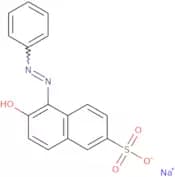
CAS:Crocein Orange G is a water-soluble, orange fluorescent dye that is used in wastewater treatment. It has been shown to form stable complexes with fatty acids and other organic compounds. These complexes are more readily removed by adsorption. Crocein Orange G has also been shown to react with potassium dichromate and form a yellow product. This product can be detected at low concentrations and is not toxic to humans or animals.
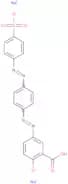
Formula:C16H11N2O4SNaPurity:Min. 95%Color and Shape:PowderMolecular weight:350.33 g/molC.I.Mordant Orange 6
CAS:C.I. Mordant Orange 6 is an alkanoic acid with a hydroxyl group and a sodium carbonate counter ion in the form of a coordination complex that is chemically stable in the presence of light and heat. The synthesis of this compound involves the reaction of 2-nitrobenzaldehyde with sodium hydroxylsulfonate followed by hydrolysis of the product with sodium carbonate. This synthetic process is used to produce C.I. Mordant Orange 6 in large quantities, which are then purified using chromatography or recrystallization techniques. The biological studies on C.I. Mordant Orange 6 have shown that it has antimicrobial properties, but it does not show cytotoxic effects against human cells in culture at concentrations up to 10 µg/mL, making it a potential candidate for use as an antimicrobial agent for applications such as food packaging materials.br>br>C.I. Mordant Orange 6 also has been shown toFormula:C19H14N4O6S·2NaPurity:Min. 95%Molecular weight:472.38 g/molC.I.Solvent Yellow 189
CAS:C.I. Solvent Yellow 189 is a monomer that is used in coatings, paints, and printing inks. It is a polymeric dye with high activity and excellent light resistance. The hydrophobic nature of this dye makes it ideal for use in coatings that require water-repellent or weatherproof properties. C.I. Solvent Yellow 189 has been shown to be reactive with formamide as well as styryl dyes to form copolymers with high crosslinked content for high-performance devices such as light barriers and filters.
Purity:Min. 95%Acid black 242
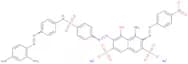
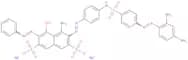
CAS:Acid Black 242 is a chemical dye that is used in the production of photoresists. It is also used as a black pigment in paints and printing inks. The dye is classified as hydrophilic, meaning it dissolves in water. Acid Black 242 has a color index number of PBk 6. It reacts with sulfide to form an acidic compound, which can be used to modulate the reaction time of certain reactions. Acid Black 242 is a benzene derivative that has been shown to depress the central nervous system when inhaled or ingested. It also inhibits the activity of diaminobenzene, which can cause depression when consumed orally or injected intravenously. The fluorescence emission spectrum of Acid Black 242 overlaps with that of other dyes such as acid red 1 and acid violet 7.
Purity:Min. 95%L-Glutathione, reduced, tested to USP spec
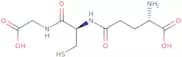
CAS:Glutathione is a tripeptide cysteine-glycine-glutamic acid which exists in cells in the reduced form (this product) or oxidised form. Reduced glutathione (GSH) is an antioxidant protecting cell components from endogenous and exogeneous reactive oxygen and nitrogen species. Reduced glutathione has also been intensely used in the affinity purification of proteins with glutathione S-transferase (GST) tag. In the protein purification process, glutathione is used for the elution of GST-fused recombinant proteins from a glutathione-immobilised resins. In the elution buffers, reduced glutathione is typically used in the 10 â 40 mM concentration range.Formula:C10H17N3O6SPurity:(Titration) 98.0 To 101.0%Color and Shape:White Off-White Crystalline PowderMolecular weight:307.32 g/molAcridine orange biological stain
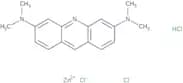
CAS:Acridine orange is a fluorescent dye that is used as a biological stain. It binds to DNA and stains the cells it has bound to, making them more visible under an ultraviolet light. This dye also produces kinetic data on the micronucleus test in mice and rats. Acridine orange can be used to detect genotoxic effects in animals and humans, such as genetic damage or cancer. Kinetic studies have shown statistically significant increases in plasma mass spectrometry, but no significant changes in erythrosine uptake were observed. Acridine orange has been shown to cause genotoxic effects on brain cells and testicular cells.
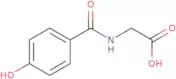
Formula:C17H20ClN3ZnCl2Color and Shape:PowderMolecular weight:369.96 g/molp-Hydroxyhippuric acid
CAS:Substrate for the hippuricase enzymeFormula:C9H9NO4Purity:(Titration) Min. 98%Color and Shape:White PowderMolecular weight:195.17 g/molAcid Black 234, Technical grade
CAS:Acid Black 234 is a reactive dye that is used in the textile industry. It has a hydroxy group and can be used for wastewater treatment. Acid Black 234 is not soluble in water but can be dissolved in organic solutions. It has high penetrant properties and its chemical stability depends on the pH of the solution. Acid Black 234 undergoes an adsorption mechanism, which involves a reaction with chloride ions to form a complex that binds to the surface of the fabric.Purity:Min. 95%C.I.Acid Orange 60
CAS:C.I. Acid Orange 60 is a polyolefin that is used as an additive for ophthalmic lenses to reduce the possibility of fogging by absorbing moisture and oxygen. It is also used in the production of ionizable dyes, nucleophilic substances, reactive substances, and surfactants. This product is typically applied using an organic solvent or chemical ionization mass spectrometry.
Purity:Min. 95%