Organic Halides
In this category, you can find organic molecules containing one or more halogen atoms in their structure. These organic halides include brominated, iodinated, chlorinated, and cyclic halide compounds. Organic halides are widely used in organic synthesis, pharmaceuticals, agrochemicals, and materials science due to their reactivity and ability to undergo a variety of chemical transformations. At CymitQuimica, we offer a comprehensive selection of high-quality organic halides to support your research and industrial applications, ensuring reliable and effective performance in your synthetic and analytical projects.
Subcategories of "Organic Halides"
Found 20442 products of "Organic Halides"
Sort by
Purity (%)
0
100
|
0
|
50
|
90
|
95
|
100
3-Bromo-2-methylbenzoic acid methyl ester
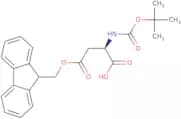
CAS:3-Bromo-2-methylbenzoic acid methyl ester is a serotonin transporter and reuptake inhibitor. It has selectivities for serotonin, dopamine and norepinephrine transporters. 3-Bromo-2-methylbenzoic acid methyl ester acts as a linker molecule in the synthesis of complex molecules like neurotransmitters. It is also a bifunctional molecule that can act as an antidepressant or anti-anxiety drug by increasing serotonin levels in the brain. 3-Bromo-2-methylbenzoic acid methyl ester’s function as a ligand is to bind to receptors on cells, which may be linked with its effects on depression and anxiety.Formula:C9H9BrO2Purity:Min. 95%Molecular weight:229.07 g/molBoc-D-aspartic acid β-9-fluorenylmethyl ester
CAS:Please enquire for more information about Boc-D-aspartic acid beta-9-fluorenylmethyl ester including the price, delivery time and more detailed product information at the technical inquiry form on this page
Formula:C23H25NO6Purity:Min. 95%Molecular weight:411.45 g/mol5-Bromo-1-Methyl-1H-indazol-3-amine
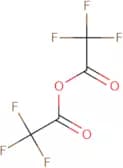
CAS:Please enquire for more information about 5-Bromo-1-Methyl-1H-indazol-3-amine including the price, delivery time and more detailed product information at the technical inquiry form on this pageFormula:C8H8BrN3Purity:Min. 95%Molecular weight:226.07 g/molTrifluoro acetic anhydride
CAS:Trifluoro acetic anhydride is a chemical compound that is used in the laboratory as a model system to study antimicrobial agents and the reaction mechanism of these compounds. It has been shown to have receptor activity against infectious diseases and enzyme activities against bacterial growth. Trifluoroacetic anhydride has also been shown to inhibit plasma mass spectrometry, which may be due to its ability to react with water vapor. The chemical inhibitor can be recovered and reused for other experiments.Formula:C4F6O3Purity:Min. 95%Color and Shape:Colorless Clear LiquidMolecular weight:210.03 g/molN-Methyl-N-[(1-methyl-1H-benzimidazol-2-yl)methyl]amine hydrochloride
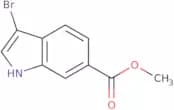
CAS:Controlled ProductPlease enquire for more information about N-Methyl-N-[(1-methyl-1H-benzimidazol-2-yl)methyl]amine hydrochloride including the price, delivery time and more detailed product information at the technical inquiry form on this pageFormula:C10H13N3Purity:Min. 95%Molecular weight:175.23 g/molMethyl 3-bromoindole-6-carboxylate
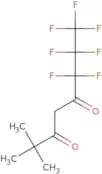
CAS:Please enquire for more information about Methyl 3-bromoindole-6-carboxylate including the price, delivery time and more detailed product information at the technical inquiry form on this pageFormula:C10H8BrNO2Purity:Min. 95%Molecular weight:254.08 g/mol2,2-Dimethyl-6,6,7,7,8,8,8-heptafluoro-3,5-octanedione
CAS:2,2-Dimethyl-6,6,7,7,8,8,8-heptafluoro-3,5-octanedione is a bidentate ligand for metal ions. It has been shown to be effective in the synthesis of nanocrystals and the activation energy for the reaction has been determined to be 70.4 kJ/mol. 2DMMHFO can be used as a precursor for the growth of silicon films by chemical vapor deposition and other techniques. The molecule has also been shown to bind with metal ions such as Cu(II) and Fe(III), which may be due to its ability to chelate these metals. 2DMMHFO has been used as an efficient catalyst in asymmetric epoxidation reactions with high enantioselectivity.Formula:C10H11F7O2Purity:Min. 95%Molecular weight:296.18 g/molMethyl 1-aminocyclohexanecarboxylate hydrochloride
CAS:Please enquire for more information about Methyl 1-aminocyclohexanecarboxylate hydrochloride including the price, delivery time and more detailed product information at the technical inquiry form on this pageFormula:C8H15NO2Purity:Min. 95%Molecular weight:157.21 g/molManganese dichloride
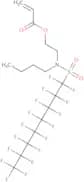
CAS:Manganese dichloride is a chemical compound that is used as an oxidation catalyst. It has been shown to have the ability to remove nitrogen from wastewater and to be used for the treatment of sodium carbonate in water. Manganese dichloride can also be used as a catalyst for the removal of volatile organic compounds from air or water. Manganese dichloride is also used in x-ray diffraction data, where it was found that this compound has a high crystallinity with α subunit and nitrogen atoms. This substance is not toxic to brain functions and does not react with water, which makes it suitable for use in wastewater treatment plants. Manganese dichloride has also been shown to have an anti-cancer effect on brain tumours and can inhibit epidermal growth factor (EGF).Formula:MnCl2Purity:Min. 95%Color and Shape:PowderMolecular weight:125.84 g/mol2-(N-Butylperfluorooctanesulfonamido)ethyl acrylate
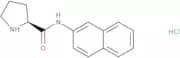
CAS:Controlled ProductPlease enquire for more information about 2-(N-Butylperfluorooctanesulfonamido)ethyl acrylate including the price, delivery time and more detailed product information at the technical inquiry form on this pageFormula:C17H16F17NO4SPurity:Min. 95%Color and Shape:Clear LiquidMolecular weight:653.35 g/molL-Proline-beta-naphthylamide hydrochloride
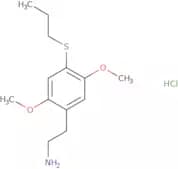
CAS:L-proline analogueFormula:C15H16N2O·HClPurity:Min. 95%Molecular weight:276.76 g/mol2,5-Dimethoxy-4-(propylsulfanyl)phenethylamine hydrochloride
CAS:Controlled ProductPlease enquire for more information about 2,5-Dimethoxy-4-(propylsulfanyl)phenethylamine hydrochloride including the price, delivery time and more detailed product information at the technical inquiry form on this pageFormula:C13H22ClNO2SPurity:Min. 95%Molecular weight:291.84 g/moln-Butyl bromide
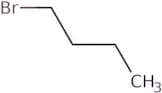
CAS:n-Butyl bromide (n-BuBr) is a chemical that has been used in the laboratory for analytical purposes. It is also used as a solvent for sodium salts, nitrogen atoms, and other chemicals. n-Butyl bromide has been shown to cause bowel disease with hyoscine, glycol ethers, and antibodies. This effect may be due to the intramolecular hydrogen transfer reaction between the carboxylic acid group of butyl bromide and carboxylate groups in proteins. The clinical relevance of this interaction is not yet known. n-Butyl bromide also has inflammatory effects on the bowel that have been seen in animal models of inflammatory bowel disease.Formula:C4H9BrPurity:Min. 95%Color and Shape:Clear Colourless To Pale Yellow LiquidMolecular weight:137.02 g/mol4,4''-Dibromo-p-terphenyl
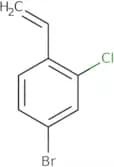
CAS:4,4''-Dibromo-p-terphenyl is a polycyclic aromatic hydrocarbon that has been synthesized as a nanomaterial. This material has been studied by XPS and microscopy as well as by kinetic experiments. The energetics of the reaction have been studied using photoelectron spectroscopy. 4,4''-Dibromo-p-terphenyl dehalogenates organometallic compounds at a rate that can be calculated using rate equations. The mechanistic study of the reaction was done through synthesizing 4,4''-Dibromo-p-terphenyl.Purity:Min. 95%4-Bromo-2-chloro-1-ethenyl-benzene
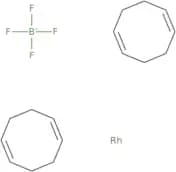
CAS:Please enquire for more information about 4-Bromo-2-chloro-1-ethenyl-benzene including the price, delivery time and more detailed product information at the technical inquiry form on this pageFormula:C8H6BrClPurity:Min. 95%Molecular weight:217.49 g/molBis (1,5-Cyclooctadiene) rhodium(I)tetrafluoroborate
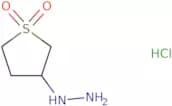
CAS:Bis (1,5-Cyclooctadiene) rhodium(I)tetrafluoroborate (BODIPY) is a catalyst that enhances the rate of hydrosilylation reactions. This catalyst has been shown to be effective in the synthesis of aryl chlorides from amines and aldehydes with high enantioselectivity. BODIPY is also immobilized on silica gel to create an active catalyst for asymmetric synthesis. The immobilization process on silica gel is done by reacting BODIPY with ammonium formate and amines. The resulting catalyst can be used for the synthesis of functionalized organic compounds, such as pyrrolidines, tetrahydrofurans, and thiophenes.Formula:C16H24BF4RhPurity:Min. 95%Molecular weight:406.07 g/mol(1,1-Dioxidotetrahydro-3-thienyl)hydrazine hydrochloride
CAS:Please enquire for more information about (1,1-Dioxidotetrahydro-3-thienyl)hydrazine hydrochloride including the price, delivery time and more detailed product information at the technical inquiry form on this pageFormula:C4H10N2O2SPurity:Min. 95%Molecular weight:150.2 g/mol1-(3-Chlorophenyl)piperazine dihydrochloride
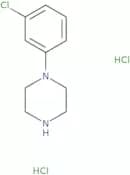
CAS:Controlled Product1-(3-Chlorophenyl)piperazine dihydrochloride is a serotonin antagonist that has been shown to cause an increase in cortisol levels. It is also a serotonergic agent, which may be related to its antidepressant activity. 1-(3-Chlorophenyl)piperazine dihydrochloride has been shown to have a matrix effect on the brain and can be used as a drug for treating primary pulmonary hypertension. It can also induce behavioral changes and stimulate ovarian activity. The compound 1-(3-Chlorophenyl)piperazine dihydrochloride is an antagonist of 5-HT2C receptors, and it has no affinity for the 5-HT2A receptor.Formula:C10H15Cl3N2Purity:Min. 95%Color and Shape:White To Yellow Or Beige SolidMolecular weight:269.6 g/mol2-Chloro-7H-pyrrolo[2,3-d]pyrimidin-4-amine
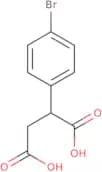
CAS:Please enquire for more information about 2-Chloro-7H-pyrrolo[2,3-d]pyrimidin-4-amine including the price, delivery time and more detailed product information at the technical inquiry form on this pageFormula:C6H5ClN4Purity:Min. 95%Molecular weight:168.58 g/mol2-(4-Bromophenyl)succinic acid
CAS:Please enquire for more information about 2-(4-Bromophenyl)succinic acid including the price, delivery time and more detailed product information at the technical inquiry form on this pageFormula:C10H9BrO4Purity:Min. 95%Molecular weight:273.08 g/mol



![N-Methyl-N-[(1-methyl-1H-benzimidazol-2-yl)methyl]amine hydrochloride](/_next/image/?url=https%3A%2Fstatic.cymitquimica.com%2Fproducts%2F3D%2Fthumb-webp%2FFM117084.webp&w=3840&q=75)



![2-Chloro-7H-pyrrolo[2,3-d]pyrimidin-4-amine](/_next/image/?url=https%3A%2Fstatic.cymitquimica.com%2Fproducts%2F3D%2Fthumb-webp%2FFC63357.webp&w=3840&q=75)