Antibiotics
Antibiotics are compounds designed to destroy or inhibit the growth of various microorganisms, playing a crucial role in treating infections and preventing the spread of diseases. This category offers a diverse range of active ingredients specifically for research in the biochemical field. These compounds are essential tools in studying bacterial mechanisms, resistance patterns, and the development of new therapeutic agents. Researchers can explore a wide variety of antibiotics to understand their effects, optimize their use, and develop novel treatments to combat emerging microbial threats. The availability of such a broad spectrum of antibiotics supports advanced research and innovation in microbiology and pharmaceutical sciences.
Subcategories of "Antibiotics"
- Macrolide Antibiotics(26 products)
- Steroidal Antibiotics(31 products)
- Tetracycline Antibiotics(20 products)
- β-Lactam Antibiotics(11 products)
Found 4100 products of "Antibiotics"
Sort by
Purity (%)
0
100
|
0
|
50
|
90
|
95
|
100
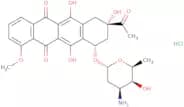
Daunorubicin HCl - Bio-X ™
CAS:<p>Daunorubicin is an anthracycline antibiotic and antineoplastic agent that is used in the treatment of a variety of cancers such as nonlymphocytic leukemia and acute lymphocytic leukemia. The drug binds to DNA and inhibits transcription by intercalating between DNA base pairs and affecting the activity of the topoisomerase II enzyme and thus the gene expression. This results in apoptosis, mitochondrial injury, and finally cell death.</p>Formula:C27H29NO10•HClPurity:Min. 95%Color and Shape:PowderMolecular weight:563.98 g/molValinomycin
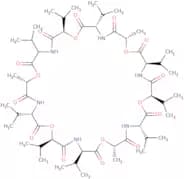
CAS:<p>Valinomycin is an ionophore antibiotic with action on potassium ion transport across cell membranes and is used for research on ion transport and as an antimicrobial agent.</p>Formula:C54H90N6O18Purity:Min. 90 Area-%Color and Shape:White PowderMolecular weight:1,111.32 g/molCefadroxil
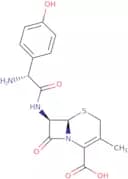
CAS:<p>Cefadroxil is a first-generation cephalosporin antibiotic with action on bacterial cell wall synthesis and is used for treating infections like strep throat, skin infections, and urinary tract infections.</p>Formula:C16H17N3O5SPurity:Min. 95%Color and Shape:PowderMolecular weight:363.39 g/molEnduracidin hydrochloride
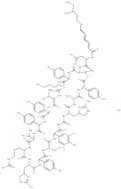
CAS:<p>Enduracidin hydrochloride is an antimicrobial compound, which is a lipopeptide antibiotic derived from the genus Streptomyces, specifically Streptomyces fungicidicus or Streptomyces roseosporus. The compound exerts its antimicrobial activity by inhibiting the synthesis of bacterial cell walls, primarily targeting the lipid II cycle, a critical precursor in the peptidoglycan synthesis pathway. This inhibition disrupts the construction of peptidoglycan layers, ultimately leading to bacterial cell lysis and death.</p>Formula:C107H138Cl2N26O31HClPurity:Min. 95%Molecular weight:2,391.76 g/molChloramphenicol D5
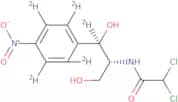
CAS:Controlled ProductLabeled analogue of Chloramphenicol; interferes with protein synthesisFormula:C11H7Cl2D5N2O5Purity:Min. 95%Color and Shape:White To Off-White SolidMolecular weight:328.16 g/molMezlocillin
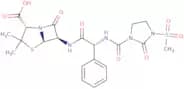
CAS:<p>Mezlocillin is a ureidopenicillin antibiotic with action on bacterial cell wall synthesis and is used for treating gram-negative and anaerobic bacterial infections.</p>Formula:C21H25N5O8S2Purity:Min. 95%Molecular weight:539.58 g/molAmpicillin sodium salt - Bio-X ™
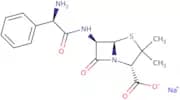
CAS:Ampicillin is a β-lactam antibiotic with a broad spectrum of activity against Gram-positive and Gram-negative bacteria. It is used in the treatment of bacterial infections, including those caused by methicillin-resistant Staphylococcus aureus (MRSA), Streptococcus pneumoniae, and Listeria monocytogenes. Ampicillin binds to penicillin-binding proteins in the bacterial cell wall by competitive inhibition. It prevents the formation of an antibiotic-inhibitor complex with the enzyme cell wall synthesis that is required for cell wall biosynthesis, inhibiting protein synthesis and cell division.Formula:C16H19N3O4S·NaPurity:Min. 85 Area-%Color and Shape:PowderMolecular weight:372.4 g/molN-Demethyl roxithromycin
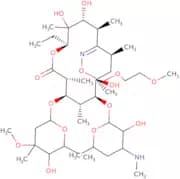
CAS:<p>N-Demethyl roxithromycin is a metabolite of roxithromycin with action on bacterial protein synthesis inhibition and is used for research on macrolide antibiotics.</p>Formula:C40H74N2O15Purity:Min. 95%Color and Shape:PowderMolecular weight:823.02 g/molClindamycin hydrochloride
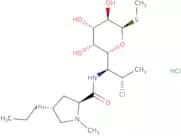
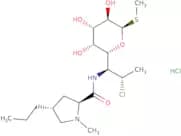
CAS:<p>Inhibitor of protein synthesis; lincosamide class</p>Formula:C18H34Cl2N2O5SColor and Shape:White PowderMolecular weight:461.44 g/molColistin sulfate
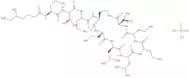
CAS:<p>Colistin is a narrow-spectrum antibiotic efficient mostly against gram-negative bacteria. Colistin interacts with the outer membrane of gram-negative bacteria and induces a transfer of divalent cations of calcium and magnesium from the negatively charged phosphate groups. This causes the disruption of the outer membrane and release of lipopolysaccharides. It is commonly used against Enterobacteriaceae and Aeromonas, and none-fermentative gram-negative bacteria as well as for carbapenem-resistant Acinetobacter strains.</p>Formula:C53H102N16O17SPurity:Min. 77 Area-%Color and Shape:White PowderMolecular weight:1,266.73 g/molLomefloxacin
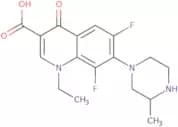
CAS:<p>Lomefloxacin is a fluoroquinolone antibiotic with a mode of action that inhibits bacterial DNA gyrase and topoisomerase IV. It is used for treating bacterial infections like bronchitis and urinary tract infections.</p>Formula:C17H19F2N3O3Purity:Min. 98 Area-%Color and Shape:PowderMolecular weight:351.35 g/molClindamycin-2-phosphate
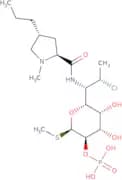
CAS:<p>Clindamycin-2-phosphate is a lincosamide antibiotic with action on bacterial protein synthesis inhibition and is used for treating serious bacterial infections like skin and respiratory infections.</p>Formula:C18H34ClN2O8PSPurity:Min. 95%Color and Shape:White PowderMolecular weight:504.96 g/molTicarcillin disodium salt, Antibiotic for Culture Media Use Only
CAS:<p>Ticarcillin is a member of the beta-lactam family of antibiotics and has bactericidal activity against Gram-positive and Gram-negative bacteria such as Staphylococcus and Pseudomonas strains. Ticarcillin inhibits cell wall synthesis by binding to penicillin-binding protein (PBP) and blocking transpeptidase. It also has a C-terminal that can inhibit domain I and II beta-lactamases (namely, PEN2). The lactam ring in ticarcillin is cleaved by beta-lactamase, which makes it ineffective, thus ticarcillin is often combined with β-lactamase inhibitors such as clavulanic acid.</p>Formula:C15H14N2Na2O6S2Purity:Min. 87.0 Area-%Molecular weight:428.40 g/molAmicoumacin B
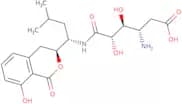
CAS:<p>Amicoumacin B is a potent antibiotic, which is isolated from the bacterial species Bacillus pumilus. It acts by inhibiting protein synthesis, targeting the ribosomal 30S subunit and disrupting translational fidelity in bacterial cells. This interference in protein production leads to the effective elimination of various Gram-positive and certain Gram-negative bacteria.</p>Purity:Min. 95%Clindamycin hydrochloride - 94%
CAS:<p>Clindamycin hydrochloride - 94% is an antibiotic that belongs to the lincosamide class of antibiotics, derived from the bacterium Streptomyces lincolnensis. This compound functions predominantly as a bacterial protein synthesis inhibitor, exerting its effects by binding to the 50S subunit of the bacterial ribosome. This binding action disrupts the process of peptide chain elongation, thereby impeding the growth and proliferation of susceptible bacteria.</p>Formula:C18H33ClN2O5S·HClColor and Shape:PowderMolecular weight:461.44 g/molDihydrostreptomycin B
CAS:<p>Dihydrostreptomycin B is an aminoglycoside antibiotic, which is derived from the bacterium Streptomyces griseus. This antibiotic operates by binding to the 30S subunit of the bacterial ribosome, leading to the inhibition of protein synthesis. The binding disrupts the decoding site, causing misreading of mRNA and ultimately resulting in bactericidal activity.</p>Formula:C27H51N7O17Purity:Min. 95%Molecular weight:745.33414Oxytetracycline hydrochloride
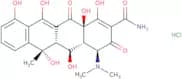
CAS:<p>A broad-spectrum antibiotic of tetracycline class which inhibits protein synthesis by targeting the 30S ribosome subunit. It has been used in human medicine as well as in veterinary medicine and agriculture.</p>Formula:C22H24N2O9•HClPurity:Min. 95%Color and Shape:Yellow PowderMolecular weight:496.89 g/molGeneticin sulfate
CAS:<p>Geneticin is very efficient against gram-negative bacteria, however it is not applied for treating infections due to high renal toxicity. Geneticin and its resistance genes found application in the selection of transgenic cell lines including yeasts such as P. pastoris and S. serevisiae, other eukaryotic cell lines such as CHO or HEK293, but also plant cells and bacterial cells.</p>Formula:C20H40N4O10·2H2SO4Purity:Min. 98 Area-%Color and Shape:White PowderMolecular weight:692.71 g/molN-Demethyl erythromycin A
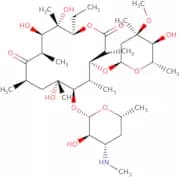
CAS:<p>N-Demethyl erythromycin A is a metabolite of erythromycin with narrow-spectrum antibiotic activity and is used for research on erythromycin derivatives.</p>Formula:C36H65NO13Purity:Min. 95 Area-%Color and Shape:White PowderMolecular weight:719.9 g/molKanamycin disulfate
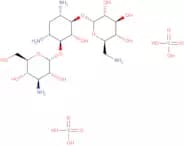
CAS:<p>Binds to 70S ribosomal subunit; inhibits translocation and induces miscoding</p>Formula:C18H36N4O11·2H2O4SPurity:Min. 67%Color and Shape:PowderMolecular weight:680.66 g/mol