Ciclo celular / Checkpoint
Los inhibidores del ciclo celular/puntos de control son compuestos que interrumpen la progresión normal del ciclo celular, particularmente en puntos de control regulatorios clave. Estos inhibidores son cruciales para estudiar la división celular, comprender la proliferación de células cancerosas y desarrollar terapias anticancerígenas. Al dirigirse a fases específicas del ciclo celular, estos inhibidores pueden inducir la detención del ciclo celular, lo que lleva a apoptosis o senescencia en células de división rápida. En CymitQuimica, ofrecemos una amplia gama de inhibidores de alta calidad del ciclo celular/puntos de control para apoyar su investigación en biología del cáncer, biología celular y desarrollo de fármacos.
Subcategorías de "Ciclo celular / Checkpoint"
- Aurora quinasa(115 productos)
- CDK(546 productos)
- Detención del ciclo celular(5 productos)
- Chk(48 productos)
- DYRK(47 productos)
- Dynamin(27 productos)
- Ferroptosis(227 productos)
- HSP(180 productos)
- Integrin(269 productos)
- Kinesina(87 productos)
- LIM quinasa(20 productos)
- Asociado a microtúbulos(274 productos)
- PKC(126 productos)
- PLK(25 productos)
- ROCK(62 productos)
- Rho(6 productos)
- Wee1(14 productos)
- c-Myc(76 productos)
Mostrar 10 subcategorías más
Se han encontrado 3905 productos de "Ciclo celular / Checkpoint"
Ordenar por
Pureza (%)
0
100
|
0
|
50
|
90
|
95
|
100
7-TFA-ap-7-Deaza-ddA
CAS:Compound 19c is a nucleotide derivative for DNA sequencing dye terminators.Fórmula:C16H16F3N5O3Forma y color:SolidPeso molecular:383.331ROCK-IN-5
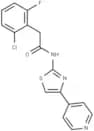
CAS:ROCK-IN-5 (I-B-37) inhibits kinases like ROCK/ERK/GSK; may aid in cardiac and neuro disease studies.Fórmula:C16H11ClFN3OSPureza:99.72% - 99.86%Forma y color:SolidPeso molecular:347.795-Methylcytidine 5′-triphosphate trisodium
5-Methylcytidine 5′-triphosphate trisodium (5-Methyl-CTP trisodium), a modified nucleoside triphosphate, enhances translational properties and stability, while
Fórmula:C10H15N3Na3O14P3Forma y color:SolidPeso molecular:563.13N1-Methylpseudouridine-5′-triphosphate tetralithium
N1-Methylpseudouridine-5′-triphosphate tetralithium, also known as 1-Methylpseudouridine-5′-triphosphate tetralithium, is a nucleobase-modified nucleotide.Fórmula:C10H13Li4N2O15P3Forma y color:SolidPeso molecular:521.9N3,5-Dimethyl-2'-O-(2-methoxyethyl) uridine
N3,5-Dimethyl-2’-O-(2-methoxyethyl) uridine, a purine nucleoside analog, exhibits broad antitumor activity, particularly against indolent lymphoid malignancies.Fórmula:C14H22N2O7Forma y color:SolidPeso molecular:330.33Stigmatellin
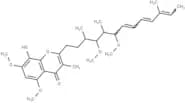
CAS:Stigmatellin is an antibiotic derived from the cell mass of the myxobacterium, effective against yeasts (yeasts), filamentous fungi (filamentous fungi), and several Gram-positive bacteria (Gram-positive bacteria). Additionally, it serves as a potent inhibitor of photosynthetic electron (photosynthetic electron) transfer. Stigmatellin utilizes various sugars, polysaccharides, and acids from the citric acid cycle as substrates, inhibiting RNA and protein synthesis. It has two different inhibitory sites: one located on the reducing side of photosystem II and the other at the cytochrome b6/f complex. Stigmatellin holds potential for use in antimicrobial and photosynthesis research.Fórmula:C30H42O7Forma y color:SolidPeso molecular:514.65DSPE-PEG2000-cRGD
DSPE-PEG2000-cRGD is a PEG compound composed of DSPE and an αvβ3-targeting peptide (cRGD). The cRGD peptide specifically binds to αvβ3 on the surface of various cancer cells and neovascular cells. This compound can be utilized for drug delivery.Forma y color:Odour Solid2'-Chloro-N6-(3-trifluoromethyl)benzyl adenosine
2’-Chloro-N6-(3-trifluoromethyl)benzyl adenosine, a purine nucleoside analog, exhibits broad antitumor activity, particularly against indolent lymphoidFórmula:C18H17ClF3N5O4Forma y color:SolidPeso molecular:459.81LDV
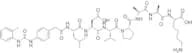
CAS:α4β1 integrin (VLA-4) ligand (Kd ~ 12 nM). Non-fluorescent derivative of LDV FITC.Fórmula:C48H70N10O12Pureza:98%Forma y color:SolidPeso molecular:979.13Biotin-PEG7-C2-NH-Vidarabine-S-CH3
Biotin-PEG7-C2-NH-Vidarabine-S-CH3 is a PEG linker with Vidarabine, an anti-herpes/zoster antiviral.Fórmula:C37H62N8O12S2Forma y color:SolidPeso molecular:875.06Remdesivir nucleoside monophosphate
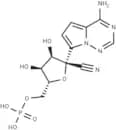
CAS:Remdesivir metabolite, antiviral nucleoside analog, effective against SARS-CoV and MERS-CoV.Fórmula:C12H14N5O7PForma y color:SolidPeso molecular:371.24N1-Methylxylo-guanosine
N1-Methylxylo-guanosine, a purine analog, targets lymphoid cancer via DNA synthesis inhibition and apoptosis.Fórmula:C11H15N5O5Forma y color:SolidPeso molecular:297.27Pseudouridimycin
CAS:Pseudouridimycin: a C-nucleoside antibiotic, inhibits bacterial RNAP, targets Gram-negative and Gram-positive bacteria.Fórmula:C17H26N8O9Pureza:98%Forma y color:SolidPeso molecular:486.44Eesperamicin A1
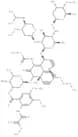
CAS:Esperamicin A1, a powerful antitumor drug, comes from Actinomadura verrucosospora.Fórmula:C59H80N4O22S4Forma y color:SolidPeso molecular:1325.54PKMYT1-IN-3
PKMYT1-IN-3 (compound 8ma) is a potent, selective inhibitor of PKMYT1, demonstrating an IC50 of 16.5 nM and exhibiting antitumor activity.Fórmula:C24H26FN5O2Forma y color:SolidPeso molecular:435.492'-Deoxy-2'-fluoro-l-uridine
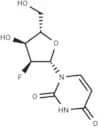
CAS:2'-Deoxy-2'-fluoro-1-uridine: an L-nucleoside, inhibits RNA viruses by blocking viral RNA polymerase.Fórmula:C9H11FN2O5Forma y color:SolidPeso molecular:246.19DSPE-PEG2000-iRGD
DSPE-PEG2000-iRGD is a PEG compound composed of DSPE and the αv-integrin targeting peptide (iRGD). The iRGD peptide binds to αv-integrins and subsequently undergoes proteolytic cleavage within tumors, producing CRGDK/R, which interacts with neuropilin-1. This compound is characterized by its tumor-targeting and tumor-penetrating properties, making DSPE-PEG2000-iRGD suitable for drug delivery applications.Forma y color:Odour SolidPhen-DC3 Trifluoromethanesulfonate
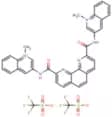
CAS:Phen-DC3 Trifluoromethanesulfonate targets G-quadruplexes and inhibits FANCJ/DinG helicases; IC50s: 65±6/50±10 nM.Fórmula:C36H26F6N6O8S2Pureza:98%Forma y color:SolidPeso molecular:848.75AURKA against 1
Compound Ac13, also termed AURKA against 1, acts as an inhibitor of the Aurora kinase (AURKA) with an IC50 of less than 0.5 nM, targeting the acetylation of endogenous lysine (K162) and exhibiting anti-tumor cell proliferation activity. The kinase activity of AURKA, acetylated at K162 and induced by AURKA against 1, is reversibly restored in HCT116 cells transfected with SIRT3.Fórmula:C28H32FN9O2Forma y color:SolidPeso molecular:545.61SP27
CAS:SP27, a selective PROTAC, degrades PLK4 with a DC50 of 19.5 nM and may be utilized in breast cancer research [1].Fórmula:C40H40F2N12O5Pureza:98%Forma y color:SolidPeso molecular:806.82