Ciclo celular / Checkpoint
Los inhibidores del ciclo celular/puntos de control son compuestos que interrumpen la progresión normal del ciclo celular, particularmente en puntos de control regulatorios clave. Estos inhibidores son cruciales para estudiar la división celular, comprender la proliferación de células cancerosas y desarrollar terapias anticancerígenas. Al dirigirse a fases específicas del ciclo celular, estos inhibidores pueden inducir la detención del ciclo celular, lo que lleva a apoptosis o senescencia en células de división rápida. En CymitQuimica, ofrecemos una amplia gama de inhibidores de alta calidad del ciclo celular/puntos de control para apoyar su investigación en biología del cáncer, biología celular y desarrollo de fármacos.
Subcategorías de "Ciclo celular / Checkpoint"
- Aurora quinasa(114 productos)
- CDK(546 productos)
- Detención del ciclo celular(5 productos)
- Chk(48 productos)
- DYRK(47 productos)
- Dynamin(27 productos)
- Ferroptosis(226 productos)
- HSP(179 productos)
- Integrin(253 productos)
- Kinesina(87 productos)
- LIM quinasa(20 productos)
- Asociado a microtúbulos(274 productos)
- PKC(124 productos)
- PLK(25 productos)
- ROCK(62 productos)
- Rho(6 productos)
- Wee1(14 productos)
- c-Myc(76 productos)
Mostrar 10 subcategorías más
Se han encontrado 3872 productos de "Ciclo celular / Checkpoint"
Ordenar por
Pureza (%)
0
100
|
0
|
50
|
90
|
95
|
100
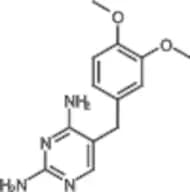
Diaveridine
CAS:Diaveridine (AI3-23935) (DVD) is a popular antibacterial synergist that is widely used in combination with sulfonamide.Fórmula:C13H16N4O2Pureza:99.10%Forma y color:White SolidPeso molecular:260.29Enoxacin hydrate
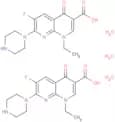
CAS:Enoxacin hydrate (AT-2266 hydrate) is a broad-spectrum 6-fluoronaphthyridinone antibacterial agent.Fórmula:C15H17FN4O3H2OPureza:99.50%Forma y color:SolidPeso molecular:347.34Foscarnet sodium
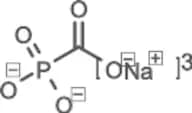
CAS:Foscarnet sodium (Phosphonoformate) is an antiviral agent used in the treatment of cytomegalovirus retinitis.Fórmula:CNa3O5PPureza:98.52%Forma y color:White Or Almost White Crystalline PowderPeso molecular:191.95ATN-161 acetate
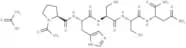
CAS:ATN-161 acetate, a pentapeptide compound derived from the synergistic region of fibronectin, is an integrin-alpha5 antagonist with antitumor activity.Fórmula:C25H39N9O10SPureza:98.27%Forma y color:SoildPeso molecular:657.7Ref: TM-T10398L
1mg190,00€5mg471,00€10mg663,00€25mg1.036,00€50mg1.429,00€100mg1.830,00€200mg2.498,00€Rifabutin
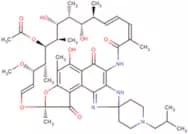
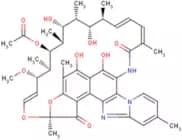
CAS:Rifabutin (LM-427), a semisynthetic ansamycin, blocks bacterial RNA synthesis by inhibiting RNA polymerase.Fórmula:C46H62N4O11Pureza:98.87% - 99.7%Forma y color:Red-Violet Crystalline PowderPeso molecular:847.00AZ-Dyrk1B-33
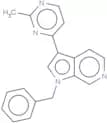
CAS:AZ-Dyrk1B-33 (3-(2-Methyl-4-pyrimidinyl)-1-(phenylmethyl)-1H-pyrrolo[2,3-c]pyridine) is a potent and selective Dyrk1B kinase inhibitor with an IC50 of 7 nM.Fórmula:C19H16N4Pureza:99.91%Forma y color:SolidPeso molecular:300.36Ref: TM-T14364
1mg44,00€5mg92,00€10mg147,00€25mg289,00€50mg419,00€100mg583,00€200mg787,00€1mL*10mM (DMSO)100,00€Doxifluridine
CAS:Doxifluridine (AMC 0101) is a fluoropyrimidine derivative and oral prodrug of the antineoplastic agent 5-fluorouracil (5-FU) with antitumor activity.Fórmula:C9H11FN2O5Pureza:99.47% - 99.86%Forma y color:White SolidPeso molecular:246.19HBX 19818
CAS:HBX 19818 is a specific ubiquitin-specific protease 7 (USP7) inhibitor (IC50: 28.1 μM).Fórmula:C25H28ClN3OPureza:97.71%Forma y color:SolidPeso molecular:421.96Ref: TM-T15464
1mg35,00€5mg80,00€10mg111,00€25mg177,00€50mg253,00€100mg353,00€200mg502,00€1mL*10mM (DMSO)89,00€Ribociclib succinate
CAS:Ribociclib succinate (LEE011 succinate) is a highly specific CDK4/6 inhibitor (IC50: 10 nM and 39 nM, respectively).Fórmula:C27H36N8O5Pureza:99.9%Forma y color:SolidPeso molecular:552.63Ref: TM-T15732
2mg34,00€5mg49,00€10mg70,00€25mg92,00€50mg109,00€100mg165,00€200mg258,00€500mg459,00€1mL*10mM (DMSO)60,00€TAME hydrochloride
CAS:TAME hydrochloride (Tos-Arg-OMe HCl) is a kind od amino acid derivatives.Fórmula:C14H23ClN4O4SPureza:99.11% - 99.21%Forma y color:White Fine Crystalline PowderPeso molecular:378.87JH-RE-06
CAS:JH-RE-06 disrupts mutagenic translesion synthesis (TLS) by preventing the recruitment of mutagenic POLζ.Fórmula:C20H16Cl3N3O4Pureza:99.29%Forma y color:SolidPeso molecular:468.72Ref: TM-T15611
1mg44,00€5mg93,00€10mg152,00€25mg334,00€50mg587,00€100mg1.044,00€1mL*10mM (DMSO)95,00€Sulfameter
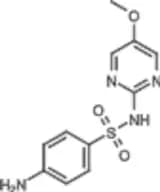
CAS:Sulfameter (Sulfametoxydiazine) is a long-acting sulfonamide antibacterial agent used to treat urinary tract infections and leprosy.Fórmula:C11H12N4O3SPureza:99.46% - 99.90%Forma y color:Crystalline SolidPeso molecular:280.3Rifaximin
CAS:Rifaximin: an oral semi-synthetic antibiotic from rifamycin SV; targets bacterial RNA polymerase to halt growth.Fórmula:C43H51N3O11Pureza:99.18% - 99.40%Forma y color:Red-Orange Crystalline PowderPeso molecular:785.88Cibisatamab
CAS:Cibisatamab, a T-cell bispecific antibody, targets CEA on cancer cells and CD3 on T-cells, inducing T-cell-mediated tumor cell killing.Pureza:SDS-PAGE:99.1%;SEC-HPLC:96.5%Forma y color:LiquidPeso molecular:191.1 kDaOxolinic acid
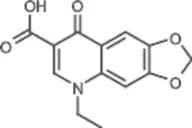
CAS:Oxolinic acid (Nidantin) is a synthetic antimicrobial related to NALIDIXIC ACID and used in URINARY TRACT INFECTIONS.Fórmula:C13H11NO5Pureza:98.39% - 99.72%Forma y color:Crystals From Dimethylformamide White Crystalline PowderPeso molecular:261.23CDK4/6-IN-2
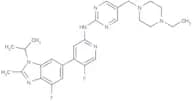
CAS:CDK4/6-IN-2 是一种CDK4和CDK6抑制剂,IC50分别为 2.7 和 16 nM。Fórmula:C27H32F2N8Pureza:99.47%Forma y color:SolidPeso molecular:506.59Bersanlimab
CAS:Bersanlimab (BI-505) is a fully human monoclonal antibody targeting Intercellular Adhesion Molecule-1 (ICAM-1).Bersanlimab has anticancer properties.Pureza:> 95% - > 95%Forma y color:LiquidPeso molecular:144.22 kDaFolinic acid calcium
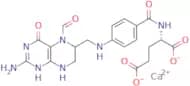
CAS:Folinic acid calcium (Leucovorin Calcium) is the active metabolite of folic acid. Leucovorin is used principally as an antidote to folic acid antagonists.Fórmula:C20H21CaN7O7Pureza:98.72% - >99.99%Forma y color:Yellow Crystalline PowderPeso molecular:511.51Mps1-IN-3
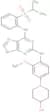
CAS:Mps1-IN-3 is an effective and selective inhibitor of MPS1 kinase (IC50: 50 nM).Fórmula:C26H31N7O4SPureza:99.25%Forma y color:SolidPeso molecular:537.63Ref: TM-T16130
2mg34,00€5mg54,00€10mg87,00€25mg149,00€50mg255,00€100mg384,00€200mg538,00€1mL*10mM (DMSO)64,00€dAURK-4 hydrochloride
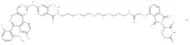
dAURK-4 hydrochloride, a derivative of Alisertib, functions as a potent and selective degrader of AURKA (Aurora A), exhibiting anticancer properties [1].Fórmula:C52H53Cl2FN8O12Pureza:99.44%Forma y color:SolidPeso molecular:1071.93