Fluorogenic Substrates
Found 217 products for "Fluorogenic Substrates".
- Lower prices
- Higher prices
- Lower purities
- Higher purities
- Faster estimated delivery
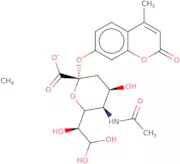
4-Methylumbelliferyl N-acetyl-a-D-neuraminic acid ammonium
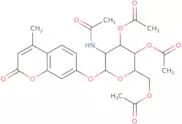
CAS:4-Methylumbelliferyl N-acetyl-alpha-D-neuraminic acid ammonium is a fluorogenic substrate for neuraminidase. After enzymatic cleaveage, free 4-methylumbelliferone (also known as hymecromone) is released, exhibiting blue fluorescence upon excitation with UV light. The strongest fluorescence of 4-methylumbelliferone requires deprotonation of the hydroxyl group (thus requires alkaline pH), with a maximal fluorescence intensity obtained with excitation at 350 to 370 nm and emission at 440 to 470 nm. The use of 4-methylumbelliferyl N-acetyl-alpha-D-neuraminic acid ammoniumas a substrate for measuring the neuraminidase activity is used for detecting the glycoproteins on the surface of influenza A and B viruses, as well as for sialidosis diagnosis.Formula:C21H28N2O11Purity:Min. 95%Color and Shape:PowderMolecular weight:471.44 g/mol4-Methylumbelliferyl 2-acetamido-3,4,6-tri-O-acetyl-2-deoxy-a-D-glucopyranoside
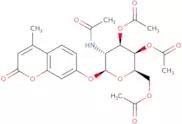
CAS:4-Methylumbelliferyl 2-acetamido-3,4,6-tri-O-acetyl-2-deoxy-a-D-glucopyranoside is a chromogenic substrate for enzymes that catalyze the hydrolysis of glycosidic bonds. It can be used in diagnostic tests to identify antibodies against certain bacteria and fungi. The fluorogenic form of 4-methylumbelliferyl 2-acetamido-3,4,6-triO acetyl -2 deoxy a D glucopyranoside can be used as a chemiluminescent substrate for detecting bacterial activity. 4 methylumbelliferyl 2 acetamido 3,4,6 triO acetyl -2 deoxy a D glucopyranoside is also useful in bioluminescent assays to detect ATP production in bacteria and other microorganisms. CAS No: 1174287–76–3
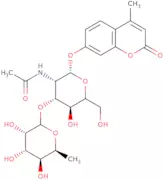
Purity:Min. 95%Molecular weight:505.48 g/mol4-Methylumbelliferyl 2-acetamido-2-deoxy-3-O-(a-L-fucopyranosyl)-b-D-glucopyranoside
CAS:4-Methylumbelliferyl 2-acetamido-2-deoxy-3-O-(alpha-L-fucopyranosyl)-beta-D-glucopyranoside is a fluorogenic substrate for alpha-L-fucosidase. After enzymatic cleaveage, free 4-methylumbelliferone (also known as hymecromone) is released, exhibiting blue fluorescence upon excitation with UV light. The strongest fluorescence of 4-methylumbelliferone requires deprotonation of the hydroxyl group (thus requires alkaline pH), with a maximal fluorescence intensity obtained with excitation at 350 to 370 nm and emission at 440 to 470 nm. The use of 4-methylumbelliferyl 2-acetamido-2-deoxy-3-O-(alpha-L-fucopyranosyl)-beta-D-glucopyranosideas a substrate for measuring the alpha-L-fucosidase activity is used for fucosidosis diagnosis (deficiency of the enzyme alpha-L-fucosidase) and lysosomal storage disorder screening.Formula:C24H31NO12Purity:Min. 95 Area-%Color and Shape:White PowderMolecular weight:525.5 g/mol2'-(4-Methylumbelliferyl)-a-D-N-glycolylneuraminic acid
CAS:2'-(4-Methylumbelliferyl)-a-D-N-glycolylneuraminic acid is a fluorogenic substrate that is used for enzymatic labeling of glycolipids. It can be used as a diagnostic or food testing agent, and also has applications in environmental testing. The CAS number for this product is 1434265-32-3.Purity:Min. 95%Molecular weight:483.42 g/molD-Alanine 7-amido-4-methylcoumarin free base
CAS:D-Alanine 7-amido-4-methylcoumarin free base is a chromogenic substrate that is used in diagnostic testing. It is used to identify the presence of beta-lactamase, which catalyzes the hydrolysis of penicillin and cephalosporin antibiotics, by turning the substrate into a bright blue color. D-Alanine 7-amido-4-methylcoumarin free base can also be used as a fluorescent substrate for bioluminescence or chemiluminescence reactions. This product is high quality and has CAS number 201847-51-0.
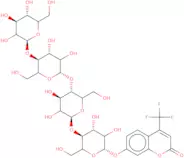
Formula:C13H14N2O3Purity:Min. 95%Molecular weight:246.26 g/mol4-(Trifluoromethyl)umbelliferyl-b-D-cellotetraoside
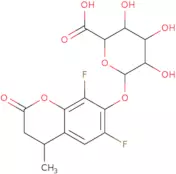
CAS:4-(Trifluoromethyl)umbelliferyl-b-D-cellotetraoside is a chemiluminescent substrate that can be used in the detection of peroxidase, horseradish peroxidase, and other enzymes. It is a fluorescent product that emits light upon reaction with hydrogen peroxide. This product has been tested for purity and quality and has shown to have no detectable levels of heavy metals or other contaminants. 4-(Trifluoromethyl)umbelliferyl-b-D-cellotetraoside is not cytotoxic and can be used for the detection of enzyme activity in living cells. 4-(Trifluoromethyl)umbelliferyl-b-D-cellotetraoside is also known as TMBECFDA, which stands for Trifluoromethyl)umbelliferone (Cellobiose) (BiotPurity:Min. 95%Molecular weight:878.7 g/mol6,8-Difluoro-4-methylumbelliferyl β-D-glucuronide
CAS:6,8-Difluoro-4-methylumbelliferyl b-D-glucuronide is a chemiluminescent substrate for the enzyme glucuronidase. The compound has been shown to be stable in the presence of a wide range of pHs and temperatures. It can be used in applications such as diagnostics, culture media and food testing. 6,8-Difluoro-4-methylumbelliferyl b-D-glucuronide has a high purity level and can be used as an indicator for other compounds such as acetaminophen or ibuprofen.Purity:Min. 95%Color and Shape:White To Off-White SolidMolecular weight:388.27 g/mol4-Methylumbelliferyl 2-acetamido-3,4,6-tri-O-acetyl-2-deoxy-b-D-galactopyranoside
CAS:4-Methylumbelliferyl 2-acetamido-3,4,6-tri-O-acetyl-2-deoxy-b-D-galactopyranoside is a fluorescent marker that is used to measure the enzymatic activity of corynebacterium glutamicum. The enzyme catalyzes the conversion of 4-methylumbelliferyl glucopyranoside to 4-methylumbelliferone glucuronide. The production of 4 methylumbelliferone glucuronide can be quantified using fluorescence spectroscopy. This product can be used in research involving chronic inflammatory diseases and cancer.Purity:Min. 95%Molecular weight:505.47 g/mol3-Carboxyumbelliferyl b-D-galactoside BSA conjugate
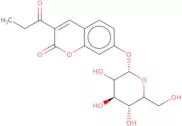
3-Carboxyumbelliferyl b-D-galactoside BSA conjugate is a fluorogenic substrate that is used in chemiluminescent enzyme assays. The reaction of this compound with the enzyme β-galactosidase leads to an increase in the intensity of light emitted by the compound, which can be measured using a luminometer. This product is often used in diagnostics, such as food testing and environmental testing, as well as high quality research.Purity:Min. 95%6,8-Difluoro-4-methylumbelliferyl b-D-cellotetraoside
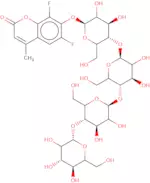
6,8-Difluoro-4-methylumbelliferyl b-D-cellotetraoside is a chemiluminescent substrate for the detection of esterases. It is also used as an enzyme substrate in diagnostic applications and as a fluorogenic substrate in food testing. 6,8-Difluoro-4-methylumbelliferyl b-D-cellotetraoside has been shown to be an excellent ligand for use in immunoassays and can be conjugated to antibodies or antigens. 6,8-Difluoro-4-methylumbelliferyl b-D-cellotetraoside is chemically stable and has high purity and high quality.Purity:Min. 95%Molecular weight:860.71 g/mol6-Chloro-4-trifluoromethylumbelliferyl b-D-galactopyranoside
6-Chloro-4-trifluoromethylumbelliferyl b-D-galactopyranoside is a chromogenic substrate that can be used in enzyme assays to measure the activity of beta-glucuronidase. This compound is sold as a conjugate with an enzyme, which will not interfere with the assay. The compound has been tested to have high purity and quality.Purity:Min. 95%4-Methylumbelliferyl 2-acetamido-2-deoxy-3,6-di-O-pivaloyl-b-D-galactopyranoside
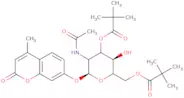
CAS:4-Methylumbelliferyl 2-acetamido-2-deoxy-3,6-di-O-pivaloyl-b-D-galactopyranoside is a chemiluminescent substrate that reacts with an enzyme to produce light. It is used in the detection of ATPase activity and in the diagnosis of diseases. This product has been tested for quality and environmental safety, and it does not contain any hazardous substances. It is highly pure and can be used for testing food, diagnosing diseases, or staining cells.Purity:Min. 95%Molecular weight:547.59 g/molD-Alanine 7-amido-4-methylcoumarin trifluoroacetate salt
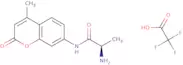
CAS:D-Alanine 7-amido-4-methylcoumarin trifluoroacetate salt is a chromogenic substrate for the enzyme Beta-galactosidase. It is used as a diagnostic tool in the detection of certain bacteria, such as Enterobacteriaceae and Clostridium perfringens. It can also be used to detect the presence of beta galactosidase in food products and environmental samples. D-Alanine 7-amido-4-methylcoumarin trifluoroacetate salt has an applications in chemiluminescence, bioluminescence, and fluorescence. This product is not intended for use as a drug or food additive.Formula:C15H15F3N2O5Purity:Min. 95%Color and Shape:White/Off-White SolidMolecular weight:360.29 g/mol3-HTC
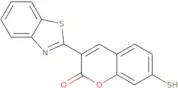
CAS:3-HTC reacts reversibly with thiols and disulfides, and can be used to measure dynamic GSH/GSSH ratios in vitro as well as to monitor the reversible redox status of whole cell lysates.(λmax: 448 nm in its reduced thiolate form, and a λmax 370-410 nm for the oxidized mixed disulfide).Formula:C16H9NO2S2Purity:Min. 95%Molecular weight:311.38 g/mol4-Methylumbelliferyl 2-acetamido-2-deoxy-4-O-(a-L-fucopyranosyl)-b-D-glucopyranoside
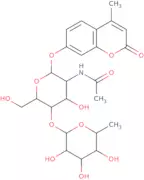
CAS:4-Methylumbelliferyl 2-acetamido-2-deoxy-4-O-(alpha-L-fucopyranosyl)-beta-D-glucopyranoside is a fluorogenic substrate for alpha-L-fucosidase. After enzymatic cleaveage, free 4-methylumbelliferone (also known as hymecromone) is released, exhibiting blue fluorescence upon excitation with UV light. The strongest fluorescence of 4-methylumbelliferone requires deprotonation of the hydroxyl group (thus requires alkaline pH), with a maximal fluorescence intensity obtained with excitation at 350 to 370 nm and emission at 440 to 470 nm. The use of 4-methylumbelliferyl 2-acetamido-2-deoxy-4-O-(alpha-L-fucopyranosyl)-beta-D-glucopyranosideas a substrate for measuring the alpha-L-fucosidase activity is used for fucosidosis diagnosis (deficiency of the enzyme alpha-L-fucosidase) and glycoprotein metabolism disorder detection.Formula:C24H31NO12Purity:Min. 95 Area-%Color and Shape:PowderMolecular weight:525.5 g/mol4-Methylumbelliferyl 2-O-(a-L-fucopyranosyl)-b-D-galactopyranoside
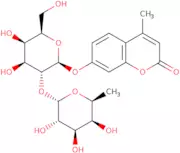
CAS:4-Methylumbelliferyl 2-O-(a-L-fucopyranosyl)-b-D-galactopyranoside is an enzyme substrate used in chromogenic assays of alpha-fucosidases. It is also used for glycoprocessing enzymes in synthesis.Purity:Min. 95%Molecular weight:484.45 g/mol6-Chloro-4-(trifluoromethyl)umbelliferyl b-D-cellotetraoside
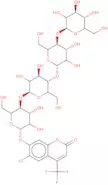
6-Chloro-4-(trifluoromethyl)umbelliferyl b-D-cellotetraoside is a fluorescent substrate that is used to measure the activity of the enzyme beta-glucuronidase. It is a chemiluminescent compound that emits light when hydrolyzed by an enzyme. 6-Chloro-4-(trifluoromethyl)umbelliferyl b-D-cellotetraoside has been shown to be a high quality and environmentally friendly product, as it does not cause any significant change in pH or turbidity in water samples. It has also been shown to be nontoxic and nonmutagenic at concentrations up to 400 ppm. This product can be used for a variety of purposes, including diagnostic tests for bacterial infections or food testing.
Purity:Min. 95%Molecular weight:913.15 g/mol4-Methylumbelliferyl a-L-idopyranoside
CAS:4-Methylumbelliferyl alpha-L-idopyranoside is a fluorogenic substrate for alpha-L-iduronidase. After enzymatic cleaveage, free 4-methylumbelliferone (also known as hymecromone) is released, exhibiting blue fluorescence upon excitation with UV light. The strongest fluorescence of 4-methylumbelliferone requires deprotonation of the hydroxyl group (thus requires alkaline pH), with a maximal fluorescence intensity obtained with excitation at 350 to 370 nm and emission at 440 to 470 nm. The use of 4-methylumbelliferyl alpha-L-idopyranosideas a substrate for measuring the alpha-L-iduronidase activity is used for Mucopolysaccharidosis I diagnosis and Hurler syndrome screening.
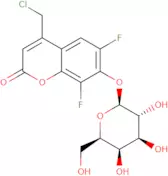
Formula:C16H18O8Purity:Min. 98 Area-%Color and Shape:White PowderMolecular weight:338.31 g/mol4-Chloromethyl-6,8-difluoroumbelliferyl b-D-galactopyranoside
CAS:4-Chloromethyl-6,8-difluoroumbelliferyl b-D-galactopyranoside is a compound commonly used in biochemical research as a fluorescent substrate for the detection of sugar hydrolase enzymes. This compound can be cleaved by enzymes such as β-galactosidase, releasing a fluorescent molecule that can be easily detected using fluorescence spectroscopy. The compound is a member of the family of umbelliferyl glycosides, which have been widely used in the study of various biochemical pathways for many years. The advantage of using this particular substrate is that the fluorescent product has a high quantum yield, which means it produces a strong signal for detection. This substrate has been used in a wide variety of applications, including the study of microbial physiology and in the development of diagnostic assays for detecting bacterial and fungal infections.
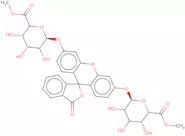
Purity:Min. 95%Molecular weight:408.74 g/molFluorescein di-b-D-glucuronide dimethyl ester
Fluorogenic substrate for beta-glucuronidasePurity:Min. 95%Color and Shape:PowderMolecular weight:712.61 g/mol