Oligosaccharides
Oligosaccharides are carbohydrates composed of a small number of monosaccharide units linked by glycosidic bonds. These molecules play significant roles in various biological processes, including cell recognition, signaling, and immune responses. In this section, you will find a comprehensive selection of oligosaccharides essential for research in glycoscience, biochemistry, and molecular biology. These compounds are vital for studying complex carbohydrate structures, their functions, and their interactions with other biomolecules. At CymitQuimica, we provide high-quality oligosaccharides to support your research and development needs, ensuring accurate and reliable results in your experiments.
Subcategories of "Oligosaccharides"
- Aminoethyl Glycosides, Aminopropyl Glycosides(14 products)
- Asn Binding Glycans(33 products)
- Biotinated Oligosaccharides(13 products)
- Blood Groups and Lewis Antigens(11 products)
- Blood Type Oligosaccharides(13 products)
- Cellooligosaccharides(1 products)
- Cyclodextrins(183 products)
- Disaccharides(192 products)
- Epitope Oligosaccharides(19 products)
- Fructooligosaccharides(2 products)
- Functional Oligosaccharides(554 products)
- Functionalised Oligosaccharides(1 products)
- Galactosamine(41 products)
- Galactose(261 products)
- Galb(1-3)GalNAc(21 products)
- Ganglio-series(11 products)
- Globo- and Isoglobo-series(17 products)
- Glucosamine(128 products)
- Glucuronic Acids(51 products)
- Glycoproteins, Glycopeptides(59 products)
- Glycosaminoglycan(26 products)
- Human Milk Oligosaccharides(19 products)
- Labeled O-Glycans(9 products)
- Labeled Oligosaccharides(36 products)
- LacNAc(53 products)
- Lacto- and Neolacto-series(14 products)
- Lacto-N-biose(10 products)
- Lactooligosaccharides(7 products)
- Linker Attached Oligosaccharides(19 products)
- Maltooligosaccharides(6 products)
- Milk Oligosaccharides(31 products)
- N-Glycans(149 products)
- Natural Glycosides(177 products)
- Natural Oligosaccharides(103 products)
- O-Glycan(18 products)
- Oligosaccharide Building Blocks(7 products)
- Oligosaccharide Replacement(2 products)
- Oligosaccharides by Component Sugar(225 products)
- Oligoses(24 products)
- Other Oligosaccharides(14 products)
- PEG Oligomers(33 products)
- Phosphated Sugars(17 products)
- Protected Sugars(526 products)
- Reagents for Oligosaccharide Synthesis(254 products)
- Ser, Thr Binding Glycans(9 products)
- Sialylated Oligosaccharides(3 products)
- Sphingoglycolipids(42 products)
- Sugar Amino Acids, Sugar Peptides(20 products)
- Sugar Antigens(31 products)
- Sugar Building Blocks by Target Oligosaccharides(225 products)
- Sugar Conjugates(100 products)
- Sulfated Sugars(16 products)
- Tetrasaccharides(34 products)
- Trisaccharides and Above(95 products)
- Xylooligosaccharides(5 products)
Show 47 more subcategories
Found 2278 products of "Oligosaccharides"
Sort by
Purity (%)
0
100
|
0
|
50
|
90
|
95
|
100
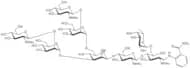
Glycyl-monosialyllacto-N-neohexose I
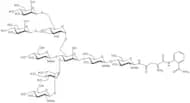
<p>Glycyl-monosialyllacto-N-neohexose I is a monosaccharide that is used as a building block in the synthesis of complex carbohydrates. It is custom synthesized and purified to high purity. This product can be fluorinated and methylated, which allows for the attachment of glycosyl groups. Glycyl-monosialyllacto-N-neohexose I is also a sugar with a CAS number. It has an average molecular weight of 137.14 g/mol and is made up of three atoms: carbon, hydrogen, and oxygen.</p>Formula:C53H89N5O39Purity:Min. 95%Molecular weight:1,420.28 g/molNGA2F Glycan, 2-AB labelled
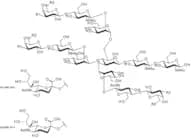
<p>NGA2F Glycan is a complex carbohydrate that is synthesized by the enzymatic transfer of an N-acetylgalactosamine (GalNAc) residue to a serine or threonine residue on protein. It is modified with methylation, Click modification, and fluorination. NGA2F Glycan has two binding sites for 2-AB labelled monosaccharides. The glycosylation site is located at the non-reducing end of the molecule, while the oligosaccharide site is located at the reducing end of the molecule.</p>Purity:Min. 95%A3 Glycan, 2-AB labelled
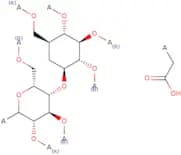
<p>A3 Glycan, 2-AB labelled is a complex carbohydrate. It is synthesized by the methylation and glycosylation of the A3 sugar, which is a monosaccharide. The A3 Glycan, 2-AB labelled has a CAS No. of 711-81-2 and is a synthetic oligosaccharide with high purity. Its chemical formula is C6H8O5N2O2 and its molecular weight is 192.19 g/mol. The A3 Glycan, 2-AB labelled has an MW of 192.19 g/mol and an MW of 643 Da (1). It also contains one saccharide unit that consists of two bonded monosaccharides: fructose and glucose. A3 Glycan, 2-AB labelled CAS No.: 711-81-2 Molecular Formula: C6H8O5N2O2 Mole</p>Purity:Min. 95%Globo H pentenyl glycoside
CAS:<p>GloboH-pentanyl backbone for incorporation onto peptide or conjugated to protein</p>Purity:Min. 95%Thiocellotetraose
<p>Thiocellotetraose is a glycosylation product of cellulose. It is a complex carbohydrate that is similar to other saccharides. Thiocellotetraose can be obtained by methylation, click modification, and fluorination. The monosaccharide units in thiocellotetraose are glucose and mannose. This product can be custom synthesized to meet your specific requirements for purity and CAS number.</p>Formula:C24H42O18S3Purity:Min. 95%Molecular weight:714.78 g/molGlucomannan oligosaccharides - from Konjac MW <10KDa
<p>Glucomannan oligosaccharides are modified polysaccharides of plant origin. They are not digested in the small intestine and are instead fermented by the large intestine to produce short-chain fatty acids. This is a novel approach to weight control. The modified monosaccharide backbone provides for a more complex carbohydrate than found in other dietary fibers, and this complex carbohydrate is resistant to digestion by mammalian enzymes. Glucomannan oligosaccharides can be used as a replacement for high-calorie sweeteners in many food applications and as a bulk laxative.</p>Purity:Min. 95%Color and Shape:PowderCarboxymethyl cellulose sodium - Viscosity 700-1500 mPa·s
CAS:<p>Food additive; soil suspension polymer in detergents; thickening agent</p>Purity:Min. 95%1,4-β-D-Xylohexaose
CAS:<p>1,4-beta-D-xylohexaose is a sugar that belongs to the group of xylooligosaccharides. It is an enzymatic inactivator that binds to the enzyme hydrolase family. Xylooligosaccharides are found in plant cell walls, where they can be used as a carbon source by termites. 1,4-beta-D-xylohexaose has been shown to be most active against neutral ph, but it is not active against acidic ph. The enzyme hydrolase family is inhibited by binding with 1,4-beta-D-xylohexaose and this prevents hydrolysis of carbohydrates, which includes glycosidic bonds.br>br><br>1,4-beta-D-xylohexaose has also been shown to be beneficial for sustainable agriculture practices as it inhibits enzymes that break down xylooligosaccharides</p>Formula:C30H50O25Purity:Min. 95%Color and Shape:PowderMolecular weight:810.7 g/molD-Lactose monohydrate
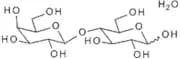
CAS:<p>Lactose is the principal sugar in human and most other mammalian milks, ( 4-O-(β-d-galactopyranosyl)-d-glucopyranose) (Collins, 2006). Lactose undergoes mutarotation; it is a reducing sugar and is significantly less soluble in water than sucrose. Lactose is much less sweet than sucrose (at ~1% about 0.15 (sucrose=1). The enzyme lactase (β-galactosidase), which is present in the small intestine, catalyzes hydrolysis of lactose to form glucose and galactose. Anhydrous lactose is an excipient, filler, diluent, and bulking agent in a wide variety of pharmaceutical tablets, capsules, powders and other preparations. Lactose also has applications as a nutrient and multi-functional ingredient in infant formulae, geriatric, dietetic and health foods (Linko, 1982).</p>Formula:C12H22O11·H2OPurity:Min. 96 Area-%Color and Shape:White Off-White PowderMolecular weight:360.31 g/molLacto-N-fucopentaose V
CAS:<p>Human milk oligosaccharide; binds cholera toxin TcdA</p>Formula:C32H55NO25Purity:Min. 80%Color and Shape:PowderMolecular weight:853.77 g/mol2-Acetamido-2-deoxy-4-O-(β-D-mannopyranosyl)-D-glucopyranose
CAS:<p>2-Acetamido-2-deoxy-4-O-(b-D-mannopyranosyl)-D-glucopyranose (MDP) is a complex carbohydrate that has been modified by methylation, glycosylation, and carbocation. MDP is a saccharide that can be used in the synthesis of polysaccharides or as an intermediate for other chemical syntheses. It is also possible to modify MDP with fluorination, which may be useful in the synthesis of new types of pharmaceuticals.</p>Formula:C14H25NO11Purity:Min. 95 Area-%Color and Shape:PowderMolecular weight:383.35 g/mol2'-O-Fucosyllactulose
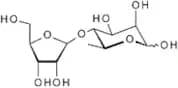
CAS:<p>2'-O-Fucosyllactulose is a modified carbohydrate that has been synthesized from a natural source. It is an oligosaccharide that contains the monosaccharide, fucose. This product can be used in the synthesis of polysaccharides and glycosylation reactions. 2'-O-Fucosyllactulose has been methylated, fluorinated, and glycosylated, which makes it suitable for use as a sugar in biotechnology applications.</p>Formula:C18H32O15Purity:Min. 90 Area-%Color and Shape:PowderMolecular weight:488.44 g/mol4-O-(b-D-Ribofuranosyl)-L-rhamnopyranose
<p>4-O-(b-D-Ribofuranosyl)-L-rhamnopyranose is a custom synthesized monosaccharide that can be modified with fluorination and methylation. This sugar can be used for glycosylation reactions to form oligosaccharides or polysaccharides. The number of sugar molecules that are attached to the sugar determines the complexity of the carbohydrate. 4-O-(b-D-Ribofuranosyl)-L-rhamnopyranose is an example of a complex carbohydrate because it has four sugars attached to it.</p>Formula:C11H20O9Purity:Min. 95%Molecular weight:296.27 g/molChitotetraose tetrahydrochloride
CAS:<p>Tetraose composed of four glucosamine residues</p>Formula:C24H46N4O17•(HCl)4Purity:Min. 95%Color and Shape:White PowderMolecular weight:808.48 g/molHybrid Glycan, 2-AB labelled
<p>Hybrid Glycan, 2-AB labelled is a custom synthesis of a high purity glycosylation product. This synthetic oligosaccharide includes saccharides that are labelled with 2-AB. The modification is Click chemistry and provides a method for attaching the label to the sugar molecule. This product is not found in nature or existing in cells or organisms. It is used as a research tool in immunology, cell biology, and structural biology applications.</p>Purity:Min. 95%1,4-β-D-Xylopentaose
CAS:<p>Xylopentaose is a pentose sugar that belongs to the group of polyols. It has been shown to be a dietary supplement that improves the lipid profile in mice and humans, which may be due to its ability to inhibit diacylglycerol acyltransferase, thereby preventing the synthesis of triglycerides. Xylopentaose is also able to increase serum glucose levels by stimulating insulin secretion through the activation of pancreatic β-cells. Xylopentaose can be used as a sweetener because it has some sweetness but does not cause tooth decay like sugar does.</p>Formula:C25H42O21Purity:Min. 95%Color and Shape:PowderMolecular weight:678.59 g/molD-Melibiose monohydrate
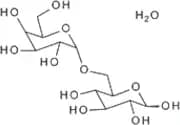
CAS:<p>D-Melibiose monohydrate is a type of sugar that can be found in the extracellular space. It is also a component of fatty acids and has been shown to act as a growth factor for some cell types. D-Melibiose monohydrate has been characterized using tissue culture, growth factor profiles, and fluorescence detector. This sugar can be used as an alternative to trehalose in vitro assays, where it has been shown to have similar biological properties. D-Melibiose monohydrate may also be used for the manufacture of solid dispersions due to its solubility in organic solvents.</p>Formula:C12H24O12Purity:Min. 98 Area-%Color and Shape:White PowderMolecular weight:360.31 g/molMannotetraose squarate
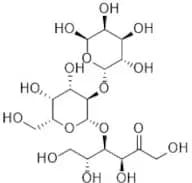
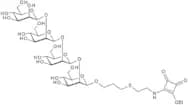
CAS:<p>Mannotetraose squarate is a modified oligosaccharide that is synthesized from mannose and tetraose. It has high purity, which is an advantage over natural oligosaccharides, and can be used in the synthesis of other carbohydrates. Mannotetraose squarate has a CAS number of 385842-90-0, which can be found on the ChemSpider database.</p>Formula:C35H57NO24SPurity:Min. 95%Molecular weight:907.89 g/mol1,1,1,1-Kestohexose
CAS:<p>Non-reducing sucrose analog containing glucose and fructose</p>Formula:C36H62O31Purity:Min. 90%Color and Shape:White PowderMolecular weight:990.86 g/molBlood Group A trisaccharide, N-aminoethyl nonanamide
CAS:<p>Blood group antigen derivative for biochemical research</p>Formula:C31H57N3O16Purity:Min. 95 Area-%Color and Shape:PowderMolecular weight:727.79 g/mol