Monosaccharides
Monosaccharides are the simplest form of carbohydrates and serve as fundamental building blocks for more complex sugars and polysaccharides. These single sugar molecules play critical roles in energy metabolism, cellular communication, and structural components of cells. In this section, you will find a wide variety of monosaccharides essential for research in biochemistry, molecular biology, and glycoscience. These compounds are crucial for studying metabolic pathways, glycosylation processes, and developing therapeutic agents. At CymitQuimica, we offer high-quality monosaccharides to support your research needs, ensuring precision and reliability in your scientific investigations.
Subcategories of "Monosaccharides"
- Alloses(11 products)
- Arabinoses(21 products)
- Erythroses(11 products)
- Fructoses(9 products)
- Fucoses(36 products)
- Galactosamine(41 products)
- Galactose(261 products)
- Glucoses(365 products)
- Glucuronic Acids(51 products)
- Glyco-substrates for Enzyme(77 products)
- Guloses(6 products)
- Idoses(4 products)
- Inositols(15 products)
- Lyxoses(4 products)
- Mannoses(65 products)
- O-Glycans(48 products)
- Psicoses(3 products)
- Rhamnoses(10 products)
- Riboses(61 products)
- Sialic Acids(100 products)
- Sorboses(4 products)
- Sugars(173 products)
- Tagatoses(4 products)
- Taloses(8 products)
- Xyloses(20 products)
Show 17 more subcategories
Found 6088 products of "Monosaccharides"
Sort by
Purity (%)
0
100
|
0
|
50
|
90
|
95
|
100
1,2,3,4,6-Penta-O-galloyl-a-D-glucopyranose
CAS:<p>1,2,3,4,6-Penta-O-galloyl-a-D-glucopyranose is a natural compound that inhibits the Cox-2 enzyme and has anti-cancer properties. It induces cell death by increasing oxidative injury and suppressing autophagy. 1,2,3,4,6-Penta-O-galloyl-a-D-glucopyranose has been shown to reduce xenograft tumor growth in mice while causing no observable toxic effects on normal tissues. This compound also inhibits the proapoptotic protein Bax and promotes the expression of Bcl2 in 3T3L1 preadipocytes. The mechanism of action may be related to its ability to inhibit basic fibroblast proliferation and induce apoptosis in k562 cells.</p>Formula:C41H32O26Purity:Min. 95%Color and Shape:Off-White PowderMolecular weight:940.68 g/mol2-Acetamido-2-deoxy-b-D-thioglucopyranose
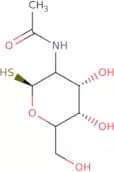
CAS:<p>2-Acetamido-2-deoxy-b-D-thioglucopyranose is a sugar with the chemical formula C6H14O7. It has been synthesized by Click chemistry to have an acetamido group on one of the carbon atoms and a 2,3,5-triiodo substituent on the other. The methylene protons at the 3 and 5 positions of the glycosidic linkage are fluorinated to give this modified sugar. It is also glycosylated with glucose to form a complex carbohydrate. 2-Acetamido-2-deoxy-b-D-thioglucopyranose has CAS number 781581-10-0 and a molecular weight of 318.19 g/mol.</p>Formula:C8H15NO5SPurity:Min. 95%Color and Shape:PowderMolecular weight:237.27 g/mol1,3,4,6-Tetra-O-acetyl-2-azido-2-deoxy-b-D-galactopyranose
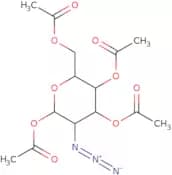
CAS:<p>1,3,4,6-Tetra-O-acetyl-2-azido-2-deoxy-b-D-galactopyranose (TAZ) is an aromatic heterocyclic sugar compound that is used in pharmaceutical formulations. It has low toxicity and can be synthesized using a number of methods. TAZ has been shown to have antifungal effects against Candida albicans and antitumor effects against cancer cells. TAZ also inhibits the activity of teniposide, which is a drug used for the treatment of leukemia. TAZ may be effective against cancer cells by acting as an amido donor and changing the conformation of the cyclic peptide.</p>Formula:C14H19N3O9Purity:Min. 95%Color and Shape:PowderMolecular weight:373.32 g/mol1-Bromo-2,3,4-tri-O-acetyl-a-D-glucuronide methyl ester
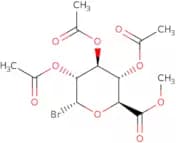
CAS:<p>1-Bromo-2,3,4-tri-O-acetyl-a-D-glucuronide methyl ester is a protected D-glucoronic acid with an alpha bromide at the anomeric position ready to undergo glycosylation reactions with suitable glycoside acceptors. Pharmaceutically active compounds have been used as acceptors to form β-linked D-glucuronide prodrugs which can be used to modify pharmacokinetics, improve solubility and lower the toxicity of the drug.</p>Formula:C13H17BrO9Purity:Min. 80%Molecular weight:397.17 g/molD-Mannose-6-phosphate disodium salt hydrate
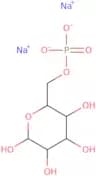
CAS:<p>D-Mannose-6-phosphate disodium salt hydrate (DMDSP) is an endogenous pentose phosphate metabolite that is found in the human body. DMDSP is generated from the metabolism of mannose and glucose and functions as a regulator of metabolic intermediates. It has also been shown to inhibit bacterial growth and function as a competitive inhibitor of bacterial DNA gyrase, an enzyme that maintains the integrity of bacterial DNA. Genetic polymorphism in the DMDP gene may be associated with changes in response to DMDSP. The reductive amination reaction can be used to synthesize this compound from L-aspartic acid, malic enzyme, and nicotinamide adenine dinucleotide phosphate.</p>Formula:C6H11O9PNa2·H2OPurity:Min. 95 Area-%Color and Shape:White PowderMolecular weight:322.11 g/molN-Acetyl-D-mannosamine
CAS:<p>N-Acetyl D-mannosamine (ManNAc) is an aldohexose (2-acetamido-2-deoxymannose) in which the axial hydroxyl group at position 2 is replaced by a N-acetyl group (Collins, 2006). It has been reported that N-acetyl D-mannosamine supplementation, may provide novel means to break the link between obesity and hypertension (Peng, 2019). N-Acetyl-D-mannosamine and N-acetyl-D-glucosamine are the essential precursors of sialic acid, the specific monomer of polysialic acid, a bacterial pathogenic determinant, for example, Escherichia coli K1 uses both amino sugars as carbon sources. Glycoproteins normally have some level of glycan sialylation, but incomplete sialylation can reduce their therapeutic effect when produced recombinantly. To improve performance, cell lines and culture media can be adjusted. The GNE enzyme controls the efficiency of sialylation in human cell lines, making it crucial for producing effective recombinant glycoprotein drugs. Adding ManNAc and other supplements to culture media improves sialylation, which boosts drug yield, increases stability and half-life, and lowers immune reactions by reducing antibody formation.It has also been reported that ManNAc can be used as a treatment for hereditary inclusion body myopathy, an adult-onset, progressive neuromuscular disorder and also for renal disorders involving proteinuria and hematuria due to podocytopathy and/or segmental splitting of the glomerular basement membrane (Galeano, 2007).</p>Formula:C8H15NO6Purity:Min. 97.5 Area-%Molecular weight:221.21 g/mol2-Acetamido-1,6-anhydro-2-deoxy-β-D-glucopyranose
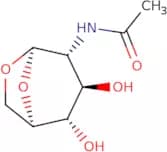
CAS:<p>2-Acetamido-1,6-anhydro-2-deoxy-b-D-glucopyranose is widely used in carbohydrate chemistry. It is used as reagent for the synthesis of oligosaccharides and also as a precursor in the synthesis of oligopeptides. 2-Acetamido-1,6-anhydro-2-deoxy-b-D-glucopyranose is an analog of levoglucosan, a compound that is often used to trace for biomass burning in enviromental chemistry studies.</p>Formula:C8H13NO5Purity:Min. 95%Color and Shape:PowderMolecular weight:203.19 g/mol4-Methylphenyl 2,3,4-tri-O-benzyl-β-L-thiofucopyranoside
<p>4-Methylphenyl 2,3,4-tri-O-benzyl-b-L-thiofucopyranoside is a custom synthesis of an oligosaccharide. It is a complex carbohydrate with CAS No. that belongs to the class of saccharide and sugar. Polysaccharides are made up of several monosaccharides linked together by glycosidic bonds, which are formed by the action of enzymes called glycosyltransferases or glycosidases. Glycosylation is the process in which a sugar molecule (usually glucose) is added to another molecule by means of a glycosidic bond. Carbohydrates are one type of macromolecule and they are important sources of energy in living things. They also play important roles in cell walls and as structural components in plants and animals. The chemical modification carried out on this compound is methylation, which refers to the addition of one or more methyl</p>Formula:C34H36O4SPurity:Min. 95%Molecular weight:540.71 g/molPropargyl β-D-glucopyranoside
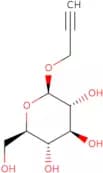
CAS:<p>A beta glycoside with an alkyne handle suitable to click chemistry</p>Formula:C9H14O6Purity:Min. 95%Color and Shape:PowderMolecular weight:218.2 g/molD-Quinovosamine hydrochloride
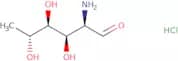
CAS:<p>Quinovosamine hydrochloride (QNH) is a fatty acid that belongs to the group of galacturonic acid. It has been shown to be biologically active in wild-type strains and in some bacterial strains, including Pseudomonas aeruginosa. QNH has also been used for preparation of monoclonal antibodies directed against receptor activity, which are activated by QNH.</p>Formula:C6H13NO4·HClPurity:Min. 95%Color and Shape:PowderMolecular weight:199.63 g/molMethyl 2,3,4-tri-O-benzyl-α-D-glucuronide benzyl ester
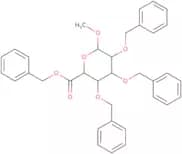
CAS:<p>Methyl 2,3,4-tri-O-benzyl-α-D-glucuronide benzyl ester is a Carbohydrate. It is soluble in water and insoluble in alcohol. The molecular weight of Methyl 2,3,4-tri-O-benzyl-α-D-glucuronide benzyl ester is 584.1 g/mol. The CAS Registry Number for Methyl 2,3,4-tri-O-benzyl-α-D-glucuronide benzyl ester is 14279733.</p>Formula:C35H36O7Purity:Min. 95%Color and Shape:Colorless Clear LiquidMolecular weight:568.66 g/molb-D-Xylopyranosyl azide
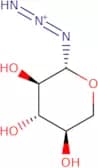
CAS:<p>b-D-Xylopyranosyl azide is a device that records multimedia. It has been found that b-D-Xylopyranosyl azide can record audio, video, and data recordings by automated means. The renaming of multimedia files is also possible with b-D-Xylopyranosyl azide.</p>Formula:C5H9N3O4Purity:Min. 95%Color and Shape:White PowderMolecular weight:175.14 g/mol1,3,4-Tri-O-acetyl-2-deoxy-2-fluoro-L-fucose
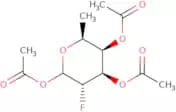
CAS:<p>Peracetylated 2-fluoro-L-fucose is the acetylated form of 2-deoxy-2-fluoro-L-fucose which is a potent inhibitor of protein fucosylation. It exhibits improved cell permeability and is rapidly deacetylated into its active form, inside the cell. It is metabolised inside the cell into a corresponding donor substrate analogue of GDP-fucose or GDP-2FF, via the salvage pathway. GDP-2FF accumulates in the cell causing a shutdown of de novo pathway which leads to the desired fucosylation inhibition. The addition of 100 uM peracetylated-2-fluoro-L-fucose to plants severely inhibits root growth by 95% compared to an untreated plant, and is more potent compared to 2-fluoro-L-fucose. The material is soluble in DMSO at 10mg/ml.</p>Formula:C12H17FO7Purity:Min. 97 Area-%Color and Shape:White Off-White PowderMolecular weight:292.26 g/mol4-Methylphenyl 2,3,4,6-tetra-O-acetyl-β-D-thioglucopyranoside
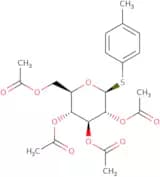
CAS:<p>4-Methylphenyl 2,3,4,6-tetra-O-acetyl-b-D-thioglucopyranoside is an antibiotic that is used to treat infections caused by a wide range of pathogens. This drug is active against Gram-negative and Gram-positive bacteria, including some resistant strains. 4MPTGA inhibits the growth of bacteria by binding to their ribosomes and preventing protein synthesis. It has been shown to have antimicrobial activity against E. coli and other Enterobacteriaceae species as well as other Gram negative bacteria such as Salmonella typhi and Proteus mirabilis. 4MPTGA has also been shown to be effective against the common animal health pathogen Staphylococcus aureus</p>Formula:C21H26O9SPurity:Min. 95%Color and Shape:White PowderMolecular weight:454.49 g/mol1,2,3,4-Tetra-O-acetyl-α-L-fucopyranose
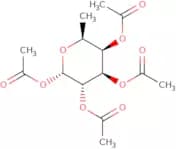
CAS:<p>1,2,3,4-Tetra-O-acetyl-α-L-fucopyranose is a chiral compound and it has been used as a biocatalyst in the industrial production of L-amino acids. The enantiomers are obtained by enzymatic hydrolysis of the racemic mixture with lipases. It has been shown that 1,2,3,4-Tetra-O-acetyl-α-L-fucopyranose is an enantioselective substrate for lipolytic enzymes. Lipolytic enzymes are also screened for lipase activity using this compound as a surrogate.</p>Formula:C14H20O9Purity:Min. 95%Color and Shape:White Off-White PowderMolecular weight:332.3 g/mol1,6-Anhydro-β-D-glucopyranose
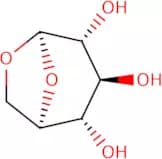
CAS:<p>Used for preparation of biologically active compounds</p>Formula:C6H10O5Purity:Min. 98 Area-%Color and Shape:White PowderMolecular weight:162.14 g/molD-Glucuronic acid, sodium salt monohydrate
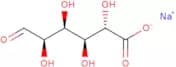
CAS:<p>Custom synthesis of D-glucuronic acid, sodium salt monohydrate.</p>Purity:Min. 95%a-D-Glucose-1,6-diphosphate tetra(cyclohexylammonium) salt hydrate
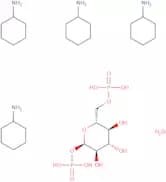
CAS:<p>a-D-Glucose-1,6-diphosphate tetra(cyclohexylammonium) salt hydrate is a synthetic sugar that can be used as a building block for polymer synthesis. It is an oligosaccharide that is synthesized by the click reaction of methylated glucose and cyclohexane diamine. This compound has been shown to be effective in the synthesis of polysaccharides and glycoproteins.</p>Formula:C6H14O12P2·4C6H13N·H2OPurity:Min. 95%Color and Shape:PowderMolecular weight:754.83 g/mol4-O-Acetyl-N-acetyl-neuraminic acid
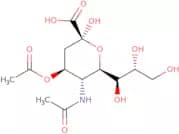
CAS:<p>4-O-Acetyl-N-acetyl-neuraminic acid is a derivative of sialic acid, which is an important component of the human cell membrane. It has been found to have inhibitory properties against influenza virus and other viruses. 4-O-Acetyl-N-acetyl-neuraminic acid inhibits viral activity by irreversible inhibition of the α subunit on the surface glycoprotein, preventing it from binding to host cells. This compound has been shown to be effective against hepatitis B virus and galleria mellonella (a type of wax moth). 4-O-Acetylneuraminic acid has also been shown to be effective in inhibiting the replication of Influenza A virus strains that are resistant to neuraminidase inhibitors such as zanamivir and oseltamivir.</p>Formula:C13H21NO10Purity:Min. 95 Area-%Color and Shape:PowderMolecular weight:351.31 g/mol2,3-O-Isopropylidene-L-ribofuranose
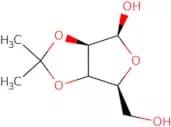
CAS:<p>2,3-O-Isopropylidene-L-ribofuranose is a chiral building block for the synthesis of α-amino acids. This compound can be obtained from l-arabinose and l-rhamnose by kinetic resolution reactions with reagents such as (R)-1,2,3,4,5,6-hexahydrobenzo[b]thiophene or (S)-1,2,3,4,5,6-hexahydrobenzo[b]thiophene. The product is an enantiospecifically pure mixture of 2,3-O-isopropylidene L-ribofuranose and its antipode. The use of acid catalysts such as sulfuric acid or hydrochloric acid will yield a higher yield of the desired product.</p>Formula:C8H14O5Purity:Min. 95 Area-%Color and Shape:PowderMolecular weight:190.19 g/mol