Apoptosis
Apoptosis inhibitors are compounds that prevent or delay the process of programmed cell death, known as apoptosis. These inhibitors are vital in studying cell survival mechanisms and are used to investigate diseases where apoptosis is dysregulated, such as cancer, neurodegenerative disorders, and autoimmune diseases. By modulating apoptosis, these inhibitors can help in the development of therapies aimed at controlling cell death. At CymitQuimica, we provide a comprehensive selection of high-quality apoptosis inhibitors to support your research in cell biology, oncology, and related fields.
Subcategories of "Apoptosis"
- ASK(6 products)
- BCL(11 products)
- Caspase(127 products)
- FOXO1(3 products)
- IAP(65 products)
- Mdm2(12 products)
- PD-1/PD-L1(126 products)
- PDK(9 products)
- PERK(24 products)
- Serine/threonin kinase(15 products)
- Survivin(13 products)
- TNF(91 products)
- c-RET(51 products)
- p53(62 products)
Show 6 more subcategories
Found 5622 products of "Apoptosis"
Sort by
Purity (%)
0
100
|
0
|
50
|
90
|
95
|
100
BRD6257
<p>BRD6257 is an orally active inhibitor of protein phosphatase 1D (proteinphosphatase, Mg2+/Mn2+ dependent 1D, PPM1D) with an IC50 of 5 nM. It activates the p53 signaling pathway (EC50 of 51 nM), enhances p21 expression, and inhibits the proliferation of cancer cells MOLM13 (IC50 = 2.8 μM). BRD6257 demonstrates good metabolic stability in human and rat liver microsomes.</p>Formula:C24H22F4N6O3SColor and Shape:SolidMolecular weight:550.53ROCK/HDAC-IN-2
<p>ROCK/HDAC-IN-2 (Compound C-9) is a dual inhibitor of ROCK/HDAC, characterized by IC50 values of 0.185 µM for HDAC6, 0.8 µM for ROCK1, and 0.7 µM for ROCK2. It effectively induces apoptosis and mitochondrial membrane potential alterations in cancer cells and demonstrates notable antitumor activity, making it useful for research in pancreatic ductal adenocarcinoma (PDAC) and triple-negative breast cancer (TNBC).</p>Formula:C22H32N4O4SColor and Shape:SolidMolecular weight:448.58DB2115 tertahydrochloride
CAS:<p>DB2115 (tertahydrochloride) inhibits PU.1, key in leukemia; potential for cancer research.</p>Formula:C32H34Cl4N8O2Color and Shape:SolidMolecular weight:704.48PROTAC CARM1/IKZF3 degrader-1
PROTAC CARM1/IKZF3 degrader-1 (Compound 074) inhibits CARM1, reducing the methylation level of its substrate BAF155. This PROTAC degrader works by degrading IKZF 1/3 via a CRBN-dependent mechanism. It suppresses MYC protein expression, thereby inhibiting the proliferation of various multiple myeloma cells. Additionally, PROTAC CARM1/IKZF3 degrader-1 can induce apoptosis in H929 cells and overcomes resistance to immunomodulatory drugs (IMiDs, such as pomalidomide). It is applicable for cancer and immunology research. (Pink: ligand for target protein CARM1/IKZF3 ligand 1; Active form of target protein ligand: EZM 2302; Black: linker; Blue: ligand for E3 ligase Cereblon Thalidomide 4-fluoride)Formula:C46H54ClN9O8Color and Shape:SolidMolecular weight:896.43FLT3/HDAC-IN-1
<p>FLT3/HDAC-IN-1 is a dual inhibitor targeting FLT3 and HDAC, with IC50 values of 30.4 nM for FLT3 and 52.4, 14.7 nM for HDAC1/3, respectively. It induces apoptosis in MV-4-11 cells and exhibits antiproliferative effects against BaF3 cells transformed by FLT3 mutations. FLT3/HDAC-IN-1 is useful for research on refractory solid tumors and hematological malignancies.</p>Color and Shape:Odour SolidPolyphyllin G
CAS:<p>Polyphyllin G (Polyphyllin VII), the the main member of polyphyllin family, shows strong anticancer activity against several carcinomas.</p>Formula:C51H84O22Purity:98%Color and Shape:SolidMolecular weight:1049.21P53/TLR2 modulator-1
<p>P53/TLR2 modulator-1 (Compound Z9) is an agent that targets both the P53 pathway and TLR2, exhibiting radioprotective properties. It mitigates apoptosis by inhibiting radiation-induced expression of P53 and Bax. Concurrently, it enhances the TLR2 pathway by upregulating downstream proteins MyD88 and P65, which promotes secretion of cytokines like IL-6, providing radioprotective effects. P53/TLR2 modulator-1 shows significant radioprotective activity in AHH-1 and HUVECs cells, enhances survival rates in C57BL/6J mice exposed to lethal radiation doses, and alleviates radiation-induced damage to their hematopoietic system, intestinal villi, and spleen. It is applicable for research on radiation-related diseases.</p>Color and Shape:Odour SolidSHP1 activator 1
SHP1 activator 1 (Compound 3n) is an activator of protein tyrosine phosphatase 1 containing the src homology-2 domain (SHP1), with an EC50 of 17.66 μM. It inhibits the proliferation of ABC-DLBCL cells and induces apoptosis by suppressing the STAT3 signaling pathway. In MDA-MB-231 cells, SHP1 activator 1 emits blue and green fluorescent signals, making it suitable as a cellular imaging agent.Formula:C27H34N4O4Color and Shape:SolidMolecular weight:478.58ZC0109
<p>ZC0109 inhibits IDO1 (50 nM) & TrxR1 (3.0 μM), induces ROS, arrests G1/S phase, causing cancer cell apoptosis.</p>Formula:C22H20BrFN8O4SColor and Shape:SolidMolecular weight:591.41PARP1-IN-16
<p>PARP1-IN-16 (compound 12a) serves as a potent PARP1 inhibitor, exhibiting an IC50 value of 1.89 nM.</p>Purity:98%Color and Shape:Odour SolidElteN378
CAS:<p>ElteN378: potently inhibits FKBP12 (Ki=0.5 nM), low weight, similar affinity to Rapamycin.</p>Formula:C23H26N2O3Purity:99.06%Color and Shape:SolidMolecular weight:378.46EGFR/COX-2-IN-1
<p>EGFR/COX-2-IN-1 is an EGFR/COX-2 inhibitor that effectively targets EGFRWT, EGFRT790M, COX-1, and COX-2 with IC50 values of 0.12, 0.076, 20.1, and 1.52 μM, respectively. It inhibits MCF-7, HT-29, and A-549 cells with IC50 values of 1.20, 5.14, and 14.81 μM, respectively. The compound induces apoptosis by upregulating Bax protein and downregulating Bcl-2 protein levels. Additionally, EGFR/COX-2-IN-1 significantly increases the proportion of cells in the G2/M phase in MCF-7 cells, demonstrating a broad-spectrum antitumor effect.</p>Formula:C20H17FN6O2S2Color and Shape:SolidMolecular weight:456.52RIPK2-IN-2
CAS:<p>RIPK2-IN-2, a RIP2 kinase PROTAC inhibitor, blocks proinflammatory signaling in autoinflammatory diseases.</p>Formula:C53H65FN14O7S2Color and Shape:SolidMolecular weight:1093.3FW-1
<p>FW-1 is a type I inhibitor of FLT3, with an IC50 of approximately 1 μM. It exhibits cytotoxic effects in FLT3-mutant AML cells, causes cell cycle arrest at the G0/G1 phase, and induces apoptosis in MV4-11 and MOLM-13 cells.</p>Formula:C24H27N7OColor and Shape:SolidMolecular weight:429.517CAY10726
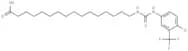
CAS:<p>CAY10726, an arylurea fatty acid, cuts ATP by 28% and promotes apoptosis in breast cancer cells by depleting mitochondrial lipids.</p>Formula:C24H36ClF3N2O3Color and Shape:SolidMolecular weight:493PTP1B-IN-30
<p>PTP1B-IN-30 (Compound 3j) is an inhibitor of PTP1B with an IC50 of 0.51 µM. It suppresses the proliferation of T47D cancer cells with an IC50 of 21.21 µM, induces cell cycle arrest at the S phase, and triggers apoptosis in T47D cells.</p>Formula:C22H21N3O5SColor and Shape:SolidMolecular weight:439.48NF-κB-IN-19
<p>NF-κB-IN-19 (Compound 8) is an NF-κB inhibitor. It effectively induces DNA damage in tumor cells through the NF-κB signaling pathway and promotes the production of reactive oxygen species (ROS), as well as induces autophagy and apoptosis. Additionally, NF-κB-IN-19 inhibits levels of VEGF and HIF-1α, exerting antiproliferative effects in tumor cells through the PI3K/AKT and STAT-3 pathways. It is also effective in overcoming cisplatin resistance and exhibits antitumor activity.</p>Formula:C24H26Cl3F2N3O4PtColor and Shape:SolidMolecular weight:759.92hCAIX-IN-23
<p>hCAIX-IN-23 (Compound 27) is a human carbonic anhydrase (hCA) inhibitor with Ki values of 10.4 nM for hCA IX and 8.5 nM for hCA XII. It not only inhibits hCA activity but also releases NO, exerting dual anti-tumor effects. By reducing the expression of hCA IX and iron regulatory proteins, hCAIX-IN-23 regulates mitochondrial caspase activity and the ferroptosis pathway, thereby inducing apoptosis. This compound is utilized in research focused on renal cancer.</p>Color and Shape:Odour SolidViolacein
CAS:<p>Violacein, a purple antibacterial and antiprotozoal compound from C. violaceum, effective against Gram-positive bacteria and P. falciparum.</p>Formula:C20H13N3O3Color and Shape:SolidMolecular weight:343.34(R)-Q-VD-OPh
<p>(R)-Q-VD-OPh is the less active enantiomer of Q-VD-OPha. Q-VD-OPha is an irreversible inhibitor of pan-caspase, with potent antiapoptotic properties.</p>Formula:C26H25F2N3O6Purity:98%Color and Shape:SolidMolecular weight:513.49